
Your shopping cart is empty!
Welcome visitor you can login or create an account.
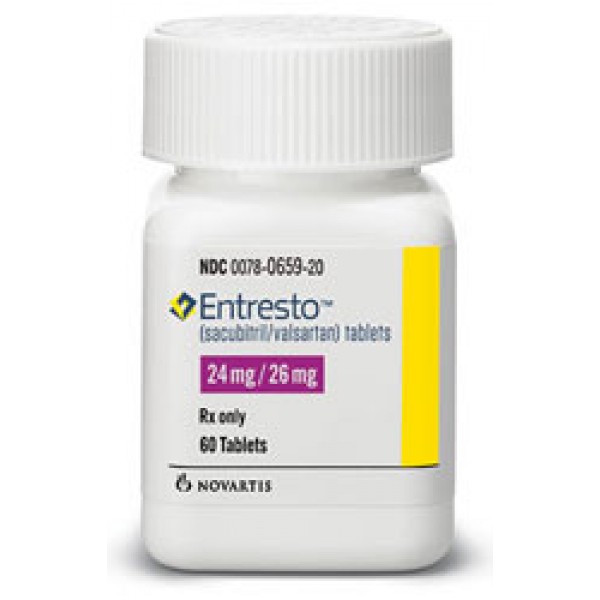
Entresto 24 mg./26 mg. 28 tablets
Product viewed: 6302


What Entresto is and what it is used for
Entresto is a medicine known as angiotensin receptor non-lipid inhibitor. It breaks down into two active substances: saquitril and valsartan.
Entresto is used to treat a certain type of chronic heart failure in adults.
This type of heart failure arises when the heart is weak and can not pump enough blood to the lungs and other parts of the body. The most common symptoms of heart failure are shortness of breath, fatigue, tiredness and swelling of the ankles.
2. What you need to know before taking Entresto
Do not take Entresto:
• if you are allergic to saquitril, valsartan or any of the other ingredients of this medicine (listed in section 6). If you think you may be allergic to any of the other ingredients of this medicine, talk to your doctor before taking Entresto;
• if you are taking another type of medicine called an angiotensin converting enzyme (ACE) inhibitor (eg enalapril, lisinopril or ramipril). ACE inhibitors are used to treat high blood pressure or heart failure. If you are taking an ACE inhibitor, wait 36 hours after taking the last dose before taking Entresto (see "Other medicines and Entresto");
• if you or a member of your family have ever had a reaction called angioedema (swelling of the face, lips, tongue and / or throat, difficulty in breathing) while taking ACE inhibitor or angiotensin receptor blocker (ARB) (such as valsartan, telmisartan or Irbesartan);
• if you have diabetes or have impaired kidney function and are being treated with a blood pressure lowering medication containing aliskiren (see "Other medicines and Entresto");
• if you have severe liver disease;
• if you are pregnant after 3 months (it is also better to avoid this medicine also in early pregnancy, see "Pregnancy and breast-feeding").
If any of the above applies to you, do not take Entresto and talk to your doctor.
Warnings and precautions
Talk to your doctor, pharmacist or nurse before taking Entresto:
• if you are taking Angiotensin Receptor Blocker (AAR) or aliskiren (see "Do not take Entresto");
• if you have ever had angioedema (swelling of the face, lips, tongue and / or throat, difficulty in breathing) (see "Do not take Entresto" and section 4 "Possible side effects");
• if you have low blood pressure or if you are taking other medicines to lower your blood pressure (for example a diuretic) or if you have vomiting or diarrhea, especially if you are 65 years of age or older or if you have kidney disease and low blood pressure;
• if you have severe kidney disease;
• if you suffer from dehydration;
• if your kidney artery is narrowed;
• if you have liver disease.
Your doctor may regularly check the level of potassium in your blood during treatment with Entresto.
If any of the above applies to you, talk to your doctor, pharmacist or nurse before taking Entresto.
Children and adolescents
This medicine should not be used in children (under the age of 18 years). The reason for this is that it has not been studied in this age group.
Other medicines and Entresto
Tell your doctor, pharmacist or nurse if you are taking, have recently taken or might take any other medicines. You may need to change the dose, take other precautions, or even stop taking one medicine. This is especially important for the following medicines:
• ACE inhibitors. Do not take Entresto with ACE inhibitors. If you are taking an ACE inhibitor, wait 36 hours after taking the last dose of the ACE inhibitor before taking Entresto (see "Do not take Entresto"). If you stop taking Entresto, wait 36 hours after taking the last dose of Entresto before you start taking ACE inhibitor;
• other medicines that are used to treat heart failure or lower blood pressure, such as an angiotensin receptor blocker or aliskiren (see "Do not take Entresto");
• some medicines called statins that are used to lower the level of high cholesterol (eg atorvastatin);
• sildenafil, a medicine used to treat erectile dysfunction or pulmonary hypertension;
• medicines that increase the level of potassium in the blood. This includes potassium supplements, salt substitutes containing potassium, potassium-sparing medicines and heparin;
• painkillers called non-steroidal anti-inflammatory drugs (NSAIDs) or selective inhibitors of cyclooxygenase-2 (Cox-2 inhibitors). If you are taking any of the medicines listed above, your doctor may ask you to check your kidney function when starting or adjusting your treatment (see "Warnings and precautions");
• lithium, a medicine used to treat some types of mental illness;
• furosemide, a medicine that belongs to a group of medicines known
Patients taking Entresto may experience low blood pressure (dizziness, vertigo), high potassium levels in the blood (which will be found in your blood tests) or reduced kidney function. If this happens, your doctor may reduce the dose of other medicines you take, temporarily lower the dose of Entresto or stop treatment with Entresto altogether.
Swallow the tablets with a glass of water. You can take Entresto with or without food.
If you take more Entresto than you should
If you accidentally take too many Entresto tablets or if someone else has taken your tablets, contact your doctor immediately. If you have severe dizziness and / or fainting, tell your doctor as soon as possible and lie down.
If you forget to take Entresto
It is recommended that you take your medicine at the same time each day. If you have missed a dose, just take the next one at the usual time. Do not take a double dose to make up for a missed tablet.
If you stop taking Entresto
Stopping treatment with Entresto may make your condition worse. Do not stop taking the medicine until your doctor tells you to do so.
If you have any further questions on the use of this medicine, ask your doctor or pharmacist.
4. Possible side effects
Like all medicines, this medicine can cause side effects, although not everyone gets them.
Some side effects can be serious.
• Stop taking Entresto and seek immediate medical attention if you notice any of the following symptoms: swelling of the face, lips, tongue and / or throat that may cause difficulty in breathing or swallowing. These may be signs of angioedema (an uncommon side effect that may affect up to 1 in 100 people).
Other possible side effects:
If any of the side effects listed below become serious, tell your doctor or pharmacist.
Very common (may affect more than 1 in 10 people):
• low blood pressure (dizziness, vertigo);
• high potassium levels in the blood (found in a blood test);
• reduced kidney function (renal impairment).
Common (may affect up to 1 in 10 people):
Coughing;
• dizziness;
• diarrhea;
• reduced red blood cell count (detected by blood test);
• fatigue;
• (acute) kidney failure (severe kidney damage);
• low potassium in the blood (found in a blood test);
• headache;
• lightening;
• weakness;
• nausea;
• low blood pressure (dizziness, vertigo) when passing from sitting or lying upright;
• gastritis (abdominal pain, nausea);
• vertigo;
• low blood sugar (found in blood tests).
Uncommon (may affect up to 1 in 100 people):
• an allergic reaction with rash and itching;
• dizziness when passing from sitting upright.
Reporting of side effects
If any of the side effects gets serious, tell your doctor, pharmacist or nurse. This includes all possible side effects not listed in this leaflet. You can also report side effects directly through the national reporting system. As you report side effects, you can contribute to getting more information on the safety of this medicine.
5. How to store Entresto
Keep out of the reach and sight of children.
Do not use this medicine after the expiry date which is stated on the carton and blister after EXP. The expiry date refers to the last day of that month.
This medicine does not require special storage conditions.
Store in the original package in order to protect from moisture.
Do not use Entresto packaging that is damaged or shows signs of tampering. Do not dispose of medicines in the sewer or in the household waste container.
Ask your pharmacist how to dispose of medicines you no longer use. These measures will help to protect the environment.
6. Package Contents and Additional Information
What Entresto contains
• The active substances are: saquitril and valsartan.
Each 24 mg / 26 mg film-coated tablet contains 24.3 mg of saquitril and 25.7 mg of valsartan (as the complex sodium salt of saquinavir-valsartan).
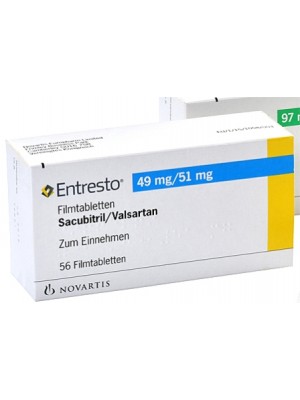
Each 49 mg / 51 mg film-coated tablet contains 48.6 mg of saquitril and 51.4 mg of valsartan (as the complex sodium salt of saquinavir-valsartan).
Each 97 mg / 103 mg film-coated tablet contains 97.2 mg of saquitril and 102.8 mg of valsartan (as the complex sodium salt of saquinavir-valsartan).
• The other ingredients in the tablet core are microcrystalline cellulose, low substituted hydroxypropyl cellulose, crospovidone, magnesium stearate, talc and colloidal anhydrous silica.
• The 24 mg / 26 mg and 97 mg / 103 mg tablets contain hypromellose, titanium dioxide (E171), macrogol 4000, talc, red gel
Entresto 97 mg / 103 mg film-coated tablets are light pink, oval tablets with debossed "NVR" on one side and "L11" on the other side. Approximate tablet dimensions of 15.1 mm x 6.0 mm.
The tablets are available in PVC / PVDC / Aluminum blisters of 14, 20, 28 or 56 tablets. The 49 mg / 51 mg and 97 mg / 103 mg tablets are also available in group packs of 168 tablets (3 packs of 56 tablets) or 196 tablets (7 packs of 28 tablets).
Not all pack sizes may be marketed.
Write a review
Your Name:Your Review: Note: HTML is not translated!
Rating: Bad Good
Enter the code in the box below:
Related Products

What Entresto is and what it is used for
Entresto is a medi..
199.00€