
Your shopping cart is empty!
Welcome visitor you can login or create an account.
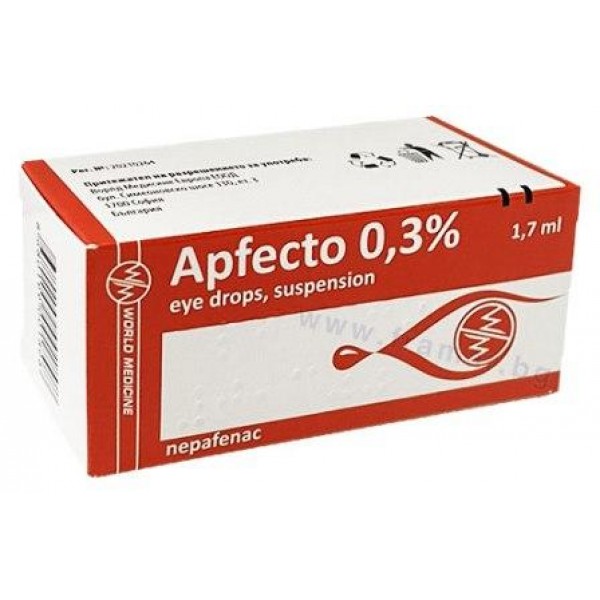
Apfecto eye droops 3 mg / ml 1.7 ml.
Product Code: Apfecto eye droops 3 mg / ml 1.7 ml.
Availability: In Stock
Product viewed: 417


What Affecto is and what it is used for
Affecto contains the active substance nepafenac and belongs to a group of medicines called non-steroidal anti-inflammatory drugs (NSAIDs).
Affecto is used in adults:
to prevent and relieve pain and inflammation in the eye after cataract surgery (curtain) of the eye;
to reduce the risk of macular edema (swelling at the back of the eye) after cataract surgery in patients with diabetes.
2. What you need to know before you use Affecto
Do not use Affecto
if you are allergic to nepafenac or any of the other ingredients of this medicine (listed in section 6);
if you are allergic to other non-steroidal anti-inflammatory drugs (NSAIDs);
if you have had asthma, skin allergy or severe nasal inflammation when using other NSAIDs. Examples of NSAIDs are: acetylsalicylic acid, ibuprofen, ketoprofen, piroxicam, diclofenac.
Warnings and precautions
Talk to your doctor, pharmacist or nurse before using Affecto:
if you bruise easily or have bleeding problems or have had them in the past;
if you have any other eye disorder (for example, an eye infection), or if you use other eye medicines (especially topical steroids);
if you have diabetes;
if you have rheumatoid arthritis;
if you have had several eye operations in a short period of time;
if you use steroids or other topical NSAIDs - these medicines can slow down the healing of wounds in the eye.
Avoid sunlight during treatment with Affecto.
It is not recommended to wear contact lenses after cataract (curtain) surgery. Your doctor will tell you when you can use contact lenses again (see also subsection "Affecto contains benzalkonium chloride").
Children and adolescents
Do not use this medicine in children and adolescents under 18 years of age, as safety and efficacy in this population have not been established.
Other medicines and Affecto
You should tell your doctor or pharmacist if you are taking, have recently taken or might take any other medicines.
Affecto may affect or be affected by other medicines you use, including other eye drops to treat glaucoma.
Also tell your doctor if you are taking medicines that reduce blood clotting (warfarin) or other NSAIDs. They may increase the risk of bleeding.
Pregnancy, lactation and fertility
If you are pregnant or breast-feeding, think you may be pregnant or are planning to become pregnant, consult your doctor before using this medicine.
Women of childbearing potential should use effective contraception during treatment with Apfecto.
The use of Affecto during pregnancy is not recommended. Do not use Affecto unless specifically prescribed by your doctor.
If you are breast-feeding, Affecto may pass into breast milk. However, no effects on the infant are expected. Affecto can be used during breastfeeding.
Driving and using machines
Do not drive or operate machinery until your vision clears. You may find that your vision is briefly blurred immediately after applying Apfecto.
Affecto contains benzalkonium chloride
This medicine contains 0.05 mg/ml benzalkonium chloride.
The preservative in Affecto, benzalkonium chloride, can be absorbed by soft contact lenses and can change the color of the lenses. You should remove your contact lenses before using this medicine and wait at least 15 minutes before putting them back in. Benzalkonium chloride can also cause eye irritation, especially if you have "dry eye" or a disorder of the cornea (the clear layer at the front of the eye). If you have an unusual sensation in the eye, such as burning or pain in the eye after using this medicine, talk to your doctor.
3. How to use Affecto
Always use this medicine exactly as your doctor or pharmacist has told you. If you are not sure, ask your doctor or pharmacist.
Use Affecto only for your eyes.
Apply Affecto in both eyes only if your doctor has advised you to do so.
Do not swallow or inject.
Use Affecto only as eye drops by instillation.
Shake well before use.
The recommended dose is:
Affecto 0.1% eye drops - one drop in the affected eye or eyes, three times a day - morning, noon and evening. Use at the same time every day;
Apfecto 0.3% eye drops - one drop in the affected eye or eyes, once a day. Use at the same time each day.
oga to apply and for how long
Start 1 day before eyelid surgery. Continue on the day of surgery. Then use the drops for as long as your doctor tells you. This may last up to 3 weeks (to prevent and relieve pain and inflammation in the eye) or up to 60 days (to prevent the development of macular edema) after your surgery.
How to use it
Wash your hands before you start.
Shake well before use.
Unscrew the bottle cap.
Hold the bottle upside down between your thumb and fingers.
Tilt your head back.
Pull down the lower eyelid with a clean finger until a "pocket" is formed between the eyelid and the eye. The drop should fall into this place (Fig. 1).
Bring the tip of the bottle close to the eye. Do it in front of a mirror if that makes it easier for you.
Do not touch the eye or eyelid, the surrounding area, or other surfaces with the tip of the dropper applicator. This can contaminate the drops.
Gently press the base of the bottle to release one drop of Affecto.
Do not squeeze the bottle, it is designed so that only a slight pressure on the bottom is sufficient (fig. 2).
If you are using the drops for both eyes, repeat the same steps for the other eye. After use, immediately put the cap on the bottle and close it tightly.
If the drop does not get into the eye, try again.
If you use other eye drops, wait at least five minutes between applying Affecto and the other drops.
If you use an eye ointment, you should apply it at the end.
If you have used more than the required dose of Apfecto
Rinse your eye with warm water. Do not put in more drops until it is time for the next regular dose.
If you forget to use Affecto
Put one drop in as soon as you remember. If it is almost time for the next dose, skip that one and continue with the next dose as per your usual schedule. Do not take a double dose to make up for a missed dose. Do not put more than one drop in the affected eye(s).
If you have stopped using Affecto
Do not stop using Apfecto without first talking to your doctor. You can usually continue using the drops unless you experience serious side effects. If you have any concerns, talk to your doctor or pharmacist.
If you have any further questions on the use of this medicine, ask your doctor, pharmacist or nurse.
4. Possible side effects
Like all medicines, this medicine can cause side effects, although not everybody gets them.
The risk of side effects affecting the cornea (problems on the surface of the eye) may be increased if you have:
complicated eye surgery;
several eye operations in a short period of time;
certain disorders of the surface of the eye, such as inflammation or dryness in the eye;
some common diseases, such as diabetes or rheumatoid arthritis.
Contact your doctor immediately if your eyes become redder or more painful while using the drops. This may result from inflammation of the ocular surface with or without cell loss or damage, or inflammation of the colored part of the eye (iritis). These side effects have been seen in up to 1 in 100 people.
The following side effects have also been observed with Apfecto 0.1% eye drops, suspension or Apfecto 0.3% eye drops, suspension, or both.
Uncommon side effects (may affect up to 1 in 100 people)
Ocular side effects: inflammation of the surface of the eye with or without cell loss or damage, foreign body sensation in the eye, crusting of the eyelid or drooping of the eyelid.
Rare side effects (may affect up to 1 in 1,000 people)
Eye side effects: inflammation of the iris, eye pain, eye discomfort, dry eye, eyelid swelling, eye irritation, eye itching, eye discharge, allergic conjunctivitis (eye allergy), increased lacrimation, deposits on the eye surface, fluid or swelling at the back of the eye, redness of the eye.
Common side effects: dizziness, headache, allergic symptoms (allergic swelling of the eyelid), nausea, skin inflammation, redness and itching.
Adverse reactions with an unknown frequency (an estimate cannot be made from the available data)
Ocular side effects: damage to the surface of the eye, such as thinning or perforation, impaired healing of the eye, scar on the surface of the eye, clouding, decreased vision, swelling of the eye, blurred vision.
General side effects: vomiting, increased blood pressure.
5. How to store Affecto
Keep out of the reach of children.
Do not use this medicine after the expiry date which is stated on the bottle and carton after EXP. The expiry date corresponds to the last day of the month stated.
To be stored below 25°C.
Keep the bottle tightly closed.
Use up to 4 weeks after first opening the bottle.
Do not dispose of medicines down the drain or in the household waste container. Ask your pharmacist how to dispose of medicines you no longer use. These measures will help protect the environment.
6. Contents of the package and additional information
What Affecto contains
Affecto 0.1% eye drops
The active substance is nepafenac. One milliliter of the suspension contains 1 mg of nepafenac.
The other ingredients are benzalkonium chloride (see section 2), boric acid, propylene glycol, carbomer, sodium chloride» guar gum, carboxymethylcedulose sodium, edetate disodium, sodium hydroxide (for pH adjustment), hydrochloric acid (for pH adjustment) and water for injections.
Affecto 0.3% eye drops
The active substance is nepafenac. One milliliter of the suspension contains 3 mg of nepafenac.
The other ingredients are benzalkonium chloride (see section 2), boric acid, propylene glycol, carbomer, sodium chloride, guar gum, carboxymethylcellulose sodium, edetate disodium, sodium hydroxide (for pH adjustment), hydrochloric acid (for pH adjustment) and water for injections.
What Affecto looks like and what it contains
Affecto is a yellow colored viscous suspension.
Apfecto 0.1% is packaged in a 5 ml LDPE bottle containing 5 ml of suspension with an LDPE-HDPE cap and an LDPE dropper applicator. The bottle is placed in a cardboard package with a patient leaflet.
Affecto 0.3% is packaged in a 5 ml LDPE bottle containing 1.7 ml of suspension with an LDPE-HDPE cap and an LDPE dropper applicator. The bottle is placed in a cardboard package with a patient leaflet.
Write a review
Your Name:Your Review: Note: HTML is not translated!
Rating: Bad Good
Enter the code in the box below: