
Your shopping cart is empty!
Welcome visitor you can login or create an account.
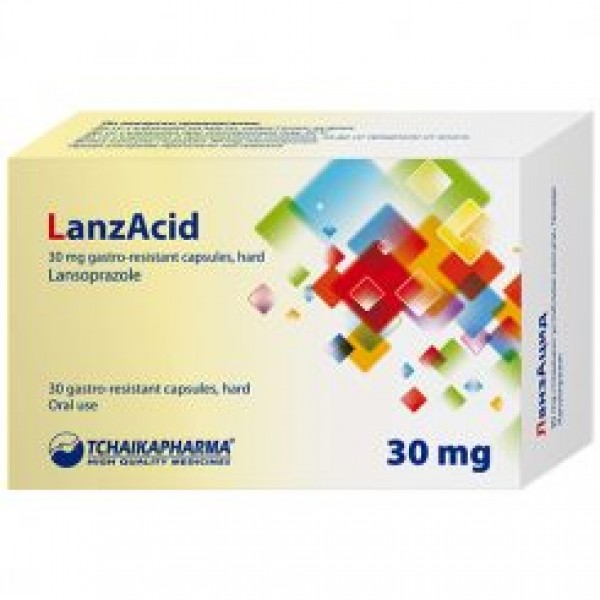
Lanzacid 30 mg. 30 tablets
Product Code: Lanzacid 30 mg. 30 tablets
Availability: In Stock
Product viewed: 391


1. What LanzAcid is and what it is used for
The active substance of LanzAcid is lansoprazole. This medicine belongs to a group of medicines called proton pump inhibitors.
The action of LanzAcid is expressed in the reduction of the amount of acids secreted in the stomach.
LanzAcid is used for:
Treatment of stomach and duodenal (bowel) ulcers;
Treatment and prevention of ulcers caused by medicines called non-steroidal anti-inflammatory drugs (NSAIDs). This includes drugs such as aspirin, ibuprofen, ketoprofen and piroxicam;
Gastroesophageal reflux disease (GERD).
This happens when acid from the stomach backs up into the esophagus, causing irritation and inflammation.
Lansoprazole can relieve the symptoms that may occur in the conditions described above and stop them from coming back.
LanzAcid can also be used to treat:
Pain from indigestion or heartburn caused by too much acid in your stomach (acid-related dyspepsia);
Diseases, such as Zollinger-Ellison Syndrome, where the stomach produces large amounts of acid. This can lead to diarrhea and stomach pain;
Infections caused by Helicobacter pylori where lansoprazole is administered in combination with appropriate antibiotics.
2. What you need to know before you take LanzAcid
Do not take LanzAcid
If you are hypersensitive to lansoprazole or any of the other ingredients of this medicine listed in section 6. Signs of an allergic reaction include: rash, trouble swallowing or breathing, swelling of the lips, face, throat or tongue.
If you are taking other medicines containing atazanavir (used to treat HIV).
Do not take this medicine if any of the above conditions apply to you. If you are not sure, talk to your doctor or pharmacist before taking LanzAcid.
Warnings and precautions
Take special care and consult your doctor before taking lansoprazole if:
You have liver problems. Your doctor may adjust your dose;
Your doctor may carry out an additional test called an endoscopy (where a very small camera is placed through the esophagus to look into the stomach) to check your condition;
This will help find out what is causing your symptoms and may help rule out more serious causes of your symptoms, such as stomach cancer.
Your doctor has prescribed lansoprazole in addition to other medicines (antibiotics) to treat Helicobacter Pylori infection: Please read the leaflets of these medicines carefully;
If you are taking lansoprazole long-term (for a longer period than 1 year), your doctor will examine you periodically to assess your condition;
Tell your doctor if you notice new symptoms or if some of your symptoms get worse.
If diarrhea occurs during treatment with lansoprazole, contact your doctor immediately, as lansoprazole is associated with a small increase in the incidence of infectious diarrhea;
If you have ever had a skin reaction after treatment with a medicine like LanzAcid that reduces stomach acid;
If you need to have a certain type of blood test (Chromogranin A);
If you have low levels of vitamin B12 or have risk factors for low levels of vitamin B12 and are receiving long-term treatment with lansoprazole. As with all acid-reducing agents, lansoprazole may result in decreased absorption of vitamin B12.
If you are not sure if any of the above apply to you, talk to your doctor or pharmacist before taking lansoprazole. Do this even if these symptoms have only occurred in the past.
As a proton pump inhibitor, lansoprazole, especially if taken for more than a year, may slightly increase the risk of fractures of the hip, wrist or spine. Tell your doctor if you have osteoporosis or if you are taking corticosteroids (which may increase the risk of osteoporosis).
When taking lansoprazole, you may get inflammation of the kidneys. Signs and symptoms may include decreased urine volume or blood in the urine and/or hypersensitivity reactions such as fever, rash and joint stiffness. You should report these symptoms to your doctor.
Other medicines and LanzAcid
Tell your doctor or pharmacist if you are taking, have recently taken or might take any other medicines, including medicines obtained without a prescription, such as medicinal products of herbal origin.
This is necessary because the use of lansoprazole can affect their action, as well as some medications can lead to a change in the action of lansoprazole.
Take special care and consult your doctor or pharmacist if you are taking any of the following medicines:
HIV protease inhibitors such as atazanavir and nelfinavir (used to treat
of HIV);
methotrexate (used to treat autoimmune diseases and cancer);
ketoconazole, itraconazole, rifampicin (used to treat infections);
digoxin (used to treat heart problems);
warfarin (used to prevent blood clots);
theophylline (used to treat asthma);
tacrolimus (used to prevent transplant rejection);
fluvoxamine (used to treat depression and other psychiatric problems);
antacids (used to treat heartburn or acid regurgitation - the return of small amounts of gas or liquid from the stomach);
sucralfate (used to treat ulcers);
St. John's wort, called Hypericum Perforatum (used to treat mild depression).
If you have any questions, talk to your doctor or pharmacist before taking lansoprazole.
LanzAcid with food and drink
You should take LanzAcid at least 30 minutes before a meal.
Pregnancy, lactation and fertility
If you are pregnant or breast-feeding, think you may be pregnant or are planning to become pregnant, ask your doctor or pharmacist for advice before using this medicine.
The use of LanzAcid capsules is not recommended during pregnancy, as there is no adequate experience with the use of lansoprazole during pregnancy. Lansoprazole is not known to harm the fetus.
There is insufficient information on the use of lansoprazole during breastfeeding.
Based on the results of animal studies, it is believed that lansoprazole passes into breast milk.
When deciding whether breastfeeding or lansoprazole therapy should be continued or discontinued, your doctor will consider the benefits and risks to your child of breastfeeding.
Driving and using machines
When using lansoprazole you may feel dizzy, tired, sick, have a headache or vision problems. If this happens, do not drive or use any tools or machines.
Important information about some of the ingredients of LanzAcid
LanzAcid contains sucrose. If you have been told by your doctor that you have an intolerance to some sugars, contact your doctor before you start taking this medicine.
3. How to take LanzAcid
Always take LanzAcid exactly as your doctor or pharmacist has told you. If you are not sure, ask your doctor or pharmacist.
How to take your medicine:
Swallow the capsules whole with a glass of water. Do not break or chew the capsules.
If you take lansoprazole once a day, take it at the same time each morning before breakfast. At least 30 minutes before meals;
If you take lansoprazole twice a day, you should take the first dose in the morning before breakfast and the second dose in the evening.
The usual dosage for adults is:
For stomach ulcer:
One 30 mg capsule every day for 4 weeks.
For duodenal ulcer:
One 30 mg capsule every day for 2 weeks.
In case of stomach and duodenal ulcer with long-term use of NSAIDs:
One 30 mg capsule every day for 4 weeks until the ulcer heals;
Your doctor may decide whether you need one 15mg or 30mg capsule a day to heal the ulcer and prevent symptoms from coming back;
Your doctor will decide when to stop taking LanzAcid.
Ulcer prevention and symptom relief while taking NSAIDs (in patients at risk):
The dosage is one capsule of 15 mg or 30 mg per day;
Your doctor will decide when to stop taking LanzAcid.
Treatment of Helicobacter Pylori infection:
The usual dose is one 30 mg capsule in combination with two different antibiotics in the morning and one 30 mg capsule in combination with two different antibiotics in the evening. Treatment is usually given for 7 days. Choose one of the two recommended combinations of antibiotics:
30 mg lansoprazole together with 250-500 mg clarithromycin and 1000 mg amoxicillin morning and evening
or
30 mg lansoprazole together with 250 mg clarithromycin and 400-500 mg metronidazole morning and evening
If you are being treated for an infection because you have an ulcer, it is unlikely that your ulcer will come back if the infection is treated successfully.
For your medicine to be as effective as possible, you need to take it at the right time and not miss a dose.
Gastroesophageal reflux disease (GERD):
One 30 mg capsule per day for 4 weeks until healing of the esophagus and/or relief of symptoms;
Your doctor will decide whether you need one 15 mg or 30 mg capsule a day to prevent recurrence of the disease.
Indigestion caused by too much acid (acid-related dyspepsia):
One 15 mg or 30 mg capsule per day for 2 to 4 weeks;
See your doctor after you have finished this course of treatment or if your symptoms do not improve.
Zollinger-Ellison syndrome:
The recommended starting dose is 60 mg once daily;
Your doctor will decide the dose that is most suitable for you depending on how you react to lansoprazole.
Patients with liver problems
If you have severe liver problems, your doctor may limit your dose to one capsule per day.
Use in children and adolescents
Do not give lansoprazole to children.
If you have taken more than the required dose of LanzAcid
Contact your doctor or go to the nearest hospital immediately. Do not forget to take with you the remaining LanzAcid capsules and the packaging. This is necessary so that the doctor knows what you have taken.
If you forget to take LanzAcid
If you forget to take the medicine at the appointed time, take it as soon as possible. However, if it is almost time for the next dose, take only the next dose without doubling it.
Do not take a double dose to make up for a missed dose. If you have stopped taking LanzAcid
Keep taking the medicine until your doctor tells you that you can stop. Do not stop taking lansoprazole just because you feel better. If you do stop taking lansoprazole, your condition may get worse again.
4. Possible unwanted drugs
Like all medicines, Lanzacid can cause side effects, although not everybody gets them.
According to the frequency of occurrence, adverse drug reactions are divided into:
Common (occurring in at least 1 in 100 and less than 1 in 10 treated patients);
Uncommon (occurring in at least 1 in 1,000 and less than 1 in 100 treated patients);
Rare (occurring in at least 1 in 10,000 and less than 1 in 1,000 treated patients);
Very rare (occurring in less than 1 in 10,000 patients treated).
Stop taking lansoprazole and see a doctor or go to hospital straight away if:
Get swelling in the hands, feet
a, ankles, face, lips or throat, which may cause difficulty in swallowing or breathing. You may also notice an itchy rash (hives or hives). This may mean that you have an allergic reaction to LanzAcid capsules;
If you have blisters, peeling or bleeding of the skin around the lips, eyes, mouth, nose and genitals. You may also have flu-like symptoms and a high fever. These may be signs of a condition called Stevens-Johnson Syndrome;
You may get a severe blistering rash where layers of skin may peel off and cover large areas of skin on the body. These could be signs of toxic epidermal necrolysis;
You may experience symptoms such as: yellowing of the skin or the whites of the eyes, tiredness and fever. This can be due to inflammation of the liver or changes in the way your liver works.
These side effects are serious and require urgent medical attention, all of which are rare or very rare (affecting less than 1 in 1,000 people).
Tell your doctor as soon as possible if:
You get persistent diarrhea and you're still sick. This can happen because lansoprazole lowers the natural acidity in the stomach, which normally helps to kill the bacteria there. This, in turn, can lead to stomach infections;
You may experience severe pain in your stomach that may spread to your back. This may be a sign of pancreatitis;
You have difficulty urinating or notice blood in your urine. This could be due to kidney problems or changes in the way your kidneys work;
You bruise more easily than usual or get more infections than usual. This could be due to blood problems. Your doctor may ask for a blood test.
The side effects listed above are rare or very rare (affecting less than 1 in 1,000 people).
If any of the following side effects become serious or last more than a few days, tell your doctor or pharmacist:
Common (affects less than 1 in 10 people)
headache, feeling dizzy or tired, or feeling generally unwell;
diarrhea, constipation, stomach pain, feeling sick (nausea) or vomiting, gas;
dry or sore mouth or throat, benign polyps in the stomach;
skin rash, itching;
changes in the way your liver works (proved by a blood test).
Uncommon (affects less than 1 in 100 people)
low mood (depression);
joint or muscle pain;
fluid retention, which can cause swelling of the arms or legs;
fracture of the hip joint, wrist or spine (if lansoprazole is used in high doses and over a long period of time);
changes in the blood count.
Rare (affects less than 1 in 1,000 people)
fever;
feeling restless, sleepy, or confused;
seeing or hearing things that are not there (hallucinations);
tingling, pins and needles, stinging, burning or crawling sensations on the skin (paresthesia);
sleep problems (insomnia);
vision problems;
feeling dizzy, with a feeling of "spinning" (vertigo);
change in taste, loss of appetite, inflammation of the tongue (glossitis);
skin reactions such as burning or stinging of the skin, bruising, red or purple spots, which may be accompanied by itching or blisters;
excessive sweating;
greater sensitivity to sunlight than usual; hair loss (alopecia);
trembling;
feeling tired, dizzy, pale skin. These may be symptoms of anemia;
swelling of the chest in men, inability to achieve or maintain an erection (impotence);
punctate hemorrhage (petechiae);
candidal yeast infections, such as thrush, which can affect the esophagus.
Very rare (affects less than 1 in 10,000 people)
inflammation of the mouth (stomatitis);
colitis (inflammation of the intestines);
changes in test values such as sodium, cholesterol and triglyceride levels.
Not known (frequency cannot be estimated from the available data)
a rash that may be accompanied by joint pain;
cutaneous forms of lupus or lupus rash;
If you take lansoprazole for more than three months, it is possible that the levels of magnesium in your blood may fall.
Low magnesium levels can manifest as fatigue, involuntary muscle contractions, disorientation, convulsions, dizziness, increased heart rate. If you experience any of these symptoms, please tell your doctor immediately. Low magnesium levels can also lead to low potassium or calcium levels in the blood. Your doctor may decide to give you regular blood tests to monitor your magnesium levels.
visual hallucinations;
colitis (collagenous).
If any of the side effects become serious, or if you notice other side effects not described in this leaflet, please tell your doctor or pharmacist.
5. How to store LanzAcid
Keep out of the reach of children.
Al/Al blister packs should be stored at a temperature below 30°C.
The HDPE bottles are closed with a polypropylene cap and a silica gel desiccant. They should be stored at a temperature below 30°C. Shelf life after first opening the bottle is 6 months.
Store in original packaging to protect from moisture.
Do not use this medicine after the expiry date which is stated on the carton and label after EXP and EXP respectively. The expiration date corresponds to the last day of the specified month.
Do not dispose of medicines down the drain or household waste container. Ask your pharmacist how to dispose of medicines you no longer use. These measures will help protect the environment.
6. Contents of the package and additional information
What LanzAcid contains
The active substance is: lansoprazole. The other excipients are:
Capsule content
Sugar spheres (containing sucrose and corn starch)
Sodium lauryl sulfate
Meglumine
Mannitol
Hypromellose 2910
Macrogol 6000
Talc
Polysorbate 80
Titanium dioxide (E171)
Methacrylic acid-ethyl acrylate copolymer (1:1) 30 percent dispersion
Composition of gelatin capsule
Gelatin
Titanium dioxide (E 171)
What the package contains
Hard gastro-resistant capsules No. 1, opaque with a white body and cap. The capsule contains white or almost white spherical microgranules.
LanzAcid is available in a package of 30 gastro-resistant capsules, hard of 30 mg presented in Al/Al blisters or HDPE bottle with polypropylene cap.
Not all types of packaging can be put on sale.
Write a review
Your Name:Your Review: Note: HTML is not translated!
Rating: Bad Good
Enter the code in the box below: