
Your shopping cart is empty!
Welcome visitor you can login or create an account.
Azitromycin 500mg. 3 capsules
Product Code: Azitromycin 500mg. 3 capsules
Availability: In Stock
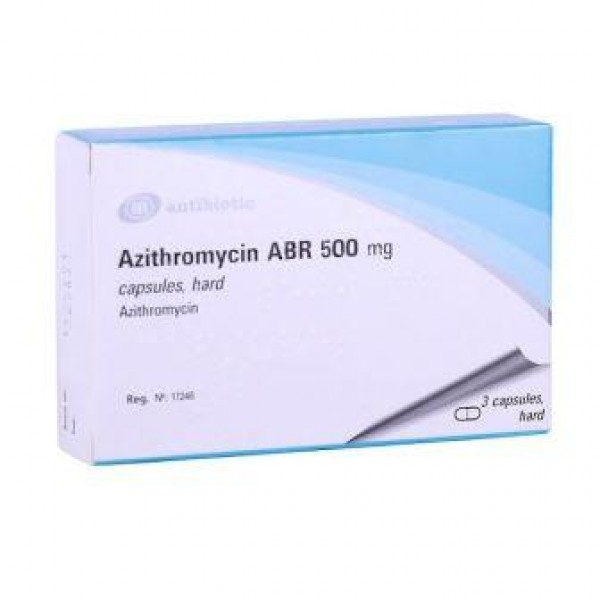
Product viewed: 171


1. What is Azithromycin ADB and what is it used for?
Azithromycin ADB contains the macrolide antibiotic azithromycin. It is active against a large number of pathogens that cause some common diseases in humans.
It is used to treat infections caused by azithromycin-sensitive bacteria and other microorganisms, such as:
Upper respiratory tract infections: inflammation of the throat and tonsils, sinuses, middle ear;
Lower respiratory tract infections: bronchitis, some types of pneumonia;
Skin and soft tissue infections: - moderate acne, erythema chronicum migrans (first stage of so-called Lyme disease), scarlet fever (erysipelas), bacterial skin infections (impetigo, secondary pyoderma);
Sexually transmitted diseases caused by a microorganism called chlamydia.
2. What you need to know before you take Azithromycin ADB
Do not take Azithromycin ADB
if you are allergic to azithromycin or any of the other ingredients of this medicine (listed in section 6);
if you are allergic to erythromycin or other macrolide and ketolide antibiotics;
if you are currently taking medicines containing ergot derivatives, due to the theoretical possibility of ergotism (bruising of the extremities, limping).
Warnings and precautions
Talk to your doctor or pharmacist before taking Azithromycin ADB.
You should tell your doctor if:
you have or have had liver disease.
Your doctor will decide whether it is necessary to monitor your liver condition or to stop treatment with this medicine.
you have had diarrhoea while taking antibiotics.
If you develop diarrhoea or loose stools during or after treatment with this medicine, contact your doctor and do not take any other medicines before consulting your doctor. Tell your doctor if the diarrhoea persists.
you have or have had kidney disease in the past.
you have heart disease or any heart complaints.
Contact your doctor immediately if you develop palpitations or other similar disturbances, dizziness or weakness during treatment.
you have myasthenia gravis (a condition that causes some muscles to become weak)
you are currently taking medicines to treat migraines containing ergot derivatives, such as ergotamine. These medicines should not be taken at the same time as azithromycin, as there is a possibility of developing a condition called ergotism (bluish discoloration of the limbs, limping).
It is important to know that sometimes serious allergic reactions (rarely life-threatening) may occur during treatment with this medicine, such as swelling of the face, lips, tongue and/or throat, shortness of breath, wheezing in the chest.
Some of them may recur due to the prolonged retention of the medicine in the tissues.
If allergic reactions occur or are suspected, you should immediately stop taking the medicine and contact your doctor.
Azithromycin ADB capsules are not suitable for use in children weighing less than 45 kg, due to the impossibility of accurate dosing.
Other medicines and Azithromycin ADB
Tell your doctor or pharmacist if you are taking, have recently taken or might take any other medicines.
It is especially important to inform your doctor if you are taking:
medicines that may affect heart rhythm and conduction (lead to prolongation of the QT interval in the cardiogram)
Serious and difficult-to-treat arrhythmia may occur.
Medicines that reduce stomach acidity, i.e. antacids
The time between individual doses should be at least 2 hours.
Cyclosporine (suppresses organ or bone marrow rejection after transplantation)
The doctor must assess the benefit of concomitant administration of azithromycin with cyclosporine. In patients in whom this is necessary, cyclosporine plasma levels should be monitored and the dose adjusted if necessary.
Warfarin, coumarin anticoagulants (reduce blood clotting)
There is an increased risk of bleeding when they are administered concomitantly with azithromycin. Your doctor may decide that monitoring of prothrombin time or other laboratory parameters is necessary.
digoxin (used to treat heart disease) and colchicine (used to treat gout and familial Mediterranean fever)
The levels of digoxin and colchicine in the blood may increase when taken with azithromycin.
ergotamine and other ergotamine derivatives
Ergotism may develop, manifested by bluish discoloration of the extremities, limping (see Warnings and precautions).
nelfinavir
Co-administration with azithromycin leads to an increase in the concentration of azithromycin.
rifabutin (antibiotic)
A decrease in the number of white blood cells may occur.
Azithromycin ADB with food, drink and alcohol
Azithromycin ADB should be taken at least 1 hour before or 2 hours after a meal.
Pregnancy, breast-feeding and fertility
If you are pregnant or breast-feeding
you, think you may be pregnant or are planning to become pregnant, ask your doctor or pharmacist for advice before using this medicine. There are no adequate and well-controlled studies in pregnant women. During pregnancy, azithromycin should only be used if there is no other alternative. It is not known whether azithromycin is excreted in breast milk. Therefore, azithromycin should only be used in breastfeeding women if there is no other alternative. Your doctor will assess whether it is possible to be treated with azithromycin if you are pregnant or breastfeeding. He will assess the balance between the benefits for you and the risks for your baby.
Driving and using machines
There is no evidence of adverse effects of Azithromycin ADB on the ability to drive and use machines.
Azithromycin ADB contains lactose monohydrate and azorubine
This product contains lactose (milk sugar) as an excipient, therefore it is not suitable for people with congenital or acquired intolerance to some sugars. If you have been told by your doctor that you have such an intolerance, consult your doctor before taking this product.
The gelatin capsule contains the colouring agent azorubine, carmoisine (E122), which may cause allergic reactions.
3. How to take Azithromycin ADB
Always take this medicine exactly as your doctor or pharmacist has told you. If you are not sure, ask your doctor or pharmacist.
The recommended dose for adults and children weighing more than 45 kg is:
for the treatment of infections of the upper and lower respiratory tract, skin and soft tissue (except erythema migrans) 1 capsule daily for 3 days;
for moderate acne: 500 mg once daily for 3 consecutive days, followed by 500 mg once weekly for the next 9 weeks. The second week's dose should be taken 7 days after the first dose. The next 8 weeks should be taken 1 tablet once daily at 7-day intervals;
for erythema migrans (first stage of so-called Lyme disease): 2 capsules (1000 mg) once on the first day, followed by 1 capsule (500 mg) from the second to the fifth day, as a single daily dose;
for the treatment of sexually transmitted infections caused by the microorganism chlamydia, the dose is 2 capsules (1000 mg) once.
Your doctor will determine the appropriate dose and regimen for the treatment of your acne or other skin and soft tissue infections.
Azithromycin ADB capsules are not suitable for use in children weighing less than 45 kg, due to the impossibility of accurate dosing.
If you have kidney or liver disease, your doctor may prescribe treatment with doses other than those indicated.
Method of administration
Azithromycin ADB capsules are taken whole, once a day. Like a number of other antibiotics, the product should be taken at least one hour before or two hours after food.
If you take more Azithromycin ADB than you should
If you take more than the prescribed dose, contact your doctor immediately or go to the nearest hospital.
The usual symptoms of an overdose with antibiotics of this group include reversible hearing loss, severe nausea, vomiting and diarrhea.
The doctor will assess whether any type of treatment is necessary if you have taken a higher dose.
If you forget to take Azithromycin ADB
If you forget to take a dose, take it as soon as possible after you remember. Do not take a double dose to make up for a forgotten one. Take the next dose at the usual time.
If you stop taking Azithromycin ADB
Do not stop taking your capsules if you feel better until your doctor tells you to. If you stop taking the medicine too soon, the infection may return or your condition may worsen.
If you have any further questions on the use of this medicine, ask your doctor, pharmacist or nurse.
4. Possible side effects
Like all medicines, this medicine can cause side effects, although not everybody gets them.
Tell your doctor straight away if you experience:
sudden wheezing, difficulty breathing, swelling of the eyelids, face or lips, rash and itching (especially all over the body);
severe or persistent diarrhoea containing blood or mucus during or after treatment has stopped, as this may be a sign of serious inflammation of the bowel;
severe skin rash with redness, scaling and blistering;
fast or uneven heartbeats;
low blood pressure;
serious skin reactions:
blistering of the skin, mouth, eyes and genitals (Stevens-Johnson syndrome);
blistering of the skin, as a sign of a severe skin reaction (toxic epidermal necrolysis);
a skin rash of small, itchy red bumps, accompanied by other general symptoms such as fever, swollen glands and an increase in eosinophils (a type of white blood cell) (Drug Reaction with Eosinophilia and Systemic Symptoms (DRESS));
a skin eruption characterised by the rapid appearance of areas of reddened skin covered with small pustules (small blisters filled with white/yellow fluid) (Acute Generalised Eczematous Pustulosis (AGEP)).
Stop taking azithromycin if you develop these skin symptoms and contact your doctor or seek medical help immediately.
The following side effects are possible with azithromycin treatment:
Very common (occurs in more than 1 in 10 people taking the product) - abdominal pain, nausea, diarrhoea, increased gas formation and bloating.
Common (occurs in at least 1 in 100 and less than 1 in 10 people taking the product) - deafness, vomiting, indigestion, fatigue, joint pain, rash, itching, loss of appetite, anorexia, dizziness, headache, numbness of the hands and feet, change in taste, impaired vision, reduced number of lymphocytes (a type of white blood cell), reduced number of eosinophils (a type of white blood cell), reduced level of bicarbonate in the blood.
Uncommon (occurs in at least 1 in 1,000 and less than 1 in 100 people taking the product) - hearing disorders, ringing in the ears, fungal infections in the mouth and vagina, reduction in the number of all white blood cells, severe allergy
a reaction that causes swelling of the face or throat, nervousness, decreased sensitivity to touch, drowsiness, insomnia, palpitations /feeling the heartbeat/, gastritis, constipation, inflammation of the liver, Stevens-Johnson syndrome (a serious illness accompanied by blistering of the skin, mouth, eyes and genitals), photosensitivity (increased skin sensitivity to sunlight), urticaria (hives), chest pain, swelling, malaise, weakness, increased values of some laboratory blood parameters (liver enzymes, bilirubin, urea, creatinine), altered potassium levels in the blood.
Rare (occurs in at least one in 10,000 and less than one in every 1,000 people taking the product) - agitation, feeling dizzy or light-headed, impaired liver function, skin eruption characterized by the rapid appearance of areas of reddened skin dotted with small pustules (small blisters filled with white/yellow fluid) /AGEP/, a skin rash of small itchy red bumps accompanied by other general symptoms such as fever, swollen glands and an increase in eosinophils (a type of white blood cell) /DRESS/.
Not known (frequency cannot be estimated from the available data) - low blood pressure, aggression or anxiety, hyperactivity, muscle weakness, heart rhythm disturbances, loss or disturbance of the sense of smell, loss of taste, tongue discolouration, inflammation of the pancreas, pseudomembranous colitis (severe, persistent or bloody diarrhoea which may be associated with stomach pain or fever), inflammation of the kidneys or kidney failure, jaundice or liver failure (sometimes life-threatening), reduced number of platelets in the blood, anaemia, severe skin reactions with flaking and blistering of the skin (toxic epidermal necrolysis, erythema multiforme), changes in heart rhythm and conduction, changes in the electrocardiogram.
If any of the side effects get serious, or if you notice any side effects not listed in this leaflet, please talk to your doctor or pharmacist.
5. How to store Azithromycin ADB
Keep out of the reach and sight of children.
At a temperature below 25°C.
Do not use Azithromycin ADB after the expiry date which is stated on the carton. The expiry date refers to the last day of that month.
Do not use Azithromycin ADB if you notice any change in the appearance of the capsules.
Do not throw away any medicines via wastewater or household waste. Ask your pharmacist how to dispose of medicines you no longer use. These measures will help protect the environment.
6. Contents of the pack and other information
What Azithromycin ADB contains
The active substance in one capsule is azithromycin dihydrate, equivalent to 500 mg azithromycin
The other ingredients are sodium lauryl sulphate, lactose, monohydrate/corn starch (85:15), magnesium stearate.
The gelatin capsule contains titanium dioxide (colorant E171), gelatin, azorubine/carmoisine (colorant E122).
What Azithromycin ADB looks like and what the package contains
Hard gelatin capsules with a white body and a pink cap, containing white or almost white powder, the presence of conglomerates is allowed, which disintegrate when pressed.
Hard gelatin capsules of 3 (three) pieces or 6 (six) pieces in a PVC/AL foil blister.
1 (one) blister with a leaflet: information for the patient in a cardboard box.
Write a review
Your Name:Your Review: Note: HTML is not translated!
Rating: Bad Good
Enter the code in the box below: