
Your shopping cart is empty!
Welcome visitor you can login or create an account.
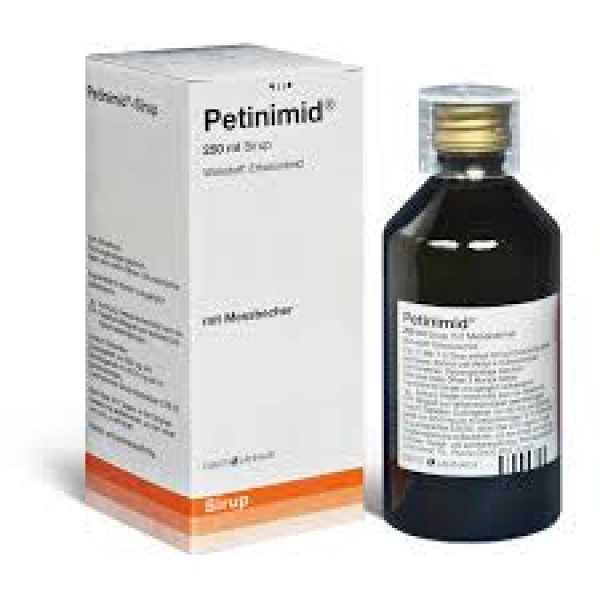
Petinimid syrup 50 mg / ml 250 ml.
Product Code: Petinimid syrup 50 mg / ml 250 ml.
Availability: In Stock
Product viewed: 161


1. What Petinimide is and what it is used for
Ethosuximide, the active substance in Petinimide syrup, is used to treat absence seizures (so-called small seizures (Petit mal) with absences).
If you suffer from mixed type of epileptic seizures, your doctor may prescribe Petinimide together with other anti-seizure medicines.
2. What you need to know before you take Petinimide
Do not take Petinimide
if you are allergic to ethosuximide, to other substances of the same pharmaceutical group (succinimides) or to any of the other ingredients of this medicine (listed in section 6).
Warnings and precautions
Talk to your doctor before taking Petinimide.
Take special care:
if you have had liver or kidney problems in the past or
if you suffer from porphyria (a rare metabolic disorder). Please tell your doctor;
if you suffer or have suffered in the past from a mental/psychiatric illness: In this case, treatment with Petinimide may lead to side effects such as irritability, agitation, states of anxiety, restlessness, aggression, difficulty concentrating or other mental changes; if you are planning a pregnancy during treatment with Petinimide or are pregnant or think you may be pregnant, consult your doctor immediately (see also section “Pregnancy and breast-feeding” below).
Serious skin reactions such as Stevens-Johnson syndrome (SJS) and drug reaction with eosinophilia and systemic symptoms (DRESS) have been reported with ethosuximide treatment. If you notice any of the symptoms described in section 4., stop taking Petinimide and seek medical help immediately. Your doctor may change your treatment to another active substance.
When treating patients with mixed epileptic seizures with Petinimide alone, an increase in the frequency of generalized tonic-clonic (Grand mal) seizures may occur. Additional anti-seizure medication may be required. It is therefore important for you to follow your doctor's advice.
Pay special attention to symptoms of bone marrow suppression, such as sore throat or pharyngeal tonsils, and a tendency to bleed. Consult your doctor if you have any of these symptoms.
Your blood count should be checked regularly (every month at first, and every six months after one year) to detect potential bone marrow damage. Your liver enzymes should also be checked regularly.
In addition, your doctor will order regular urine tests. You should make sure that you have all clinical and laboratory tests exactly as recommended.
Anti-seizure treatment is usually long-term. The use of antiepileptics may lead to impaired performance in some patients (e.g. children and adolescents may perform worse at school). This effect has not been observed with Petinimide treatment, but cannot be completely ruled out.
A small number of patients treated with antiepileptics have had thoughts of harming or killing themselves. This effect has not been observed with Petinimide treatment so far, but cannot be completely ruled out. If you ever have such thoughts, contact your doctor immediately.
If the patient treated with this medicine is a child in your care, please monitor him for any signs of these effects and, if necessary, contact a doctor immediately.
Other medicines and Petinimide
Tell your doctor or pharmacist if you are taking or have recently taken any other medicines, including medicines obtained without a prescription.
The effects of medicines and other substances may interact.
This also applies to other antiepileptic medicines used together with Petinimide. It may be necessary to administer an additional antiepileptic medicine, for example, if you suffer from mixed type of seizures. Your doctor will carefully monitor your treatment and may prescribe regular laboratory tests for some therapeutic combinations.
For example, valproic acid or sodium valproate may lead to an increase or decrease in the effect of Petinimide. Carbamazepine may reduce the effect of Petinimide. The use of Petinimide may increase the effect of phenytoin.
During treatment with Petinimide, the use of sleeping pills and sedatives should be avoided, as they may lead to an increase in the sedative effects
For the same reason, you should not consume alcohol during treatment with Petinimide
The effect of hormonal contraceptives (pills, transdermal patches, etc.) may be reduced by Petinimide. For this reason, other methods of contraception should be used.
Petinimide with food, drink and alcohol
Petinimide should be taken with food.
During treatment with Petinimide, the consumption of alcoholic beverages should be avoided.
Pregnancy and breast-feeding
If you are pregnant or
If you are pregnant, think you may be pregnant or are planning to have a baby, ask your doctor or pharmacist for advice before taking this medicine.
During pregnancy or while breast-feeding, you should only take Petitimid if your doctor has specifically told you to.
Pregnancy
If you have already taken Petitimid before you become pregnant, you should not stop taking it without first consulting your doctor, as stopping treatment suddenly may be dangerous for you and your baby. After careful consideration of the potential risks, your doctor may tell you to use Petitimid to treat your epilepsy during pregnancy, as epileptic seizures can pose a great risk to both the mother and the child. On the other hand, it is known that the risk of malformations in the fetus is slightly higher in the mother if she takes an anticonvulsant medicine during pregnancy, especially if a combination of several antiepileptic medicines is used. For this reason, your doctor will take special care to determine the exact dose (which will be the lowest possible dose), to schedule all necessary examinations and, if necessary, to prescribe folic acid or vitamin K supplements to minimize the risk.
Breastfeeding
Petinimide passes into the baby's body with breast milk. Your doctor will decide whether you can take Petinimide while breastfeeding your baby.
Driving and using machines
Warning: The use of this medicine may affect your reactivity and ability to drive.
For this reason, when starting treatment, you should not drive, operate machinery or perform any other potentially hazardous activities. Depending on the response to treatment, your doctor will decide whether you can drive or operate machinery.
This medicine contains methyl-4-hydroxybenzoate.
This preservative may cause allergic reactions (possibly delayed).
This medicine contains sodium
This medicine contains less than 1 mmol sodium (23 mg) per millilitre, i.e. essentially sodium-free.
3. How to take Petinimide
Always take this medicine exactly as your doctor has told you. If you are not sure, ask your doctor or pharmacist.
The recommended dose is:
Adults, elderly patients (> 65 years) and children over 6 years of age Therapy is usually started with a low dose of 500 mg (10 ml) daily and gradually increased every 5 to 7 days, depending on tolerability, with a maximum increase of 250 mg (5 ml) until seizure control is achieved, most often in doses of 1000 - 1500 mg (20 -30 ml) daily. Occasionally, 2000 mg (40 ml) may be required in several doses.
Children 0 to 6 years
Infants and children are usually started at 250 mg (5 ml) daily and the dose is gradually increased in small increments every few days until seizure control is achieved.
For most children, the optimal dose is 20 mg/kg daily. The maximum dose is 1000 mg (20 ml) daily.
Dosage changes should only be made by the treating physician.
Use in children
Children aged 0 to 6 years and those who cannot swallow capsules should be given ethosuximide syrup. Older children and adults usually take ethosuximide in capsule form.
In patients with severe renal impairment, the doctor will prescribe a lower dose
Tip:
Ethosuximide can be dialyzed. For this reason, patients undergoing hemodialysis treatment require an additional dose after each hemodialysis session or a different dosing schedule. Between 39 and 52% of the administered amount of the medicinal product is removed during a four-hour dialysis session.
The administration of this medicinal product to patients with severe hepatic impairment requires caution. A dose reduction may be necessary.
Method of administration
For oral use (by mouth).
The prescribed daily dose is usually administered in two divided doses.
The syrup is taken during meals.
Duration of treatment
In general, antiepileptic treatment is long-term, usually more than several years. Your doctor will determine the appropriate dose, any necessary changes in dosage, the duration of treatment and the appropriate time and manner of stopping treatment.
As with all antiepileptic medicines, Petinimide should be taken regularly. Any change in dosage or addition of other medicines should be done gradually and never suddenly.
Your doctor will inform you what to do.
If you take more Petinimide than you should
Overdose with Petinimide leads to severe fatigue, lethargy, mood swings or agitation, sometimes irritability. In addition, nausea, vomiting and depression of the central nervous system (sometimes even leading to coma and shallow/depressed breathing) may occur. Immediate medical attention is required.
Information for healthcare professionals:
More information on overdose of ethosuximide can be found at the end of this leaflet.
If you forget to take Petinimide
Do not take a double dose to make up for a forgotten dose. Take the next dose at the usual time.
If you stop taking Petinimide
Do not stop taking Petinimide without first consulting your doctor, even if you no longer have seizures. Stopping the medication may cause your seizures to return.
Any change in dose, addition or discontinuation of other medicines, especially when stopping treatment, should be done gradually, over several weeks and always under medical supervision.
If you have any further questions on the use of this medicine, ask your doctor or pharmacist.
4. Possible side effects
Like all medicines, this medicine can cause side effects, although not everybody gets them.
Serious side effects
Stop taking Petinimide and contact your doctor immediately if you experience any of the following symptoms:
Reddish patches on the body, the patches are target-like or round, often with blisters in the middle, peeling skin, ulcers in the mouth, throat, nose, genitals and eyes. These serious skin rashes may be preceded by high fever and flu-like symptoms (Stevens-Johnson syndrome).
Widespread rash, high fever and enlarged lymph nodes (Drug Reaction with Eosinophilia and Systemic Symptoms (DRESS))
The following list presents other side effects due to ethosuximide, arranged by body system and, where available, by frequency of occurrence.
Uncommon side effects (may affect up to 1 in 100 patients treated)
When using high doses: decreased appetite and weight loss
Drowsiness, headache, dizziness, hyperactivity, euphoria, irritability, movement and gait disorders, drowsiness or sleep disorders
At high daily doses or in patients with a sensitive stomach: complaints such as stomach or abdominal pain, nausea, vomiting, hiccups, cramps and diarrhea; swelling of the tongue and palate. These reactions are usually transient, rarely severe and usually do not require discontinuation of therapy.
Very rare side effects (may affect up to 1 in 10,000 people treated)
Increased libido, paranoid psychosis and increased depression with possible suicidal tendencies
Scleroderma (thickening of the skin), hirsutism (increased facial and body hair)
Not known (frequency cannot be estimated from the available data)
Seek medical help if you notice any of the following symptoms: Conditions related to changes in the blood (easier bruising or bleeding, fever, sore throat, mouth ulcers, tiredness, recurring infections or infections that do not go away. Your doctor may carry out regular blood tests to check for these effects.
Allergic reactions, hives and other skin reactions, including itchy rashes and systemic lupus
with
Irritability, agitation, anxiety, restlessness, aggression, inability to concentrate or other mental changes (especially in patients with a previous history of such changes)
Parkinson-like symptoms and sensitivity to light
Myopia
Changes in liver function values, porphyria (a rare metabolic disease that in severe cases can lead to liver damage)
Changes in kidney function values
Vaginal bleeding
Changes in laboratory values (blood count, liver and kidney function values).
5. How to store Petinimide
Keep out of the reach of children.
Do not use this medicine after the expiry date which is stated on the carton. The expiry date refers to the last day of that month.
This medicine does not require any special storage conditions.
The syrup should only be taken within 3 months of first opening.
Do not throw away any medicines via wastewater or household waste. Ask your pharmacist how to dispose of medicines you no longer use. These measures will help protect the environment.
6. Contents of the pack and other information
What Petinimide syrup contains
The active substance is ethosuximide. 1 ml of syrup contains 50 mg ethosuximide.
The other ingredients are: methyl-4-hydroxybenzoate (E 218), macrogol 300, hypromellose 2910, sucralose, sodium citrate, citric acid monohydrate, purified water.
What Petinimide looks like and contents of the pack
Clear, colourless liquid in a brown glass bottle with a child-resistant cap.
250 ml (with oral syringe and adapter).
Write a review
Your Name:Your Review: Note: HTML is not translated!
Rating: Bad Good
Enter the code in the box below: