
Your shopping cart is empty!
Welcome visitor you can login or create an account.
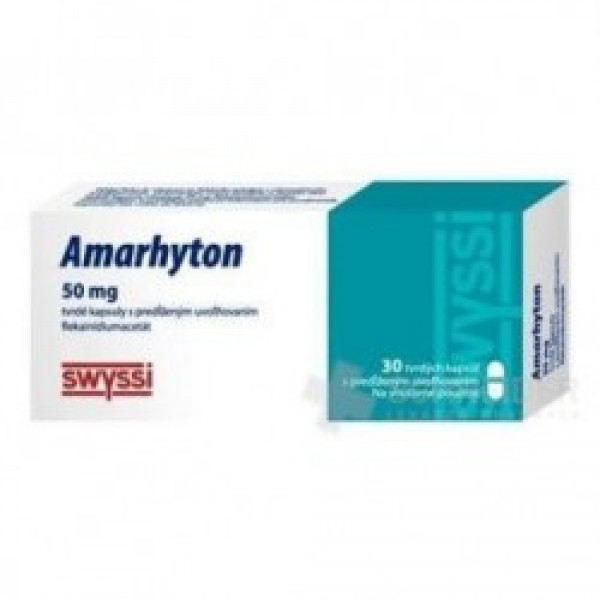
Amariton 50 mg. 30 capsules
Product Code: Amariton 50 mg. 30 capsules
Availability: In Stock
Product viewed: 214


1. What Amariton prolonged-release hard capsules are and what they are used for
Amariton prolonged-release hard capsules belong to a group of medicines that work against cardiac arrhythmia (known as antiarrhythmics). It suppresses the conduction of the stimulus in the heart and prolongs the time the heart is at rest, causing the heart to pump normally again.
Amariton prolonged-release hard capsules are used:
for certain serious cardiac arrhythmias associated with a strong heartbeat or tachycardia, when other treatment has not been effective.
for serious ventricular arrhythmias that do not respond to treatment with other medicines or when other treatments are not suitable.
for serious atrial arrhythmias at the discretion of a specialist, when other treatment has not been effective.
2. What you need to know before you take Amariton 50 mg prolonged-release hard capsules
Do not take Amariton, prolonged-release hard capsules:
if you are allergic to flecainide acetate or any of the other ingredients of this medicine (listed in section 6).
if you have a heart condition other than the one you are taking this medicine for. If you are not sure or if you need more information, talk to your doctor or pharmacist.
if you are taking other certain antiarrhythmic medicines (sodium channel blockers)
if you suffer from Brugada syndrome (a genetic heart disease).
Warnings and precautions
Talk to your doctor before taking Amaritone.
if you suffer from reduced liver function and/or reduced kidney function, as the concentration of Amaritone in the blood may increase. In this case, your doctor may regularly check the concentration of Amaritone in your blood.
if you are elderly, as the concentration of Amaritone in the blood may increase,
if you have a permanent pacemaker or temporary pacemaker electrodes,
if you have suffered from cardiac arrhythmia after heart surgery,
if you suffer from severe bradycardia or pronounced low blood pressure. These conditions must be corrected before using Amaritone prolonged-release hard capsules,
if you have experienced a myocardial infarction.
Lower or higher levels of potassium in the blood may affect the action of Amaritone prolonged-release hard capsules prolonged release. Diuretics, medicines that stimulate intestinal peristalsis (laxatives) and corticosteroid hormones (corticosteroids) can reduce the level of potassium in the blood. In this case, your doctor may test the amount of potassium in your blood.
Children under 12 years of age
Amariton hard capsules with prolonged release is not approved for use in children under 12 years of age, however, toxicity of flecainide has been reported in children who have reduced their milk intake, as well as in infants whose diet has been switched from milk to dextrose products.
Other medicines and Amaryton, hard capsules with prolonged release.
If you take certain other medicines together with Amaryton hard capsules with prolonged release, the medicines can sometimes affect each other in the way they work and/or their side effects (i.e. there may be an interaction).
Interactions may occur when you use this medicine, for example together with:
digoxin (a medicine to stimulate the heart); Amariton prolonged-release hard capsules may increase the level of digoxin in your blood;
medicines that reduce the pumping function of the heart, such as beta blockers;
certain medicines for epilepsy (e.g. phenytoin, phenobarbital and carbamazepine): the breakdown of Amariton may be accelerated by these substances;
cimetidine (an antacid); may increase the effect of Amariton prolonged-release hard capsules;
amiodarone (for heart disease); the dose of Amariton may need to be reduced in some patients;
medicines for depression (paroxetine, fluoxetine and some other antidepressants);
clozapine (a medicine used to treat schizophrenia);
mizolastine, astemizole and terfenadine (medicines for allergies);
quinine and halofantrine (antimalarial medicines);
verapamil (to lower blood pressure);
quinidine (an antiarrhythmic medicine);
medicines to treat AIDS infections (ritonavir, lopinavir and indinavir);
thiazides and loop diuretics;
disopyramide (an antiarrhythmic medicine); do not take Amariton prolonged-release capsules if you are also taking disopyramide;
terbinafine (to treat fungal infections);
bupropion (a medicine to stop smoking).
Tell your doctor or pharmacist if you are taking, have recently taken or might take any other medicines.
Amariton prolonged-release hard capsules with food, drink and alcohol
Amariton prolonged-release hard capsules should be taken on an empty stomach or at least one hour before a meal.
Dairy products (milk, powdered milk and possibly yogurt) may reduce the absorption of flecainide in children and infants. Amariton hard capsules with
extended-release is not approved for use in children under 12 years of age. Flecainide toxicity has been reported in children who have reduced their milk intake and in infants whose diet has been switched from milk to dextrose products.
Pregnancy, lactation and fertility
During pregnancy, Amariton extended-release hard capsules should be used only if the benefits outweigh the risks, as Amariton has been shown to cross the placenta in patients taking flecainide acetate during pregnancy. If Amariton extended-release hard capsules are used during pregnancy, the maternal plasma flecainide acetate level should be monitored regularly. You should inform your doctor as soon as you suspect that you are pregnant, or if you are planning to have children.
Flecainide is excreted in breast milk. Amariton prolonged-release hard capsules should only be used during breast-feeding if the benefits outweigh the risks.
If you are pregnant or breast-feeding, think you may be pregnant or are planning to have a baby, ask your doctor or pharmacist for advice before taking this medicine.
Driving and using machines
If you suffer from side effects such as dizziness, double or blurred vision or if you experience dizziness, your ability to react may be reduced. This can be dangerous in situations that require concentration and attention, such as driving, using dangerous machinery or working at heights. If you are not sure whether Amariton prolonged-release hard capsules have a negative effect on your ability to drive, discuss this with your doctor.
3. How to take Amariton prolonged-release hard capsules
Always take this medicine exactly as your doctor has told you. If you are not sure, ask your doctor or pharmacist!
Your doctor will prescribe a personal dose adapted to your condition. Treatment with Amariton prolonged-release hard capsules is normally started under medical supervision (if necessary - in hospital). Strictly follow your doctor's advice when taking Amariton prolonged-release hard capsules. If you are not sure, contact your doctor or pharmacist.
When and how to take the capsules
Take the capsule by swallowing it with a sufficient amount of liquid (e.g. water). The daily dose is usually taken divided throughout the day, on an empty stomach or at least one hour before a meal.
The total dose is only for guidance and is as follows:
The usual starting dose is between 100 mg and 200 mg. The dose may be increased by your doctor to a maximum of 400 mg per day.
Elderly patients
Your doctor may prescribe a lower dose. The dose for elderly patients should not exceed 300 mg per day.
Patients with reduced kidney or liver function
Your doctor may prescribe a lower dose.
Patients with a permanent pacemaker
The daily dose should not exceed 200 mg per day.
Patients who are also being treated with cimetidine (a medicine for stomach problems) or amiodarone (a medicine for heart arrhythmia)
Your doctor will regularly monitor your condition and in some patients a lower dose will be prescribed.
During your treatment, your doctor will regularly determine the level of flecainide acetate in your blood and you will have an electrocardiogram (ECG). A simple ECG should be done once a month and a more extensive ECG once every three months. At the beginning of treatment and when the dose is increased, an ECG is done every 2 to 4 days.
In patients taking lower doses than those usually prescribed, ECGs should be performed more frequently. Your doctor may adjust your doses at intervals of 6 to 8 days. An ECG will be performed in these patients at the 2nd and 3rd weeks after starting treatment.
Use in children
These capsules should not be taken by children under 12 years of age.
If you take more than the required dose of Amariton prolonged-release hard capsules
If you suspect an overdose, you should inform your doctor immediately.
If you forget to take Amariton prolonged-release hard capsules
Take the dose when you remember that you have forgotten to take it, unless you realize that it is almost time for your next dose. In the latter case, you should not take the dose you have forgotten in addition, but should continue to follow your schedule. It is important to take the capsules according to the schedule. Consult your doctor if you are in doubt.
Do not take a double dose to make up for a forgotten capsule.
If you stop taking Amariton prolonged-release hard capsules
If you suddenly stop taking Amariton prolonged-release hard capsules you will not experience withdrawal symptoms, however your heart arrhythmia will no longer be controlled as desired. Therefore, never stop taking it without your doctor's knowledge.
If you have any further questions on the use of this medicine, ask your doctor or pharmacist.
4. Possible side effects
Like all medicines, this medicine can cause side effects, although not everybody gets them. If you experience any of the side effects listed below, seek medical help immediately:
Common (affects 1 in 100 people):
Changes in your heart rate; palpitations, increased or decreased heart rate;
You have chest pain;
You experience shortness of breath or other breathing or lung problems;
You have a fever, flushing or sweating;
You feel run down or have a feeling of weakness.
Rare (affects 1 in 10,000 patients):
You have ringing in the ears;
Your skin and eyes start to turn yellow (jaundice);
You have fits (convulsions).
Other side effects (how often they occur is unknown):
Heart attack;
Heart failure/arrest (stopping breathing, loss of consciousness and loss of heart function).
Like other antiarrhythmic medicines, Amaryl can cause arrhythmia. Existing arrhythmias may worsen or new arrhythmias may occur. The risk of proarrhythmic reactions is most likely in patients with structural heart disease and/or significant heart function impairment.
Other side effects that may occur are:
Very common (more than 1 in 10 patients):
dizziness, fainting,
vision problems such as double vision, blurred vision and difficulty focusing.
Common (more than 1 in 100 patients but less than 1 in 10):
shortness of breath,
weakness,
tiredness (fatigue),
fever,
swelling (oedema) and discomfort,
low blood pressure (hypotension).
Uncommon (more than 1 in 1,000 patients but less than 1 in 100):
nausea,
vomiting,
constipation,
abdominal pain,
anorexia,
diarrhea,
dyspepsia (pain in the epigastric area, feeling of fullness),
swelling,
reduction in red blood cells (which can make your skin pale and cause weakness or shortness of breath),
reduction in white blood cells (which makes you susceptible to infections), reduction in platelets (which can make you bleed more easily than normal even with minor injuries),
allergic skin reactions such as rashes and hair loss.
Rare (affects more than 1 in 10,000 patients but less than 1 in 1,000):
inflammation of the lung (pneumonia),
itchy skin ("tingling"),
problems with coordination,
involuntary, repetitive movements (tics),
decreased sensitivity,
increased sweating,
temporary loss of consciousness,
tremor,
vertigo,
flushing of the face (enchyma),
sleepiness,
severe depression,
anxiety,
insomnia (difficulty falling asleep),
headache,
nervous disorders, e.g. in the arms and legs,
convulsions,
confusion,
seeing things that are not there (hallucinations),
loss of memory (amnesia),
hives,
increased liver enzymes with or without jaundice (yellowing of the eyes and skin).
Very rare (occurs in less than 1 in 10,000 patients):
increased levels of certain antibodies,
corneal precipitate,
light sensitivity.
Not known (frequency cannot be estimated from the available data)
certain changes in the electrocardiogram (increased PR and QRS intervals),
increased stimulation threshold in patients with pacemakers or temporary pacing electrodes,
impaired conduction between the atrium and the ventricle of the heart (second and third degree atrioventricular block),
stopping of the heartbeat,
sensation of the heartbeat (palpitations),
pause in the normal heart rhythm (sinus node arrest),
faster or slower heartbeat, loss of the heart's ability to pump enough blood to the body's tissues,
manifestation of a certain pre-existing heart disease (Brugada syndrome) that was not observed before treatment with Amaryl prolonged-release capsules,
"shadow" of the lungs or lung diseases (pneumofibrosis and interstitial lung disease liver),
impaired liver function.
If you get any side effects, tell your doctor or pharmacist. This includes any side effects not listed in this leaflet.
information on the safety of this medicine.
5. How to store Amariton prolonged-release hard capsules
Keep out of the reach and sight of children. Store below 30°C.
Do not take this medicine after the expiry date which is stated on the packaging after “Do not take after” or “Expiry date”*. The expiry date refers to the last day of that month.
Do not throw away any medicines via wastewater or household waste. Ask your pharmacist how to throw away medicines you no longer take. These measures will help protect the environment.
6. Contents of the pack and other information
What Amaritone prolonged-release hard capsules contain
The active substance is flecainide acetate.
Amaritone 50 mg prolonged-release hard capsules: each capsule contains 50 mg flecainide acetate.
The other ingredients are:
Povidone (K25);
Microcrystalline cellulose;
Crospovidone (type A);
Colloidal anhydrous silica;
Magnesium stearate;
For the coating of the mini-tablets:
Methacrylic acid acid-methyl methacrylate copolymer (1:2);
Macrogol 400;
Talc.
Capsule shell: gelatin and titanium dioxide (E171).
What Amarnton 50 mg prolonged-release hard capsules look like and contents of the pack
Amariton 50 mg prolonged-release hard capsules are gelatin opaque capsules No. 4 with a white body and a white cap, containing white or almost white round mini-tablets.
Pack sizes: 28 or 30 capsules.
Not all pack sizes may be marketed.
Write a review
Your Name:Your Review: Note: HTML is not translated!
Rating: Bad Good
Enter the code in the box below: