
Your shopping cart is empty!
Welcome visitor you can login or create an account.
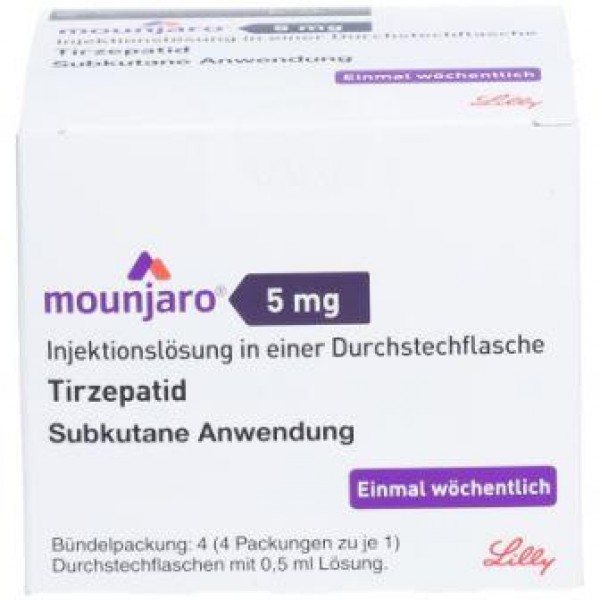
Mounjaro 5 mg./dose 4 doses
Product Code: Mounjaro 5 mg./dose 4 doses
Availability: In Stock
Product viewed: 394


1. What Mounjaro is and what it is used for
Mounjaro contains the active substance tirzepatide and is used to treat adults with type 2 diabetes mellitus. Mounjaro lowers the level of sugar in the body only when blood sugar levels are high.
Mounjaro is also used to treat adults who are obese or overweight (with a BMI of at least 27 kg/m2). Mounjaro affects the regulation of appetite, which can help you eat less food and reduce your weight.
In type 2 diabetes, Mounjaro is used:
on its own, when you cannot take metformin (another diabetes medicine);
with other diabetes medicines, when they are not enough to control your blood sugar levels. These other medicines may be medicines taken by mouth and/or insulin given by injection.
Mounjaro is also used together with diet and exercise to lose weight and to keep weight under control in adults who have:
BMI of 30 kg/m2 or more (obese) or
BMI of at least 27 kg/m2 but less than 30 kg/m2 (overweight) and weight-related health problems (such as prediabetes, type 2 diabetes, high blood pressure, abnormal levels of fats in the blood, breathing problems during sleep called ‘obstructive sleep apnoea’, or a history of heart attack, stroke or blood vessel problems)
BMI (body mass index) is a measure of your weight in relation to your height.
In patients with obstructive sleep apnoea (OSA) and obesity, Mounjaro can be used with or without positive airway pressure therapy.
It is important to continue to follow the diet and exercise advice given to you by your doctor, nurse or pharmacist.
3. What you need to know before you use Mounjaro KwikPen
Do not use Mounjaro KwikPen
if you are allergic to tirzepatide or any of the other ingredients of this medicine (listed in section 6).
Warnings and precautions
Talk to your doctor, nurse or pharmacist before using Mounjaro if:
you have severe problems with digestion or food staying in your stomach for longer than normal (including severe gastroparesis).
you have ever had pancreatitis (inflammation of the pancreas which can cause severe stomach and back pain that does not go away).
you have an eye problem (diabetic retinopathy or macular oedema).
you are using a sulphonylurea (another medicine for diabetes) or insulin for your diabetes, as a condition where your blood sugar is very low (hypoglycaemia) may occur. Your doctor may need to change the dose of these other medicines to reduce this risk.
When you start treatment with Mounjaro, in some cases you may lose body fluids/dehydration, e.g. due to vomiting, nausea and/or diarrhoea, which may lead to a decrease in kidney function. It is important to avoid dehydration by drinking plenty of fluids. Contact your doctor if you have any questions or concerns.
If you know that you are going to have an operation where you will be under anaesthesia (sleeping), you should tell your doctor that you are being treated with Mounjaro.
Children and adolescents
This medicine should not be given to children and adolescents under 18 years of age as it has not been studied in this age group.
Other medicines and Mounjaro
You should tell your doctor, nurse or pharmacist if you are taking, have recently taken or might take any other medicines.
Pregnancy
If you are pregnant or breast-feeding, think you may be pregnant or are planning to have a baby, ask your doctor for advice before taking this medicine. This medicine should not be used during pregnancy as the effects of this medicine on your unborn child are not known. Therefore, it is recommended that you use contraception while using this medicine.
Breastfeeding
It is not known whether tirzepatide passes into breast milk. A risk to newborns/infants cannot be excluded. If you are breast-feeding or intend to breast-feed, talk to your doctor before using this medicine. You and your doctor should decide whether you should stop breast-feeding or postpone the use of Mounjaro.
Driving and using machines
This medicine is unlikely to affect your ability to drive or use machines. However, if you use Mounjaro in combination with a sulphonylurea or insulin, it may lead to a condition where your blood sugar is very low (hypoglycaemia), which may reduce your ability to concentrate. Avoid driving or using machines if you experience signs of low blood sugar, e.g. headache, drowsiness, weakness, dizziness, feeling hungry, confusion, irritability, fast heartbeat and sweating (see section 4). See section 2 “Warnings and precautions” for information on the increased risk of low blood sugar. Talk to your doctor for more information.
Mounjaro KwikPen contains sodium
This medicine contains less than 1 mmol sodium (23 mg) per dose, i.e. essentially ‘sodium-free’.
Mounjaro KwikPen contains benzyl alcohol
This medicine contains 5.4 mg of benzyl alcohol in each 0.6 ml dose. Benzyl alcohol may cause allergic reactions.
Talk to your doctor, nurse or pharmacist if you are pregnant or breast-feeding, or if you have liver or kidney disease. This is because large amounts of benzyl alcohol can build up in your body and cause side effects (called ‘metabolic acidosis’).
3. How to use Mounjaro KwikPen
Always use this medicine exactly as your doctor or pharmacist has told you. If you are not sure, ask your doctor or pharmacist.
How much to use
The starting dose is 2.5 mg once a week for four weeks.
After four weeks, your doctor will increase your dose to 5 mg once a week.
Your doctor may increase your dose in 2.5 mg increments to 7.5 mg, 10 mg, 12.5 mg or 15 mg once a week if needed. In all cases, your doctor will tell you to stay on the same dose for at least 4 weeks before switching to a higher dose.
Do not change your dose unless your doctor tells you to.
When to inject Mounjaro
You can use your pen at any time of the day, regardless of food. You should use it on the same day each week, if possible. To help you remember when to inject Mounjaro, you may want to mark it on a calendar.
If needed, you can also change the day of the week that you inject Mounjaro, as long as it has been at least 3 days since your last injection. Once you have chosen a new injection day, continue injecting once a week on this new day.
How to inject Mounjaro KwikPen
Mounjaro is injected under the skin (subcutaneous injection) in the abdomen (tummy) area, at least 5 cm from the navel, or in the upper leg (thigh) or upper arm. You may need help from another person if you want to inject into your upper arm.
If you want, you can use the same area of your body each week. But make sure you choose a different injection site within this area. If you also inject insulin, choose a different site for your injection.
Read the “Instructions for Use” on the pen carefully before using Mounjaro KwikPen.
Testing your blood sugar levels
If you are using Mounjaro with a sulphonylurea or insulin, it is important to test your blood sugar levels as instructed by your doctor, nurse or pharmacist (see section 2, “Warnings and precautions”).
If you use more Mounjaro than you should
If you use more Mounjaro than you should, talk to your doctor immediately. Taking too much of this medicine may cause low blood sugar (hypoglycemia) and may cause nausea or vomiting.
If you forget to use Mounjaro
If you forget to inject a dose and
it is 4 days or less since you should have used Mounjaro, use it as soon as you remember. Then inject your next dose as usual on the scheduled day.
if it is more than 4 days since you should have used Mounjaro, do not inject the missed dose. Inject your next dose as usual on the scheduled day.
Do not inject a double dose to make up for a missed dose. The minimum time between two doses should be at least 3 days.
If you stop using Mounjaro
Do not stop using Mounjaro without talking to your doctor. If you stop using Mounjaro and you have type 2 diabetes, your blood sugar levels may increase.
If you have any further questions on the use of this medicine, ask your doctor, nurse or pharmacist.
4. Possible side effects
Like all medicines, this medicine can cause side effects, although not everybody gets them.
Serious side effects
Uncommon (may affect up to 1 in 100 people)
Inflammation of the pancreas (acute pancreatitis), which can cause severe stomach and back pain that does not go away. You should see a doctor immediately if you experience these symptoms.
Rare (may affect up to 1 in 1,000 people)
Severe allergic reactions (e.g. anaphylactic reaction, angioedema). You should seek medical attention immediately and tell your doctor if you experience symptoms such as difficulty breathing, rapid swelling of the lips, tongue and/or throat with difficulty swallowing and a fast heartbeat.
Other side effects
Very common (may affect more than 1 in 10 people)
Nausea
Diarrhoea
Abdominal pain reported in patients treated for weight control
Vomiting reported in patients treated for weight control
Constipation reported in patients treated for weight control
These side effects are usually not serious. . Nausea, diarrhoea and vomiting are most common when tirzepatide is first started, but decrease over time in most patients.
Low blood sugar (hypoglycaemia) is very common when tirzepatide is used with medicines that contain a sulphonylurea and/or insulin. If you are using a sulphonylurea or insulin for type 2 diabetes, your dose may need to be reduced while you are using tirzepatide (see section 2 “Warnings and precautions”). Symptoms of low blood sugar may include headache, drowsiness, weakness, dizziness, feeling hungry, confusion, irritability, fast heartbeat and sweating. Your doctor should tell you how to treat low blood sugar levels.
Common (may affect up to 1 in 10 people)
Low blood sugar (hypoglycaemia) when tirzepatide for the treatment of type 2 diabetes is used together with metformin and a sodium-glucose cotransporter 2 inhibitor (another medicine for diabetes).
Allergic reaction (hypersensitivity) (e.g. rash, itching and eczema)
Dizziness reported in patients treated for weight control
Low blood pressure reported in patients treated for weight control
Reduced hunger (decreased appetite) reported in patients treated for type 2 diabetes
Abdominal pain reported in patients treated for type 2 diabetes
Vomiting reported in patients treated for type 2 diabetes - this usually decreases over time
Indigestion (dyspepsia)
Constipation reported in patients treated for type 2 diabetes
Swelling of the stomach
Burning (eructation)
Gas (flatulence)
Reflux or heartburn (also called gastroesophageal reflux disease - GERD) - a condition in which stomach acid flows back from the stomach into the esophagus.
Hair loss reported in patients treated for weight control
Feeling tired
Injection site reactions (e.g. itching or redness)
Rapid heartbeat
Increased levels of pancreatic enzymes (such as lipase and amylase) in the blood.
Increased levels of calcitonin in the blood in patients treated for weight control
Uncommon (may affect up to 1 in 100 people)
Low blood sugar (hypoglycaemia) is an uncommon reaction when tirzepatide is used with metformin to treat type 2 diabetes.
Gallstones
Inflammation of the gallbladder
Weight loss reported in patients treated for type 2 diabetes
Pain at the injection site
Increased levels of calcitonin in the blood in patients treated for type 2 diabetes and OSA with obesity
Altered sense of taste
Change in skin sensitivity
Slowed stomach emptying
Reporting side effects
5. How to store Mounjaro KwikPen
Keep out of the reach and sight of children.
Do not use this medicine after the expiry date which is stated on the pen label and carton after “EXP”. The expiry date refers to the last day of that month.
Store in a refrigerator (2°C - 8°C). Do not freeze. DO NOT USE THE PEN if it has been frozen.
Mounjaro KwikPen can be stored outside the refrigerator below 30°C for up to 30 days after first use, after which the pen should be discarded.
Do not use this medicine if you notice that the pen is damaged or the medicine is cloudy, discoloured or contains visible particles.
Do not throw away any medicines via wastewater or household waste. Ask your pharmacist how to throw away medicines you no longer use. These measures will help protect the environment.
6. Contents of the pack and other information
What Mounjaro KwikPen contains
Active substance: tirzepatide
Mounjaro 2.5 mg/dose KwikPen: Each dose contains 2.5 mg tirzepatide in 0.6 ml solution. Each multidose pre-filled pen contains 10 mg tirzepatide in 2.4 ml (4.17 mg/ml). Each pen delivers 4 doses of 2.5 mg.
Mounjaro 5 mg/dose KwikPen: Each dose contains 5 mg tirzepatide in 0.6 ml solution. Each multidose pre-filled pen contains 20 mg tirzepatide in 2.4 ml (8.33 mg/ml). Each pen delivers 4 doses of 5 mg.
Mounjaro 7.5 mg/dose KwikPen: Each dose contains 7.5 mg tirzepatide in 0.6 ml solution. Each multidose pre-filled pen contains 30 mg of tirzepatide in 2.4 ml (12.5 mg/ml). Each pen delivers 4 doses of 7.5 mg.
Mounjaro 10 mg/dose KwikPen: Each dose contains 10 mg of tirzepatide in 0.6 ml of solution. Each multidose pre-filled pen contains 40 mg of tirzepatide in 2.4 ml (16.7 mg/ml). Each pen delivers 4 doses of 10 mg.
Mounjaro 12.5 mg/dose KwikPen: Each dose contains 12.5 mg of tirzepatide in 0.6 ml of solution. Each multidose pre-filled pen contains 50 mg of tirzepatide in 2.4 ml (20.8 mg/ml). Each pen delivers 4 doses of 12.5 mg.
Mounjaro 15 mg/dose KwikPen: Each dose contains 15 mg tirzepatide in 0.6 ml solution. Each multidose pre-filled pen contains 60 mg tirzepatide in 2.4 ml (25 mg/ml). Each pen delivers 4 doses of 15 mg.
The other ingredients are disodium hydrogen phosphate heptahydrate (E339), benzyl alcohol (E1519) (see section 2 “Mounjaro KwikPen contains benzyl alcohol” for further information), glycerol, phenol, sodium chloride, sodium hydroxide (see section 2 “Mounjaro contains sodium” for further information); concentrated hydrochloric acid and water for injections.
What Mounjaro looks like and contents of the pack
Mounjaro is a clear, colourless to pale yellow solution for injection in a pre-filled pen (KwikPen).
Each KwikPen contains 2.4 ml of solution for injection (4 doses of 0.6 ml) and a refill. Needles are not included.
Pack sizes of 1 and 3 KwikPens
Not all pack sizes may be available in your country.
Write a review
Your Name:Your Review: Note: HTML is not translated!
Rating: Bad Good
Enter the code in the box below: