
Your shopping cart is empty!
Welcome visitor you can login or create an account.
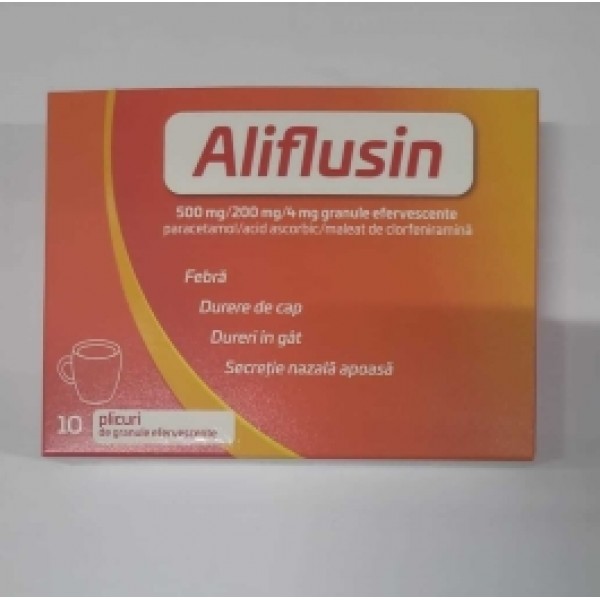
Aliflusin 500 mg/200 mg/4 mg. 10 sachets
Product Code: Aliflusin 500 mg/200 mg/4 mg. 10 sachets
Availability: In Stock
Product viewed: 295


1. What is Alifluzin and what is it used for?
Alifluzin is a combination medicine containing 3 active substances: paracetamol, which has analgesic and antipyretic effects, chlorphenamine maleate, which reduces nasal secretion, suppresses the sneezing reflex and tearing of the eyes, and ascorbic acid, which replenishes the deficiency of vitamin C in the body.
This medicine is indicated for the short-term treatment of symptoms of flu, colds and flu-like conditions such as headache, fever, sore throat, especially if accompanied by rhinitis, in adults and adolescents over 15 years of age. You should only take Alifluzin if you have a combination of cold and flu symptoms, such as pain/fever and runny nose.
If after 3 days of treatment for fever and after 5 days of treatment for pain (adolescents over 15 years of age - after 3 days) you do not feel better or your condition worsens, you should seek medical attention.
2. What you need to know before you take Alifluzin
Do not take Alifluzin
if you are allergic to paracetamol, ascorbic acid or chlorphenamine maleate, or any of the other ingredients of this medicine (listed in section 6);
if you have severe liver failure;
if you have angle-closure glaucoma;
if you are at risk of urinary retention associated with disorders of the segment of the urethra passing through the prostate;
if you are currently taking monoamine oxidase inhibitors (MAOIs) or have taken them in the last two weeks;
in children and adolescents under 15 years of age.
Warnings and precautions
Talk to your doctor or pharmacist before taking Alifluzin.
Special warnings
In case of high or prolonged fever, initial bacterial superinfection, persistent symptoms after 3 days in case of fever and 5 days (adolescents over 15 years of age - after 3 days) in case of pain, contact your doctor.
This medicine contains paracetamol. Make sure you are not taking any other medicines containing paracetamol, including those without a prescription. Do not take them at the same time to avoid exceeding the recommended daily dose (see section 3).
The risk of overdose with this medicine is increased in patients with liver disease.
Caution should be exercised when taking it in patients:
with mild to moderate liver damage, including liver failure not caused by alcoholic cirrhosis, Gilbert's syndrome (familial non-haemolytic jaundice),
with low glutathione levels, e.g. severely malnourished, anorexia, low body mass index (BMI), disabled patients,
dehydrated,
regular drinkers of alcohol,
with sepsis.
The use of paracetamol may increase the risk of metabolic acidosis. Symptoms of metabolic acidosis include: rapid, deep and difficult breathing, nausea, vomiting and loss of appetite. Contact your doctor immediately if you experience the above symptoms at the same time.
Do not take at the same time as other cold and flu medicines.
Precautions
Paracetamol should be used with caution in patients with impaired renal function, acute hepatitis, glucose-6-phosphate dehydrogenase deficiency, haemolytic anaemia and methaemoglobin reductase deficiency.
Due to the risk of hypertensive crisis, this medicine should not be taken by patients currently taking monoamine oxidase inhibitors or within the last two weeks. (see section "Do not take Alifluzin").
Due to the presence of chlorphenamine, alcohol, medicines containing alcohol and sedatives (especially barbiturates) should be avoided during treatment with this medicine. These medicines increase the sedative effect of antihistamines, which may affect the ability to drive and use machines.
Caution should be exercised in patients with bronchial asthma or chronic obstructive pulmonary disease, with cardiovascular disease, hypertension, hyperthyroidism and gastric outlet obstruction.
Influence on laboratory test results
The use of paracetamol may affect the values of blood tests for uric acid and glucose tests. Chlorphenamine may alter the results of skin allergy tests. It is recommended to stop using the product at least 3 days before skin tests.
Children and adolescents
This medicine should not be used in children and adolescents under 15 years of age.
Other medicines and Alifluzin
You should tell your doctor or pharmacist if you are taking, have recently taken or might take any other medicines.
Do not take Alifluzin with monoamine oxidase inhibitors (MAOIs) (medicines used to treat depression) currently or if you have taken them in the last two weeks (see section "Do not take Alifluzin").
The use of medicines containing alcohol should be avoided while taking Alifluzin.
Caution should be exercised when taking:
opioid derivatives (analgesics, antitussives and substitution treatments),
neuroleptics (medicines for the treatment of mental disorders, mainly schizophrenia and other psychoses),
barbiturates (hypnotics and for the treatment of epilepsy
),
benzodiazepines (anxiolytics, sedatives, hypnotics, antiepileptics and muscle relaxants),
anxiolytics other than benzodiazepines (e.g. meprobamate),
hypnotics (lorazepam, diazepam),
sedating antidepressants (amitriptyline, doxepin, mianserin, mirtazapine, trimipramine),
antihistamines H1 receptor blockers (medicines used to treat allergies)
antihypertensives affecting the central nervous system,
baclofen (muscle relaxant),
thalidomide (a medicine that affects the immune system, used to treat multiple myeloma),
anticholinergic antiparkinsonian medicines (such as benzatropine),
atropine-like antispasmodics (containing hyoscine),
disopyramide (a medicine to treat heart disease),
phenothiazine neuroleptics (medicines to treat psychosis, such as chlorpromazine, thioridazine, perphenazine),
clozapine (medicine for the treatment of schizophrenia and psychiatric disorders in Parkinson's disease),
salicylamide (analgesic),
rifampicin (antibiotic),
antiepileptic medicines (e.g. phenytoin, carbamazepine, lamotrigine and others),
hypnotics, barbiturates and other medicines that induce liver enzymes, caffeine,
non-steroidal anti-inflammatory drugs (acetylsalicylic acid, ibuprofen, diclofenac, naproxen),
coumarin anticoagulants (acenocoumarol, warfarin),
fluphenazine (medicine for the treatment of psychosis),
zidovudine,
lamotrigine,
domperidone,
metoclopramide,,
probenecid,
cholestyramine,
chloramphenicol,
any substances with a harmful effect on the liver.
Alifluzin with food, drink and alcohol
Avoid drinking alcohol while taking Alifluzin as it can damage the liver and cause excessive sedation.
Pregnancy, breast-feeding and fertility
If you are pregnant or breast-feeding, think you may be pregnant or are planning to have a baby, ask your doctor or pharmacist for advice before taking this medicine.
Pregnancy
Alifluzin is not recommended during pregnancy due to the presence of chlorphenamine.
Breast-feeding
Alifluzin is not recommended during breast-feeding due to the presence of chlorphenamine.
Fertility
Animal studies have not shown harmful effects of paracetamol, chlorphenamine maleate or ascorbic acid on fertility.
Driving and using machines
Drowsiness may occur, especially at the beginning of treatment, which affects the psychophysical fitness of people driving and using machines. This effect may be increased by the simultaneous use of alcohol, medicines containing alcohol or sedatives. You should not drive or use machines while taking this medicine.
Alifluzin contains sucrose and glucose (in the maltodextrin)
If you have been told by your doctor that you have an intolerance to some sugars, contact your doctor before taking this product.
This medicinal product contains 3156 mg of sucrose per sachet. This should be taken into account in patients with diabetes mellitus.
Alifluzin contains sodium
This medicinal product contains 88.8 mg of sodium (main component of cooking/table salt) per sachet. This is equivalent to 4.5% of the recommended maximum daily intake of sodium for an adult.
3. How to take Alifluzin
Always take this medicine exactly as your doctor or pharmacist has told you. If you are not sure, ask your doctor or pharmacist.
Use in adults and adolescents over 15 years of age:
The recommended single dose is one sachet (500 mg paracetamol, 200 mg ascorbic acid and 4 mg chlorphenamine maleate) up to 3 times a day if necessary with an interval of at least 4 hours between doses. The maximum daily dose of 3 sachets (1500 mg paracetamol, 600 mg ascorbic acid and 12 mg chlorphenamine maleate) should not be exceeded within 24 hours.
Patients with renal impairment
If you have kidney problems, the interval between 2 doses will be determined by your doctor.
Patients with hepatic impairment
In patients with mild to moderate hepatic impairment or Gilbert's syndrome, the dose should be reduced or the dosing intervals extended. The dose and the interval between 2 doses will be determined by your doctor.
Do not take this medicine if you have severe liver damage (see "Do not take Alifluzin").
Elderly age
No dose adjustment is required in elderly patients with normal kidney/liver function.
Children and adolescents under 15 years of age
Do not use this medicine in children and adolescents under 15 years of age.
Method of administration
Orally.
The effervescent granules should be dissolved in a glass of warm water and the solution should be drunk immediately after preparation.
Duration of treatment
This medicine should not be used without consulting a doctor for more than 3 days in the treatment of high fever and 5 days (adolescents over 15 years of age - 3 days) in the treatment of pain. This medicine should be used in the presence of pain and fever. If these symptoms disappear, use of the medicine should be discontinued.
If you take more Alifluzin than you should
Stop treatment and contact a doctor or emergency medical service immediately.
Symptoms related to chlorphenamine maleate
Overdose with chlorphenamine may cause: convulsions (especially in children), impaired consciousness, coma.
Symptoms related to paracetamol
The risk of paracetamol intoxication occurs especially in elderly patients and young children (the most common causes are doses higher than recommended and accidental poisoning); these poisonings can be fatal. Overdose of the medicinal product may cause within a few to more hours signs and symptoms such as nausea, vomiting, excessive sweating, drowsiness and general weakness. These signs and symptoms may resolve the next day, although liver damage begins to develop, the symptoms of which may include epigastric distension, recurrent nausea and jaundice. If you have taken more than the prescribed dose of medicine, contact a doctor immediately, even if you feel well, because of the risk of delayed, serious and irreversible liver damage.
If you have taken more than the prescribed dose of medicine, contact a doctor immediately.
If you forget to take Alifluzin
Do not take a double dose to make up for a forgotten dose.
If you have any further questions on the use of this medicine, ask your doctor or pharmacist.
4. Possible side effects
Like all medicines, this medicine can cause side effects, although not everybody gets them.
Side effects related to paracetamol:
Stop taking the medicine and consult a doctor immediately or go to the hospital if you develop the following reactions:
swelling of the larynx, which
makes breathing impossible (isolated cases);
anaphylactic shock, manifested by confusion, pale skin, drop in blood pressure, sweating, passing little urine, rapid breathing, weakness and fainting (isolated cases);
erythema multiforme (isolated cases);
severe skin reaction: toxic epidermal necrolysis (Lyell's syndrome), bullous erythema multiforme (Stevens-Johnson syndrome), acute generalized exanthematous pustulosis, characterized by a rash with pustules all over the body, erosions in the mouth, skin, genitals, red spots on the torso, often with blisters in the center, large blisters that burst, large white spots on the skin, weakness, fever and joint pain (very rare);
prolonged itching of the skin (pruritus), skin rash, excessive sweating, lumps, red or purple discoloration of the skin (purpura), allergic reaction that causes swelling of the tissues under the skin (angioedema), allergic reaction that causes blistering of the skin (urticaria); these are rare;
acute or chronic pancreatitis, bleeding, abdominal pain, diarrhoea, nausea, vomiting, liver damage (failure), irreversible damage (necrosis) of the liver, yellowing of the skin, mucous membranes and the whites of the eyes (jaundice); these are rare.
Other side effects are:
Rare (may affect up to 1 in 1,000 people):
anaemia due to various deficiencies, bone marrow suppression, reduction in the number of platelets;
fluid accumulation in the tissues (oedema);
kidney damage (nephropathy) and impaired absorption or secretion of the tubules in the kidneys (tubulopathies).
Paracetamol is a commonly used drug and reports of adverse reactions are rare and usually related to overdose.
Isolated cases of dizziness have been reported.
Adverse reactions associated with chlorphenamine
Stop taking the drug and contact a doctor immediately or go to hospital if you have an allergic reaction:
hypersensitivity reactions (allergic reaction), anaphylactic reactions (severe allergic reactions with cough, difficulty swallowing, rapid heartbeat, itching, swelling of the eyelids or the area around the eyes, face, tongue, shortness of breath, fatigue, etc.);
central nervous system depression in the form of drowsiness, nausea and muscle weakness, which in some patients disappear after 2-3 days of treatment; common;
blockage of the bile ducts (cholestasis), hepatitis or other liver problems (including upper abdominal or stomach pain, dark urine, etc.); these are rare.
Other side effects are:
Common (may affect up to 1 in 10 people):
uncoordinated and involuntary movements of the facial muscles (dyskinesia), impaired coordination (rigidity), tremor, numbness, tingling, burning sensation like a needle prick (paraesthesia);
blurred or double vision;
dry nose and throat, dry mucous membranes;
dry mouth, loss of appetite, taste and smell disturbances, gastrointestinal disturbances (nausea, vomiting, diarrhoea, constipation, upper abdominal pain), which may be reduced when taken with food;
increased sweating;
urinary retention and/or difficulty urinating.
Rare (may affect up to 1 in 1,000 people):
changes in blood tests (lack of granulocytes, reduction in white blood cells, anaemia, anaemia due to bone marrow suppression (aplastic anaemia) or reduction in platelet count (thrombocytopenia) with symptoms such as unusual bleeding, sore throat or tiredness;
photosensitivity, hypersensitivity to similar medicines;
sometimes agitation, especially when given in high doses to children or elderly patients, characterised by anxiety, insomnia, nervousness, hallucinations, palpitations and convulsions;
tinnitus (unpleasant sound sensations), acute labyrinthitis;
generally in case of overdose, disturbances in heart rhythm, palpitations, rapid pulse (tachycardia) may occur;
low blood pressure (hypotension), increased blood pressure (hypertension), fluid accumulation in the tissues (oedema);
tightness in the chest, difficulty breathing;
inability to have sexual intercourse in men (impotence), bleeding between periods
5. How to store Alifluzin
Keep out of the reach and sight of children.
Store below 25°C.
Store in the tightly closed original package in order to protect from light and moisture.
Do not use this medicine after the expiry date which is stated on the carton and sachet after "EXP".
The expiry date refers to the last day of that month.
Do not throw away any medicines via wastewater or household waste.
Ask your pharmacist how to throw away medicines you no longer use.
These measures will help protect the environment.
6. Contents of the pack and other information
What Alifluzin contains
The active substances are paracetamol, ascorbic acid and chlorphenamine maleate. Each sachet of effervescent granules contains 500 mg paracetamol, 200 mg ascorbic acid, 4 mg chlorphenamine maleate.
The other ingredients are: citric acid, sodium hydrogen carbonate, sucrose, magnesium citrate, sodium cyclamate (E952), sodium saccharin (E954), lemon flavor (Tetrarome Lemon P0551 987323: corn maltodextrin, flavors (limonene, beta-pinene, citral, gamma terpinene, linalool), α-tocopherol (E307)).
What Alifluzin looks like and contents of the pack
The primary packaging is PAP/aluminum/PE laminate sachets. The primary packaging is placed together with the leaflet in a cardboard box. The package contains 10 or 20 sachets.
Write a review
Your Name:Your Review: Note: HTML is not translated!
Rating: Bad Good
Enter the code in the box below: