
Your shopping cart is empty!
Welcome visitor you can login or create an account.
Succiprol 95 mg. 60 tablets
Product Code: Succiprol 95 mg. 60 tablets
Availability: In Stock
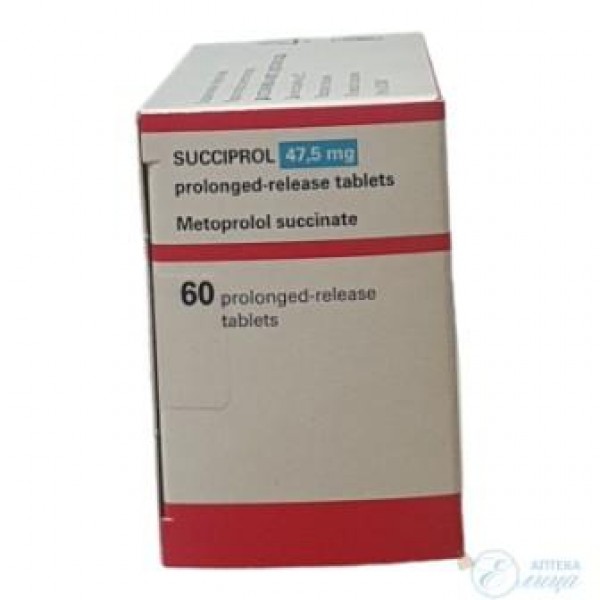
Product viewed: 115


1. What Succiprol 95 mg prolonged-release tablets are and what they are used for
Metoprolol succinate, the active substance in Succiprol 95 mg prolonged-release tablets, belongs to a group of medicines called selective beta-receptor blockers, which mainly work on the heart. This medicine affects the body's response to certain nerve signals, especially in the heart. As a result, it lowers blood pressure and increases the pumping power of the heart.
Succiprol 95 mg prolonged-release tablets are used for
treatment of high blood pressure;
treatment of poor blood supply to the coronary arteries (coronary heart disease, angina);
treatment of rapid forms of heart rhythm disorders (tachycardia arrhythmias), especially those originating in the atria (supraventricular tachycardias);
prevention of a subsequent myocardial infarction after a previous one (maintenance treatment);
treatment of functional cardiovascular disorders;
prevention of migraine;
treatment of mild to moderate stable chronic weakness of the heart muscle (heart failure) (with impaired left ventricular function) in addition to standard treatment.
Children and adolescents aged 6-18 years
For the treatment of high blood pressure (hypertension)
2. What you need to know before you take Succiprol 95 mg prolonged-release tablets
Do not take Succiprol 95 mg prolonged-release tablets
if you are allergic to metoprolol, other beta-blockers or any of the other ingredients of this medicine (listed in section 6)
if you have certain forms of heart rhythm disturbances (second and third degree
AV block, high-degree sinoatrial block)
if you have a slow heart rate (heart rate < 50 beats/minute)
if you suffer from dysfunction of the sinoatrial node of the heart (sick sinus syndrome)
if you have had circulatory collapse mainly due to heart failure
if you suffer from severely impaired blood circulation in the arms and/or legs
if you suffer from pathologically low blood pressure, i.e. when the systolic value (the upper value of the blood pressure reading) is lower than 90 mmHg
if you suffer from an untreated hormone-producing tumor of the adrenal gland (phaeochromocytoma)
if you have high levels of acids in the blood caused by metabolic dysfunction
if you suffer from severe bronchial asthma or a chronic lung disease that makes the bronchi impassable
if you are also treated with MAO inhibitors (medicines used to treat depression, except MAO-B inhibitors)
if a myocardial infarction is suspected and the pulse is below 45 beats/minute, the upper value of the blood pressure reading is < 100 mmHg and there are certain forms of heart rhythm disorders
if you are using other medicines to lower blood pressure such as verapamil and diltiazem
if you are using antiarrhythmics such as disopyramide.
Patients with chronic heart failure should not take metoprolol:
if they suffer from unstable, decompensated heart failure (which may manifest as fluid retention in the lungs, poor circulation or low blood pressure), unless the condition has been stabilised with medical treatment;
if they are receiving continuous or temporary treatment with medicines that increase the pumping capacity of the heart (e.g. dobutamine);
if they have a systolic (upper number) blood pressure continuously below 100 mmHg.
Warnings and precautions
Talk to your doctor or pharmacist before taking Succiprol 95 mg prolonged-release tablets if you have one or more of the following symptoms or develop any of these symptoms during treatment:
if you suffer from bronchial asthma: metoprolol may worsen the symptoms of bronchial asthma. The effect of certain medicines for the treatment of bronchial asthma may be impaired. Succiprol 95 mg prolonged-release tablets should not be used in severe forms of bronchial asthma
if you suffer from diabetes mellitus: metoprolol may mask the symptoms of low blood sugar levels. Regular blood sugar monitoring is necessary.
if you have a mild form of a certain heart rhythm disorder (first-degree AV block);
if you have a certain type of chest pain (angina pectoris) called Prinzmetal's angina;
if you suffer from mild or moderate circulatory disorders: arms/legs;
if you have high blood pressure due to a tumor of the adrenal medulla (phaeochromocytoma). An alpha-receptor blocker should be used before and during treatment with metoprolol.
if you have an overactive thyroid gland;
if you are going to have surgery: you should inform the anaesthetist before the surgery that you are taking Succiprol 95 mg prolonged-release tablets;
if you suffer from psoriasis;
if you have a tendency to allergic reactions. Metoprolol may increase both the sensitivity to allergy-causing compounds (allergens) and the severity of an acute general allergic reaction.
Other medicines
a and Succiprol 95 mg prolonged-release tablets
Tell your doctor or pharmacist if you are taking, have recently taken or might take any other medicines.
Careful medical supervision is necessary when the following medicines are taken at the same time as Succiprol 95 mg prolonged-release tablets:
Medicines for the treatment of heart rhythm disorders, such as calcium antagonists of the verapamil and diltiazem type or class I antiarrhythmics (e.g. disopyramide). You should not receive verapamil-type calcium antagonists intravenously (exception: intensive care).
Other beta-receptor blockers (e.g. eye drops with the active substance timolol).
Other interactions
Inhaled anaesthetics enhance the heart-slowing effect of metoprolol.
Metoprolol may enhance the effect of medicines* that lower blood pressure
(e.g. reserpine, alpha-methyldopa, clonidine, guanfacine and cardiac glycosides). This may, for example, lead to a marked slowing of the pulse rate.
The following substances may increase the concentration of methyldopa in the blood and thus enhance the effect of Succiprol 95 mg prolonged-release tablets:
Alcohol
Medicines to treat high stomach acid levels such as cimetidine
Medicines to lower blood pressure such as hydralazine
Certain medicines to treat depression such as paroxetine, fluoxetine and sertraline
Medicines to treat insomnia such as diphenhydramine
Some compounds to treat joint diseases such as hydroxychloroquine and celecoxib
Some medicines to treat fungal infections (terbinafine)
Neuroleptics (e.g. chlorpromazine, triflupromazine, chlorprothixene)
Some medicines to treat heart rhythm disorders such as amiodarone, quinidine and possibly propafenone
Some medicines to treat allergies.
If you also use anti-inflammatory drugs (e.g. indomethacin or other prostaglandin synthesis inhibitors), the blood pressure-lowering effect of beta-blockers may be reduced.
Rifampicin (an antibiotic used to treat e.g. tuberculosis) reduces the blood pressure-lowering effect of metoprolol.
Beta-blockers may suppress the release of insulin in patients with type 2 diabetes. You should regularly monitor your blood sugar levels. If necessary, your doctor will adjust your blood sugar-lowering treatment (insulin and oral antidiabetics).
If Succiprol 95 mg prolonged-release tablets are taken at the same time as noradrenaline or adrenaline (neurotransmitters that occur naturally in the body and have a stimulating effect on the cardiovascular system and thus increase blood pressure) or medicines with similar effects, your blood pressure may increase significantly.
The effect of adrenaline to treat hypersensitivity reactions may be impaired.
Metoprolol may reduce the excretion of other drugs (e.g. lidocaine, an anesthetic for local anesthesia).
If concomitant treatment with clonidine (a drug used to treat high blood pressure) is to be stopped, Succiprol 95 mg prolonged-release tablets should be stopped several days before clonidine.
Taking Succiprol 95 mg prolonged-release tablets with food and drink
Metoprolol and alcohol can mutually enhance their sedative effects. Therefore, you should not drink alcohol while taking metoprolol.
Pregnancy and breast-feeding
If you are pregnant or breast-feeding, think you may be pregnant or are planning to become pregnant, ask your doctor or pharmacist for advice before taking this medicine.
Pregnancy
Metoprolol should only be taken during pregnancy if strictly indicated and the benefit-risk ratio has been carefully assessed by the treating doctor. There is evidence that metoprolol reduces the blood supply to the placenta and may therefore cause growth disorders in the foetus.
Treatment with metoprolol should be stopped 48-72 hours before the due date. If this is not possible, the newborn should be carefully monitored for 48-72 hours after birth.
Breast-feeding
Metoprolol is excreted in breast milk.
Although no adverse reactions are expected when using metoprolol in therapeutic doses, infants should be monitored for drug effects.
Driving and using machines
Dizziness and fatigue may occur during treatment with Succiprol 95 mg prolonged-release tablets. Your ability to react may be altered to the extent that you are unable to drive or operate machinery, or to operate machinery without appropriate safety precautions. This is especially true in combination with alcohol or with an increased dose of metoprolol.
Succiprol 95 mg prolonged-release tablets contain glucose and sucrose
If your doctor has told you that you have an intolerance to some sugars, contact your doctor before taking Succiprol 95 mg prolonged-release tablets.
3. How to take Succiprol 95 mg prolonged-release tablets.
Always take Succiprol 95 mg prolonged-release tablets exactly as your doctor has told you. If you are not sure, ask your doctor or pharmacist. Unless otherwise prescribed by the doctor, the recommended dose is:
Therapeutic indication Usual dose, once daily If necessary, the daily dose may be increased as follows:
High blood pressure 1/2 95 mg prolonged-release tablet Maximum dose 2 95 mg prolonged-release tablets or additional administration of another blood pressure-lowering medicine
Poor blood supply to the coronary arteries (coronary heart disease, angina) 1/2 to 2 95 mg prolonged-release tablets Maximum dose 2 95 mg prolonged-release tablets or additional administration of another blood pressure-lowering medicine
Forms of irregular heart rhythm with accelerated heartbeat 1/2 to 2 95 mg prolonged-release tablets Maximum dose 2 95 mg prolonged-release tablets
Functional cardiovascular disorders 1/2 to 2 95 mg prolonged-release tablets 95 mg prolonged-release Maximum dose 2 95 mg prolonged-release tablets
Maintenance treatment after myocardial infarction 1 to 2 95 mg prolonged-release tablets Maximum dose 2 95 mg prolonged-release tablets
Prophylactic treatment of migraine 1 95 mg prolonged-release tablet Maximum dose 2 95 mg prolonged-release tablets
Therapeutic indication Usual dose, once daily If necessary, the daily dose can be increased as follows:
Treatment of NYHA class II heart failure
The treating physician should be experienced in the treatment of stable symptomatic heart failure.
Initial dose
During the first two weeks
1 23.75 mg prolonged-release tablet
The patient's condition should be carefully monitored after each dose increase!
From week 3
1/2 prolonged-release tablet of 95 mg
Then the dose is doubled every other week to a maximum dose of
2 prolonged-release tablets of 95 mg (equivalent to 190 mg* metoprolol succinate) or the highest dose tolerated by the patient.
190 mg* metoprolol succinate is the recommended dose for long-term treatment of heart failure.
Treatment of NYHA class III heart failure
Initial dose
During the first two weeks
11.88 mg* metoprolol succinate
(equivalent to Vi prolonged-release tablet of 23.75 mg).
The dose can be increased to
1 prolonged-release tablet of 23.75 mg
1/2 prolonged-release tablet of 47.5 mg* in the second week.
* Tablets with an appropriate concentration of the active substance are available for this dosage.
Patients with impaired renal function
No dose adjustment is necessary.
Patients with impaired hepatic function
A dose reduction may be necessary in patients with severe hepatic impairment, e.g. patients with an artificially connected vein to relieve pressure (portocaval shunt).
Children and adolescents
High blood pressure: For children aged 6 years and over, the dose depends on the child's body weight. The doctor will determine the right dose for you.
the dose for your child.
The usual starting dose is 0.5 mg/kg once daily, but not more than 50 mg. The dose will be adjusted to the nearest tablet strength. Your doctor may increase the dose to 2.0 mg/kg depending on the blood pressure response. Doses above 200 mg once daily have not been studied in children and adolescents.
Succiprol 47.5 mg prolonged-release tablets are not recommended for children under 6 years of age.
Elderly patients over 80 years of age
Experience with the use of metoprolol in patients over 80 years of age is insufficient. Therefore, caution is required when increasing the dose in these patients.
Method of administration
The prolonged-release tablets should be taken once daily, preferably with breakfast. The prolonged-release tablets should be swallowed whole or divided, but should not be chewed or crushed. They should be taken with water (at least ½ cup).
Duration of treatment
The duration of treatment will be determined by your doctor.
If you take more Succiprol 95 mg prolonged-release tablets than you should
Contact your doctor or an emergency room doctor immediately, who will decide what action to take depending on the number of tablets taken. Take the packaging with you so that the doctor can know what substance was taken and can take appropriate measures.
Depending on the size of the overdose, the following symptoms may develop: pronounced drop in blood pressure, slow pulse, heart rhythm disturbances, heart failure, circulatory collapse, cardiac arrest, narrowing/spasms of the airways, loss of consciousness (even coma), nausea, vomiting and blue-red discoloration of the skin and mucous membranes (cyanosis).
Concomitant use of alcohol, blood pressure lowering drugs, quinidine (a drug for treating heart rhythm disorders) or barbiturates (a sedative) may worsen the symptoms.
The first signs of overdose appear 20 minutes to 2 hours after taking the drug.
If you forget to take Succiprol 95 mg prolonged-release tablets
Do not take a double dose to make up for a missed tablet. Continue taking the tablets as directed.
Do not take a double dose to make up for a missed dose.
If you stop taking Succiprol 95 mg prolonged-release tablets
If you want to stop or discontinue treatment with Succiprol 95 mg prolonged-release tablets early, consult your doctor.
Treatment with beta-blockers should not be stopped abruptly. If treatment has to be stopped, this should always be done slowly over a period of at least 2 weeks, if possible by gradually reducing the dose by half to reach the lowest dose of ½ prolonged-release tablet of 23.75 mg (equivalent to 11.88 mg metoprolol succinate). This last dose should be taken at least 4 days before treatment is completely stopped. If symptoms occur, treatment should be reduced even more slowly.
Abrupt discontinuation of beta-blockers may lead to worsening of heart failure and may increase the risk of myocardial infarction and sudden cardiac death.
If you have any further questions on the use of this medicine, ask your doctor or pharmacist.
4. Possible side effects
Like all medicines, this medicine can cause side effects, although not everybody gets them.
Please inform your doctor or emergency room doctor immediately if you notice one or more of the following signs:
heart pain
shortness of breath
yellowing of the skin and/or eyes (this may be a sign of inflammation of the liver)
The following frequencies have been used to evaluate the side effects:
Very common: more than 1 in 10 patients treated
Common: 1 to 10 in 100 patients treated
Uncommon: 1 to 10 in 1,000 patients treated
Rare: 1 to 10 in 10,000 patients treated
Very rare: less than 1 in 10,000 patients treated, frequency not known (from 1 to 10 in 10,000 patients treated)
5. How to store Succiprol 95 mg prolonged-release tablets
Keep out of the reach and sight of children.
Do not use this medicine after the expiry date which is stated on the carton and blister after “EXP”. The expiry date refers to the last day of that month.
Do not store above 25°C.
HDPE bottles: Use within 6 months of opening.
Do not throw away medicines via wastewater or household waste. Ask your pharmacist how to dispose of medicines you no longer use. These measures will help protect the environment.
6. Contents of the pack and other information
What Succiprol 95 mg prolonged-release tablets contain
- The active substance is metoprolol succinate (Ph. Eur.).
Each prolonged-release tablet of Succiprol 95 mg contains 95 mg of metoprolol succinate (Ph. Eur.) corresponding to 100 mg of metoprolol tartrate.
- The other ingredients are:
Tablet core: sucrose, maize starch, macrogol 6060, polyacrylate dispersion 30%, talc, povidone K90, microcrystalline cellulose, magnesium stearate,
(Ph. Eur.), silicon dioxide, colloidal anhydrous, D-glucose (see section 2 “Succiprol 95 mg prolonged-release tablets contain glucose and sucrose”).
Tablet coating: hypromellose, talc, macrogol 6000, titanium dioxide (E 171).
What Succiprol 95 mg prolonged-release tablets look like and contents of the pack
Succiprol 95 mg prolonged-release tablets are white, oblong, biconvex prolonged-release tablets, scored on both sides, approx. 15x7 mm (length x width).
Succiprol 95 mg prolonged-release tablets are available in:
Aluminium/aluminium blisters:
packs containing 10,14,20,28,30, 50,60,90,98 and 100 prolonged-release tablets
calendar packs containing 14,28 and 98 prolonged-release tablets
HDPE bottles with PP twist-off caps:
packs containing 30,60,100, 250 and 500 prolonged-release tablets
Not all pack sizes may be marketed.
Write a review
Your Name:Your Review: Note: HTML is not translated!
Rating: Bad Good
Enter the code in the box below: