Your shopping cart is empty!
Welcome visitor you can login or create an account.
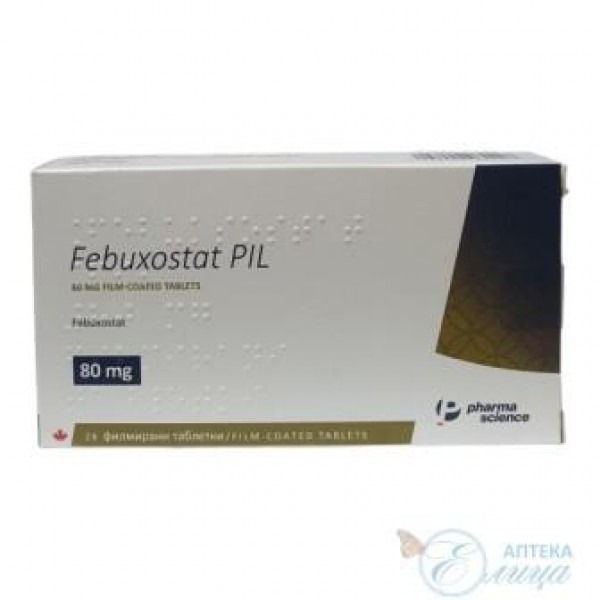
Febuxostat Pil 80 mg. 28 tablets
Product Code: Febuxostat Pil 80 mg. 28 tablets
Availability: In Stock
Product viewed: 205


1. What Febuxostat PIL is and what it is used for
Febuxostat PIL tablets contain the active substance febuxostat and are used to treat gout, which is caused by too much of a chemical called uric acid (urate) in the body. In some people, the amount of uric acid builds up in the blood and can become too high to remain soluble. When this happens, urate crystals can form in or around the joints and kidneys. These crystals can cause sudden, severe pain, redness, warmth and swelling of the joint (known as a gout attack). If left untreated, larger deposits called tophi can form in or around the joints. These tophi can cause damage to the joints and bones.
Febuxostat PIL works by reducing uric acid levels. Keeping uric acid levels low by taking Febuxostat PIL once a day, every day, stops the crystals from forming and over time reduces symptoms. Keeping uric acid levels low enough for a long enough period of time can also reduce the size of tophi.
Febuxostat PIL 120 mg tablets are also used to treat and prevent high levels of uric acid in the blood, which may occur if you start chemotherapy for blood cancers.
When chemotherapy is given, the cancer cells are destroyed and at the same time the levels of uric acid in the blood increase, unless prophylaxis against uric acid formation is used.
Febuxostat PIL is intended for use in adults.
2. What you need to know before you take Febuxostat PIL
Do not take Febuxostat PIL
If you are allergic to febuxostat or any of the other ingredients of this medicine (listed in section 6).
Warnings and precautions
Talk to your doctor before taking Febuxostat PIL:
if you have or have had heart failure, heart problems or a stroke;
if you have or have had kidney disease and/or a serious allergic reaction to allopurinol (a medicine used to treat gout);
if you have or have had liver disease or abnormal liver function tests;
if you are being treated for high uric acid levels as a result of Lesch-Nyhan syndrome (a rare hereditary disease in which there is too much uric acid in the blood);
if you have thyroid problems.
If you experience allergic reactions to Febuxostat PÍL, stop taking this medicine (see also section 4).
Possible symptoms of allergic reactions may include:
rash, including severe forms (e.g. blisters, nodules, peeling rash), itching;
swelling of the limbs or face;
difficulty breathing;
high fever with enlarged lymph nodes;
but also serious life-threatening allergic conditions with cardiac or circulatory arrest.
Your doctor may decide to permanently stop treatment with Febuxostat PIL.
There have been rare reports of potentially life-threatening skin rashes (Stevens-Johnson syndrome) with febuxostat, which appear on the body, starting as red, round spots or patches, often with a central blister. They may also include sores in the mouth, throat, nose, genitals and conjunctivitis (red and swollen eyes). The rash may progress to blistering or peeling of the skin covering large areas. If you develop Stevens-Johnson syndrome with febuxostat, you should never start taking Febuxostat PIL again. If you develop a rash or such skin symptoms, tell your doctor immediately and tell them that you are taking this medicine.
If you are currently having a gout attack (sudden onset of severe pain, tenderness, redness, warmth and swelling of a joint), wait until the gout attack has resolved before you start taking Febuxostat PIL for the first time.
Some people may experience a flare-up when they start taking certain medicines that control uric acid levels. Not everyone gets a flare-up, but you may still get a flare-up even if you are taking Febuxostat PIL, especially in the first weeks or months of treatment. It is important to keep taking Febuxostat PIL even if you have a flare-up, as Febuxostat PIL continues to work to lower uric acid. Over time, gout attacks will occur less frequently and be less painful if you continue to take Febuxostat PIL every day.
Your doctor will often prescribe other medicines if needed to prevent or treat the symptoms of attacks (such as pain and swelling in a joint).
In patients with very high uric acid levels (e.g. those undergoing chemotherapy for malignant disease), treatment with uric acid-lowering drugs may lead to accumulation of xanthines in the urinary tract, with possible stone formation, although this has not been observed in patients treated with f
ebuxostat for tumor lysis syndrome.
Your doctor may ask you to have blood tests to check that your liver is working properly.
Children and adolescents
Do not give this medicine to children under 18 years of age because safety and efficacy have not been established.
Other medicines and Febuxostat PIL
Tell your doctor or pharmacist if you are taking, have recently taken or might take any other medicines, including medicines obtained without a prescription.
It is especially important to tell your doctor or pharmacist if you are taking medicines containing any of the following substances, as they may interact with Febuxostat PIL and your doctor may take the necessary measures:
Mercaptopurine (used to treat cancer)
Azathioprine (used to reduce the immune response)
Theophylline (used to treat asthma).
Pregnancy and breast-feeding
It is not known whether Febuxostat PIL can harm an unborn baby. Febuxostat PIL should not be used during pregnancy. It is not known whether Febuxostat PIL passes into breast milk. You should not take Febuxostat PIL if you are breast-feeding or planning to breast-feed.
If you are pregnant or breast-feeding, think you may be pregnant or are planning to have a baby, ask your doctor or pharmacist for advice before taking this medicine.
Driving and using machines
You should be aware that you may experience dizziness, drowsiness, blurred vision and numbness or tingling sensations during treatment and you should not drive or use machines if affected.
Febuxostat PIL contains sodium
This medicine contains less than 1 mmol sodium (23 mg) per film-coated tablet, i.e. essentially sodium-free.
3. How to take Febuxostat PI?
Always take this medicine exactly as your doctor has told you. If you are not sure, ask your doctor or pharmacist.
The usual dose is one tablet a day.
The tablets should be taken by mouth and can be taken with or without food.
Gout
Febuxostat PIL is available as an 80 mg tablet or a 120 mg tablet. Your doctor will prescribe the most suitable dosage for you.
Continue to take Febuxostat PIL every day, even when you are not experiencing a gout attack or flare-up.
Prevention and treatment of high uric acid levels in patients undergoing chemotherapy for cancer Febuxostat PIL is available as a 120 mg tablet.
Start taking Febuxostat PIL two days before chemotherapy and continue as directed by your doctor. Treatment is usually short-term.
If you take more Febuxostat PIL than you should
In case of accidental overdose, ask your doctor what to do or contact the nearest emergency department.
If you forget to take Febuxostat PIL
If you miss a dose of Febuxostat PIL, take it as soon as you remember, unless it is almost time for your next dose. In this case, skip the missed dose and take the next dose at the usual time. Do not take a double dose to make up for a missed dose.
If you stop taking Febuxostat PIL
Do not stop taking Febuxostat PIL without your doctor's advice, even if you feel better. If you stop taking Febuxostat PIL your uric acid levels may start to rise and your symptoms may get worse, due to the formation of new urate crystals in and around the joints and kidneys.
If you have any further questions on the use of this medicine, ask your doctor or pharmacist.
4. Possible side effects
Like all medicines, this medicine can cause side effects, although not everybody gets them.
Stop taking this medicine and contact your doctor immediately or go to the nearest emergency department if the following rare side effects occur (may affect up to 1 in 1,000 people) as serious allergic reactions may occur:
anaphylactic reactions, drug hypersensitivity (see also section 2. "Warnings and precautions");
potentially life-threatening skin rashes characterised by blistering and peeling of the skin and the inner surface of body cavities, e.g. mouth and genitals, painful ulcers in the mouth and/or genitals, accompanied by high fever, sore throat and tiredness (Stevens-Johnson syndrome/toxic epidermal necrolysis) or with enlarged lymph nodes, enlarged liver, hepatitis (up to liver failure), increased white blood cell count (drug reaction with eosinophilia and systemic symptoms, Dress) (see section 2);
generalised skin rashes.
Common side effects (may affect up to 1 in 10 people) are:
abnormal liver test results;
diarrhoea;
headache;
rash (including different types of rash, please see below under the headings "uncommon" and "common");
nausea;
worsening of gout symptoms;
localised swelling due to fluid retention in the tissues (oedema);
dizziness;
shortness of breath;
itching.
Other side effects not mentioned above are described below.
Uncommon side effects (may affect up to 1 in 100 people) are:
decreased appetite, changes in blood sugar levels (diabetes), symptoms of which may include excessive thirst, increased blood lipid levels, weight gain;
loss of sex drive;
sleep problems, drowsiness;
dizziness, numbness, tingling sensation, reduced or altered sense of touch (hypoesthesia, hemiparesis and paraesthesia), altered taste, reduced sense of smell (hyposmia);
abnormal electrocardiogram, irregular or rapid heartbeat, palpitations;
hot flushes or flushing (e.g. flushing of the face or neck), increased blood pressure, bleeding (haemorrhage, which is only seen in patients undergoing chemotherapy for blood cancers);
cough, shortness of breath, chest pain or discomfort, inflammation of the nasal passages and/or throat (upper respiratory tract infection), bronchitis, lower respiratory tract infection;
dry mouth, abdominal pain/discomfort or gas, upper abdominal pain, heartburn/indigestion, constipation, more frequent bowel movements, vomiting, stomach discomfort;
itchy rash, hives, skin inflammation or discoloration of the skin, small red or purple spots on the skin, small, flat red spots on the skin, flat, red areas of the skin covered with small, confluent bumps, rash, areas of redness and spots on the skin, increased sweating, night sweats, alopecia, redness of the skin (erythema), psoriasis, eczema, other types of skin diseases;
muscle cramps, muscle weakness, muscle/joint pain, bursitis or arthritis (inflammation of the joints usually accompanied by pain, swelling and/or stiffness), pain in the extremities, back pain, muscle spasms, muscle spasms, stiffness in the muscles and/or joints;
blood in the urine, abnormally frequent urination, abnormal urine test results (increased protein in the urine), decreased ability of the kidneys to function properly, urinary tract infection;
chest pain, chest discomfort;
stones in the gallbladder or bile ducts (cholelithiasis);
increased levels of thyroid-stimulating hormone (TSH) in the blood;
changes in blood chemistry or blood cell or platelet counts (abnormal blood test results);
kidney stones;
erectile dysfunction;
decreased thyroid function, blurred vision, vision changes;
ringing in the ears;
runny nose;
mouth ulcers;
inflammation of the pancreas: common symptoms are abdominal pain, nausea and vomiting;
urgent need to urinate;
pain;
feeling unwell;
increased INR;
bruise;
swelling of the lips.
Rare side effects (may affect up to 1 in 1,000 people) are:
muscle damage, a condition which can rarely be serious. This can cause muscle problems and, especially if you feel unwell or have a high temperature at the same time, this may be caused by an unusual breakdown of muscle. Contact your doctor immediately if you experience muscle pain, tenderness or weakness;
severe swelling of the deeper layers of the skin, especially around the eyes, genitals, hands, feet or tongue, with possible sudden difficulty in breathing;
high fever combined with a measles-like skin rash, enlarged lymph nodes, enlarged liver, hepatitis (up to liver failure), increased white blood cell count (leukocytosis with or without eosinophilia);
various types of rash (e.g. with white spots, with blisters, with pus-filled blisters, with peeling skin, rash similar to smallpox), widespread erythema, necrosis, blistering of the epidermis and mucous membranes, leading to peeling and possible sepsis (Stevens-Johnson syndrome/toxic epidermal necrolysis);
nervousness;
feeling thirsty;
decreased weight, increased appetite, uncontrolled loss of appetite (anorexia);
change or decrease in the amount of urine, resulting from inflammation of the kidneys (tubulointerstitial nephritis);
inflammation of the liver (hepatitis);
yellowing of the skin (jaundice);
bladder infection
liver damage;
increased levels of creatine phosphokinase in the blood (as an indicator of muscle damage);
sudden cardiac death;
decreased number of red blood cells (anaemia);
depression;
sleep disturbance;
loss of taste;
burning sensation;
dizziness;
circulatory failure;
lung infection (pneumonia);
mouth sores; inflammation of the oral cavity;
gastrointestinal perforation;
rotator cuff syndrome;
polymyalgia rheumatica;
feeling hot;
sudden loss of vision due to blockage of an artery in the eye.
5. How to store Febuxostat PIL
Keep out of the reach and sight of children.
Do not use this medicine after the expiry date which is stated on the carton and blister foil after "EXP". The expiry date refers to the last day of that month.
This medicine does not require any special storage conditions.
Do not throw away any medicines via wastewater or household waste. Ask your pharmacist how to throw away medicines you no longer use. These measures will help protect the environment,
6. Contents of the pack and other information
What Febuxostat PIL contains
The active substance is febuxostat.
Each tablet contains 80 mg or 120 mg of febuxostat.
The other ingredients are:
Tablet core: microcrystalline cellulose, mannitol (E421), hydroxypropylcellulose, croscarmellose sodium, magnesium stearate, sodium lauryl sulfate, silica, colloidal anhydrous.
Film coating: Oradry II yellow containing: polyvinyl alcohol (E 1203), titanium dioxide (E 171), macrogol 3350, talc (E 553b), yellow iron oxide (E 172), red iron oxide (E 172),
What Febuxostat PIL looks like and contents of the pack
Febuxostat PIL 80 mg film-coated tablets are pale yellow to yellow, capsule-shaped, flat on both sides and marked "F80" on one side.
Febuxostat PIL 120 mg film-coated tablets are pale yellow to yellow, capsule-shaped, flat on both sides and marked "F120" on one side.
The tablets are available in Aluminium/Aluminium or PVC/PE/PVDC blisters, placed in cartons containing 10, 14, 28, 30, 42, 56, 84 and 98 film-coated tablets.
Not all pack sizes may be marketed.
Write a review
Your Name:Your Review: Note: HTML is not translated!
Rating: Bad Good
Enter the code in the box below: