
Your shopping cart is empty!
Welcome visitor you can login or create an account.
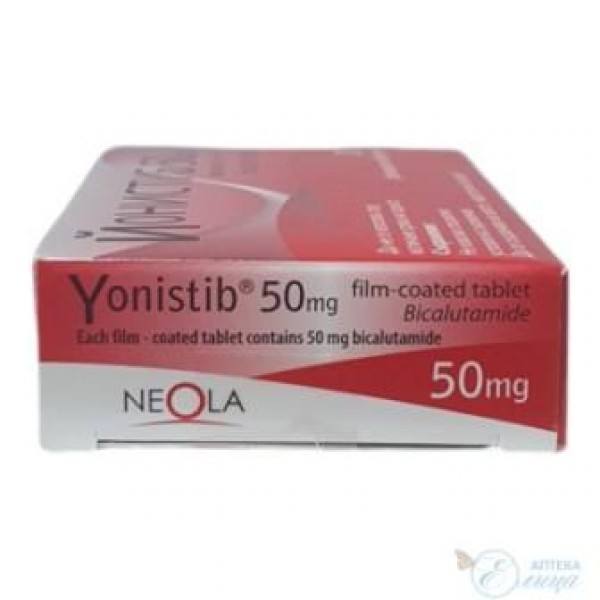
Yonistib 50 mg. 28 tablets
Product Code: Yonistib 50 mg. 28 tablets
Availability: In Stock
Product viewed: 174


1. What Ionistib is and what it is used for
Ionistib is used to treat advanced prostate cancer. It is taken together with a medicine known as a luteinizing hormone-releasing hormone (LHRH) analogue, which lowers the levels of androgens (male sex hormones) in the body or when the testicles are surgically removed. The active ingredient in Ionistib belongs to a group of medicines called non-steroidal anti-androgens. It blocks an unwanted effect of male sex hormones (androgens) and thus suppresses the growth of cells in the prostate.
2. Before you take Ionistib
Do not take Ionistib:
If you are allergic (hypersensitive) to bicalutamide or any of the other ingredients of Ionistib;
If you are taking terfenadine or astemizole (for hay fever or allergies), or cisapride (for stomach problems).
Ionistib should not be taken by women, children and adolescents.
Warnings and precautions
Talk to your doctor or pharmacist before taking Ionistib:
If your liver function is moderately or severely impaired. The medicine should only be taken after your doctor has carefully considered the possible benefits and risks. If this is the case, your doctor will regularly perform laboratory tests of liver function. If severe liver function disorders develop, treatment with Ionistib should be discontinued;
If your kidney function is severely impaired. The medicine should only be taken after your doctor has carefully considered the possible benefits and risks;
If you have a disease of the heart or blood vessels, including heart rhythm problems (arrhythmia) or if you are being treated with medicines for such diseases. The risk of heart rhythm problems may increase with Ionistib. If this is the case, your doctor should regularly monitor your heart function;
If you have diabetes and are already taking an LHRH analogue. Medicines of this type include goserelin, buserelin, leuprorelin and triptorelin.
Other medicines and Ionistib:
Please tell your doctor or pharmacist if you are taking or have recently taken any other medicines, including medicines obtained without a prescription.
Bicalutamide should not be taken with any of the following medicines:
Terfenadine or astemizole (for hay fever or allergies), cisapride (for stomach disorders).
If you take Ionistib with one of the following medicines, its effect, as well as that of the other medicines, may be affected. Please talk to your doctor before taking any of these medicines with Ionistib:
Warfarin or similar medicines to prevent blood clots;
Ciclosporin (used to suppress your immune system to prevent and treat rejection of a transplanted organ or bone marrow);
Calcium channel blockers (used to treat high blood pressure or heart disease);
Cimetidine (used to treat stomach ulcers);
Ketoconazole (used to treat fungal infections of the skin and nails);
Bicalutamide Accord may interact with some medicines used to treat heart rhythm problems (e.g. quinidine, procainamide, amiodarone and sotalol) or may increase the risk of heart rhythm problems when used with some other medicines (e.g. methadone, used for pain relief and as part of drug detoxification), moxifloxacin (an antibiotic), antipsychotics used for serious mental illnesses.
Ionistib with food and drink
Ionistib can be taken before, during or after a meal, but can also be taken without food. The film-coated tablets should be swallowed with some water or other liquid.
Pregnancy and breast-feeding
Ionistib is contraindicated in women and should not be given to pregnant or breast-feeding women.
Driving and using machines
Ionistib is unlikely to adversely affect the ability to drive or use machines. However, some people may occasionally feel dizzy or drowsy after taking Ionistib.
If you still need to drive or use machines, you should do so with caution.
Important information about some of the ingredients of Ionistib
Ionistib contains lactose. If your doctor has told you that you have an intolerance to some sugars, such as lactose, contact your doctor before taking this medicine.
3. How to take Ionistib
Always take Ionistib exactly as your doctor has told you. If you are not sure, ask your doctor or pharmacist.
The usual dose is one film-coated tablet a day. It is best to take the tablet at the same time each day. The tablet should be swallowed with some water or other liquid, without chewing, and can be taken with or without food.
Children and adolescents
This medicine should not be taken by patients under 18 years of age.
If you take more Ionistib than you should
If you take more than the usual dose, contact your doctor. In case of overdose, go to the nearest hospital immediately. If possible,
Take the tablets or the pack with you to show the doctor what you have taken.
If you forget to take Ionistib
If you forget to take your medicine, take your dose as soon as you remember and then take the next dose at the usual time. Do not take a double dose to make up for a forgotten dose. If you are worried, ask your doctor or pharmacist for advice.
If you stop taking Ionistib
Do not stop taking your tablets, even if you feel well, unless your doctor tells you to.
If you have any further questions on the use of this product, ask your doctor or pharmacist.
4. Possible side effects
Like all medicines, Ionistib can cause side effects, although not everybody gets them.
Contact your doctor or seek medical help immediately if you experience any of the following serious side effects:
Uncommon (may affect up to 1 in 100 people):
Severe shortness of breath or sudden worsening of shortness of breath, which may be accompanied by cough or fever. Signs of inflammation of the lungs called interstitial lung disease;
Rash, itchy skin, hives;
Swelling of the face, lips, tongue and/or throat, which may cause difficulty swallowing and breathing problems.
Also tell your doctor immediately if you notice any of the following:
Very common (may affect more than 1 in 10 people):
Stomach pain;
Blood in the urine.
Common (may affect up to 1 in 10 people):
Yellowing of the skin or whites of the eyes (jaundice).
Other possible side effects:
Very common (may affect more than 1 in 10 people):
Low levels of red blood cells (anaemia). This may make you feel tired or look pale;
Dizziness;
Swelling and tenderness of the breasts;
Enlargement of the breasts in men;
Feeling weak;
Hot flushes;
Constipation;
Being sick (nausea);
Swelling (oedema).
Common (may affect up to 1 in 10 people):
Loss of appetite;
Indigestion;
Gas (flatulence);
Weight gain;
Itching;
Dry skin;
Skin rash;
Problems getting an erection (erectile dysfunction);
Reduced sex drive;
Depression;
Sleepiness;
Hair loss;
Hair regrowth or growth of extra hair;
Chest pain;
Reduced heart function;
Heart attack;
Liver toxicity;
Changes in liver enzyme levels.
Sometimes Ionistib can cause changes in the blood, which is why your doctor may ask you to do some blood tests.
Uncommon (may affect up to 1 in 100 people):
Changes in the ECG (prolongation of the QT interval).
5. How to store Ionistib
Keep out of the reach and sight of children.
This medicinal product does not require any special storage conditions.
Do not use Ionistib after the expiry date which is stated on the blister and carton. The expiry date refers to the last day of that month.
Medicines should not be thrown away via wastewater or household waste. Ask your pharmacist how to throw away medicines you no longer use. These measures will help protect the environment.
6. Contents of the pack and other information
What Ionistib contains:
The active substance is: bicalutamide. Each film-coated tablet contains 50 mg bicalutamide.
The other ingredients are:
Tablet core:
Lactose monohydrate;
Povidone K-25;
Sodium starch glycolate Type A;
Magnesium stearate.
Film-coating:
Opadry OY-S-9622, which contains hypromellose 5cp (E464), titanium dioxide (E171) and propylene glycol.
What Ionistib looks like and contents of the pack
Ionistib is supplied as white, round, biconvex film-coated tablets.
The film-coated tablets are packed in blisters and cartons.
Each carton contains 28 film-coated tablets.
Write a review
Your Name:Your Review: Note: HTML is not translated!
Rating: Bad Good
Enter the code in the box below: