
Your shopping cart is empty!
Welcome visitor you can login or create an account.
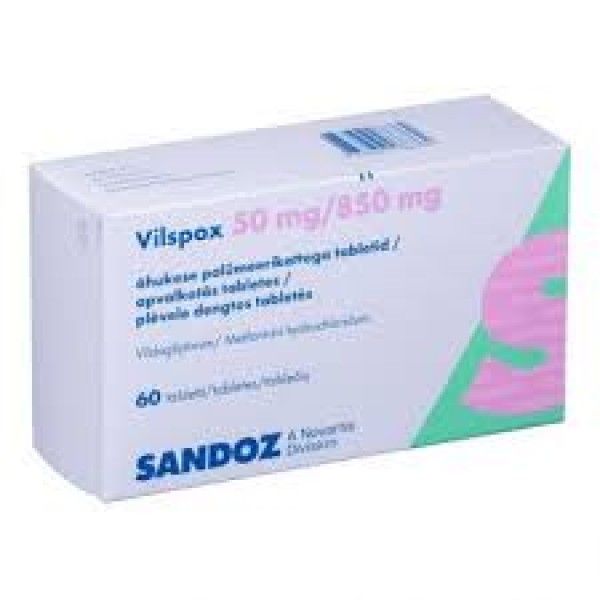
Vilspox 50 mg. / 850 mg. 30 tablets
Product Code: Vilspox 50 mg. / 850 mg. 30 tablets
Availability: In Stock
Product viewed: 1334


What is Vilspox and what it is used for
The active substances in Vilspox, vildagliptin and metformin, belong to a group of medicines called 'oral antidiabetics'.
Vilspox is used to treat adult patients with type 2 diabetes. This type of diabetes is also called non-insulin dependent diabetes mellitus.
Type 2 diabetes develops when the body does not produce enough insulin or if the insulin that the body produces does not work properly. The disease can also develop when the body produces too much glucagon.
Both insulin and glucagon are produced in the pancreas. Insulin helps lower blood sugar levels, especially after meals. Glucagon activates the process of sugar production in the liver, which leads to an increase in blood sugar levels.
How Wilspox works
The two active substances vildagliptin and metformin help control blood sugar levels. The substance vildagliptin works so that the pancreas produces more insulin and less glucagon. The substance metformin works by helping the body make better use of insulin. This medicine has been found to lower blood sugar levels, which can help prevent complications from diabetes.
2. What you need to know before you take Wilspox
Do not take Vilspox
• if you are allergic to vildaglishin, metformin or any of the other ingredients of this medicine (listed in section b). If you think you may be allergic to any of these, talk to your doctor before taking Vilspox.
• if you have uncontrolled diabetes, such as severe hyperglycaemia (high blood sugar), nausea, vomiting, diarrhea, rapid weight loss, lactic acidosis (see “Risk of lactic acidosis” below) or ketoacidosis. Ketoacidosis is a condition in which substances called 'ketone bodies' accumulate in the blood and this can lead to diabetic overeating. Symptoms include stomach pain, rapid and deep breathing, drowsiness, or an unusual fruity odor on your breath.
• if you have had a heart attack or if you have heart failure or serious circulatory problems or difficulty breathing, which may be a sign of heart problems.
• if you have severely reduced kidney function.
• if you have a severe infection or severe dehydration (you have lost a lot of water from your body).
• if you are about to have a contrast X-ray (a specific type of X-ray that involves injecting a contrast agent). Please also see the information on this in the "Warnings and precautions" section.
• if you have liver problems.
• if you drink too much alcohol (every day or periodically).
• if you are breast-feeding (see also “Pregnancy and breast-feeding”).
Warnings and precautions Risk of lactic acidosis
Vilspox can cause a very rare but very serious side effect called lactic acidosis, especially if your kidney function is not normal. The risk of developing lactic acidosis is also increased in uncontrolled diabetes, severe infections, prolonged fasting or alcohol consumption, dehydration (see more information below), liver problems and any condition in which part of the body has a reduced oxygen supply. (as an acute severe heart disease).
If any of the above apply to you, talk to your doctor for further instructions.
Stop taking Vilspox briefly if you have a condition that may be associated with dehydration (significant loss of body fluids), such as severe vomiting, diarrhea, fever, heat exposure, or if you drink less fluids than normal. Talk to your doctor for further instructions.
Stop taking Vilspox and contact a doctor or nearest hospital immediately if you have any of the symptoms of lactic acidosis, as this condition can lead to coma.
Symptoms of lactic acidosis include:
• vomiting
• stomach pain (abdominal pain)
• muscle spasms
• general malaise accompanied by severe fatigue
• difficulty breathing
• low body temperature and heart rate
Lactic acidosis is a condition that requires urgent medical attention and must be treated in a hospital.
Vilspox does not replace insulin. Therefore, Vilspox should not be used to treat type 1 diabetes.
Talk to your doctor or pharmacist before taking Vilspox if you have or have had pancreatic disease.
Talk to your doctor or pharmacist before taking Vilspox if you are also taking a sulphonylurea antidiabetic medicine. Your doctor may decide to reduce the dose of the sulphonylurea when you take it at the same time as Vilspox to avoid the risk of low blood sugar (hypoglycaemia).
You should not take this medicine if you have taken vildagliptin but have had to stop taking it due to liver disease.
Diabetic skin wounds are a common complication
Other medicines and Vilspox
If you need to be injected with an iodine-containing contrast agent into your bloodstream, for example to have an X-ray or a scan, you must stop taking Vilspox before or during the injection. Your doctor will decide when you should stop and when to resume treatment with Vilspox.
Tell your doctor if you are taking, have recently taken or might take any other medicines. You may need to have your blood sugar and kidney function checked more often or your doctor may adjust your dose of Vilspox. It is extremely important to mention the following:
• glucocorticoids, which are mainly used to treat inflammation;
• beta-2 agonists, which are mainly used to treat respiratory diseases;
• other medicines used to treat diabetes,
• medicines that increase urine output (diuretics);
• medicines used to treat pain and inflammation (NSAIDs and COX-2 inhibitors, such as ibuprofen and celecoxib);
• certain medicines to treat high blood pressure (ACE inhibitors and angiotensin II receptor antagonists);
• certain medicines that act on the thyroid gland, or;
• certain medicines that act on the nervous system.
Wilspox with alcohol
Avoid excessive alcohol consumption while taking Vilspox, as this may increase the risk of lactic acidosis (see section “Warnings and precautions”).
Pregnancy and lactation
• If you are pregnant, think you may be pregnant or are planning to have a baby, talk to your doctor before taking this medicine. Your doctor will discuss with you the possible risk of taking Vilspox during pregnancy.
• Do not use Vilspox if you are pregnant or breast-feeding (see also “Do not take Vilspox”).
Ask your doctor or pharmacist for advice before taking any medicine.
Driving and using machines
If you feel dizzy while taking Vilspox, do not drive or use any tools or machines.
3. How to take Vilspox
The amount of Vilspox to be taken is different and depends on the condition of each patient. Your doctor will tell you exactly what dose of Vilspox you should take.
Always take this medicine exactly as your doctor has told you. If you are not sure, talk to your doctor or pharmacist.
The recommended dose is one 50 mg / 850 mg or 50 mg / 1000 mg film-coated tablet taken twice a day.
If you have reduced kidney function, your doctor may prescribe a lower dose. Also, if you are taking a sulphonylurea antidiabetic medicine, your doctor may prescribe a lower dose.
Your doctor may prescribe this medicine on its own or with certain other medicines that lower your blood sugar.
When and how to take Vilspox
• Swallow the tablet whole with a glass of water,
• Take one tablet in the morning and evening, during or immediately after a meal. Taking the tablet immediately after a meal will reduce the risk of stomach irritation.
Continue to follow any advice regarding the diet prescribed by your doctor. Especially if you are on a diabetes weight control diet, continue to follow it while taking Vilspox.
If you take more Vilspox than you should
If you take too many Vilspox tablets, or if someone else takes your tablets, contact your doctor or pharmacist immediately. You may need medical attention. Take the pack and this leaflet with you if you need to see a doctor or go to the hospital.
If you forget to take Vilspox
If you forget to take a tablet, take it with your next meal, unless you need to take the next tablet. Do not take a double dose (two tablets at a time) to make up for a forgotten tablet.
If you stop taking Vilspox
Continue to take this medicine for as long as your doctor prescribes it to keep your blood sugar level under control. Do not stop taking Vilspox unless your doctor tells you to. If you have any questions about how long you should take this medicine, talk to your doctor.
If you have any further questions on the use of this medicine, ask your doctor or pharmacist.
4, Possible side effects
Like all medicines, this medicine can cause side effects, although not everybody gets them.
You should stop taking Vilspox and contact your doctor immediately if you get the following side effects:
• Lactic acidosis (very rare: may affect up to 1 user in 10,000):
Vilspox can cause a very rare but very serious side effect called lactic acidosis (see section “Warnings and precautions”). If this happens, you should stop taking Vilspox and consult a doctor immediately or go to the nearest hospital, as lactic acidosis can lead to coma.
5. How to store Vilspox
Keep out of reach of children.
Do not use this medicine after the expiry date which is stated on the blister and the carton after EXP. The expiry date refers to the last day of that month.
Store below 30 ° C.
Store in the original package in order to protect from moisture.
Do not throw away any medicines via wastewater or household waste. Ask your pharmacist how to dispose of medicines no longer required. These measures will help to protect the environment.
6. Contents of the pack and other information
What Vilspox contains
- The active substances are vildagliptin and metformin hydrochloride.
Vilspox 50 mg / 850 mg film-coated tablets
Each film-coated tablet contains 50 mg vildagliptin and 850 mg metformin hydrochloride (corresponding to 660 mg metformin).
Vilspox 50 mg / 1000 mg film-coated tablets
Each film-coated tablet contains 50 mg vildagliptin and 1000 mg metformin hydrochloride (corresponding to 780 mg metformin).
- The other ingredients: hydroxypropylcellulose, magnesium stearate, hypromellose 2910 3cP, titanium dioxide (E 171), yellow iron oxide (E 172), macrogol 4000 and talc.
What Vilspox looks like and contents of the pack
Vilspox 50 mg / 850 mg film-coated tablets
Yellow, elliptical film-coated tablet with bevelled edges, engraved with “NVR” on one side and “SEH” on the other.
Length: approx. 20.1 mm Width: approx. 8.0 mm
Vilspox 50 mg / 1000 mg film-coated tablets
Dark yellow, elliptical film-coated tablet with bevelled edges, engraved with "NVR" on one side and "FLO" on the other side.
Length: approx. 21.1 mm Width: approx. 8.4 mm
Vilspox is packaged in aluminum / aluminum blisters (PA / Alu / PVC // Alu) or in polychlorotrifluoroethylene (PCTFE) / PVC // Alu blisters
It is available in packs containing 30 or 60 film-coated tablets.
Not all pack sizes and tablets may be marketed.
Write a review
Your Name:Your Review: Note: HTML is not translated!
Rating: Bad Good
Enter the code in the box below:
Related Products
EUCREAS. 50 mg. / 850 mg. 60 tablets Eucreas is used to trea..
69.00€
What Synjardy is and what it is used for
Synjardy is a medi..
69.00€
What DALTEX is and what it is used for
The active substan..
53.00€
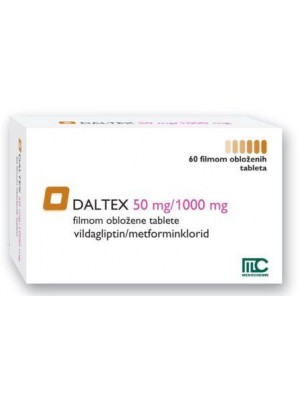
What DALTEX is and what it is used for
The active substan..
46.00€