Your shopping cart is empty!
Welcome visitor you can login or create an account.
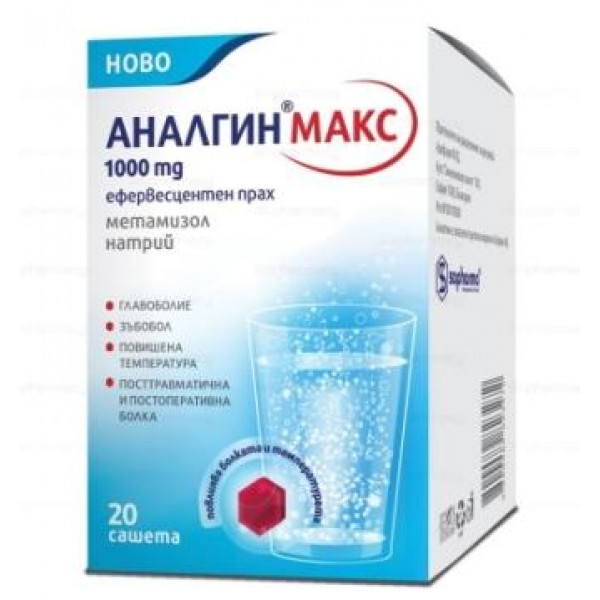
Analgin Max 1000 mg. 20 sachets
Product Code: Analgin Max 1000 mg. 20 sachets
Availability: In Stock
Product viewed: 5074


If this medicine is not prescribed by a doctor, its use as an analgesic agent should not exceed 5 days, and for a fall in temperature of 3 days.
If you take more Alginine Max than you should
In case of overdosage, contact a doctor for help.
If you forget to take Analgin Max
Do not take a double dose to make up for the missed dose.
If you have any further questions on the use of this medicine, ask your doctor or pharmacist.
4. Possible side effects
Like all medicines, this medicine can cause side effects, although not everyone gets them.
The frequency listed below is the frequency with which adverse reactions were reported.
Uncommon (occurring in less than 1 in every 100 patients):
itching, skin rash (violet to dark red rash, sometimes accompanied by blistering);
a decrease in blood pressure whose manifestations are increased heartbeat, pallor, sweating, trembling, dizziness, nausea, loss of consciousness. The risk of a significant drop in blood pressure increases at a very high temperature.
Rare (occurring in less than 1 in every 1,000 patients):
skin rashes, severe allergic reactions that may occur with swelling of the face, tongue or throat, shortness of breath and wheezing in the chest, drop in blood pressure;
decreased white blood cell count, which increases the likelihood of infection, punctual bleeding on the skin and mucous membranes, reduced red blood cell counts, which may lead to pallor, weakness or shortness of breath;
seizures after high doses.
Very rare (occurring in less than 1 patient in every 10,000 patients):
a significant reduction in white blood cell count and associated decrease in resistance to infections;
a significant reduction in platelet count (platelet), which increases the risk of bleeding or bruising;
severe skin injuries and reactions, e.g. blistering of the skin of the hands, feet and feet, less often on the lips, face and genitals;
asthma attack (shortness of breath and chest tightness);
impaired kidney function, urinary protein, decreased urine output;
increases in bilirubin values in the blood.
Not known (can not be estimated from available data):
nausea, vomiting, decreased appetite;
dizziness;
rapid heartbeat, bloating of the fingers, nose, lips, mucous membranes;
jaundice.
When taken at high doses, Analgin Max may cause dizziness, dizziness, and headache, which may adversely affect attention and disturb reactions in unexpected situations.
If any of the side effects gets serious, or if you notice any side effects not listed in this leaflet, please tell your doctor or pharmacist.
How to Store Analgin Max
Store below 25 ° C.
Keep out of the reach and sight of children.
Do not use this medicine after the expiry date which is stated on the sachet. The expiry date refers to the last day of that month.
Do not dispose of medicines in the sewer or in the household waste container. Ask your pharmacist how to dispose of medicines you no longer use. These measures will help to protect the environment.
6. Package Contents and Additional Information
What contains Analgin Max
The active substance in 1 sachet is: metamizole sodium 1000 mg.
The other ingredients are sucrose (compressible), anhydrous citric acid, anhydrous sodium carbonate, anhydrous magnesium citrate, sodium cyclamate (E952), saccharin sodium (E954), colloidal anhydrous silica, lemon flavor and maltodextrin).
What Analgin Max looks like and what the package contains
White or almost white effervescent powder with lemon smell.
Powder for oral solution 3.0 g in a sachet of paper / aluminum / polyethylene.
One pack contains 6, 10 or 20 sachets.
Write a review
Your Name:Your Review: Note: HTML is not translated!
Rating: Bad Good
Enter the code in the box below:
Related Products
ANALGIN 500 mg drops. / Ml. 20 ml. WHAT ANALGIN oral drops ..
15.00€