
Your shopping cart is empty!
Welcome visitor you can login or create an account.
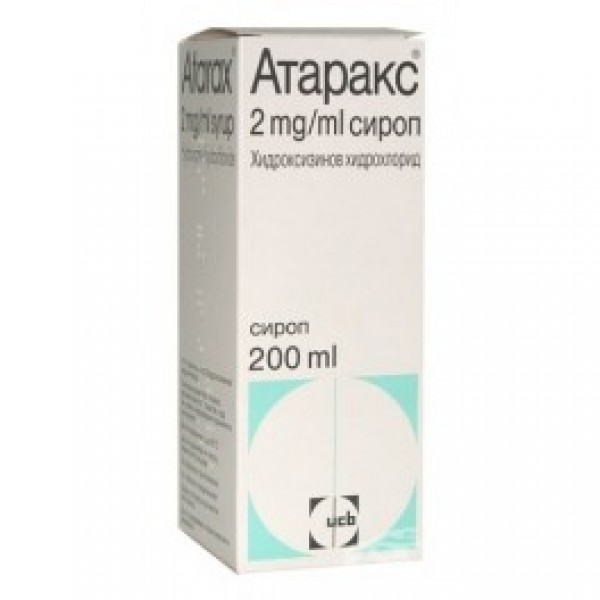
Atarax syrup 200 ml.
Product Code: Atarax syrup 200 ml.
Availability: In Stock
Product viewed: 2135


Atarax syrup 200 ml.
Qualitative and quantitative composition
1 ml ATARAX syrup contains 2 mg hydroxyzine dihydrochloride.
For excipients, see section 6.1.
3. Formulation
Syrup: clear, colorless solution
4. Clinical data:
4.1. Indications ATARAX is indicated for:
- Symptomatic treatment of anxiety in adults;
- Symptomatic treatment of pruritus;
- Premedication in surgery.
4.2. Dosage and method of administration
Age:
- For the symptomatic treatment of anxiety:
50 mg daily in three divided doses, respectively 12,5 -12,5 -25 mg, which is equal to ml 6,25 ml - 6,25 ml -12,5 ml with no-severe cases can be applied to 300 mg daily, i.e. 150 ml of
- For the symptomatic treatment of pruritus:
Beginning with an initial dose of 25 mg ie 12,5 ml bedtime if needed and may be continued with a dose 25 mg of 12,5 ml, ie 3 to 4 times daily.
- For premedication before surgery:
50 to 200 mg, ie 25 to 100 ml per day, administered in single or 2 divided doses: single dose 1 hour before surgery and may also be appointed as a single dose in the evening before anesthesia.
The maximum single dose in adults should not exceed 200 mg (or 100 ml of syrup), while a daily dose should not be higher than 300 mg (or 150 ml of syrup).
Children (12 months old):
- For the symptomatic treatment of pruritus:
12 months to 6 years: 1 mg / kg per day to 2.5 mg / kg daily, in the form of divided doses, i.e., in ml 0,5 ml / kg in 1,25 ml / kg from 6: 1 mg / kg per day to 2 mg / kg daily, ie in ml 0,5 ml / kg at 1 ml / kg, taken as divided doses;
- For premedication before surgery:
A single dose of 1 mg / kg i.e. in ml 0,5 ml / kg 1 hour prior to surgery, or 1 mg / kg in the evening, before anesthesia.
Determination of the dose:
The dose should be individualized within the recommended dosing regimen and depending on the patient's response to treatment.
In elderly patients starting treatment with half the recommended dose, due to the prolonged action of the product.
In patients with hepatic dysfunction dose reduction by 33%.
The dose should be reduced in patients with moderate to severe renal impairment due to decreased excretion of the metabolite cetirizine.
4.3. Contraindications
- Known hypersensitivity to any component of ATARAX, to cetirizine, other piperazine derivatives, to aminophylline or ethylenediamine.
- Patients with porphyria.
- Pregnancy and lactation (see section 4.6).
- Intra-arterilnoto or subcutaneous ATARAX injection is contraindicated.
4.4.Spetsialni warnings and special precautions for use
ATARAX should be used with caution in patients at potential risk of convulsions.
Young children are more prone to adverse effects associated with the central nervous system (see section 4.8). In children convulsions occur more frequently than adults.
Due to its potential anticholinergic effects, ATARAX should be used with caution in patients with glaucoma, bladder outflow obstruction, decreased gastrointestinal motility, myasthenia gravis or dementia.
There is a need for dose adjustment in case of concomitant ATARAX other means, central nervous system depressants or drugs having anticholinergic properties (see section 4.5).
Should avoid concomitant use of alcohol and ATARAX (see section 4.5). Caution should be exercised in patients with known susceptibility to cardiac arrhythmia or those concomitantly treated with arrhythmogenic agents. In elderly patients, it is recommended initiating therapy with half of the dose is usually due to prolonged action of the product. ATARAX dose should be reduced in patients with impaired hepatic function or those with moderate to severe renal impairment (see section 4.2).
ATARAX therapy should be discontinued 5 days before allergy testing or methacholine bronchial challenge in order to avoid impact on results.
4.5. Interactions
Potentiate ATARAX should be considered when co-administered with CNS depressant agents, or those with antiholinerhichni UV, the dose should be individualized. Alcohol also potentiates the effects of ATARAX.
ATARAX antagonize the action of betahistine and anticholinesterase agents. ATARAX therapy should be discontinued 5 days before allergy testing or methacholine bronchial challenge in order to avoid impact on results.
Must be avoided and concomitant use of MAO inhibitors ATARAX.
ATARAX counteract pressor effect of epinephrine.
Hydroxyzine antagonizes anticonvulsant activity of phenytoin in rats.
Cimetidine 600 mg, twice a day reduced serum concentrations of hydroxyzine 36% and increased the peak concentrations of the metabolite, cetirizine 20%.
ATARAX an inhibitor of cytochrome P450 2D6 (Ki: 3.9 uM; 1.7jig/ml) and at high doses can lead to interactions with substrates of CYP2D6. At 100 uM ATARAX no inhibitory effect on 1A1 and 1A6 isoforms of UDP-glucuronyl transferase in hepatic microsomes of human. It inhibits cytochrome P450 2S9/S10, 2C19 and ZA4 isoforms at a concentration (IC50: 19 to 140 uM; 7do 52 jig / ml) than the peak plasma concentrations. Metabolite cetirizine no inhibitory effect on human liver cytochrome P450 (1A2, 2A6, 2S9/S10, 2C19, 2D6, 2E1 and ZA4) and isoforms of UDP-glucuronyl transferase. Therefore, ATARAX does not affect the metabolism of drugs that are substrates of these enzymes.
Since hydroxyzine is metabolized in the liver, the increase of blood concentrations of hydroxyzine can be monitored by co-administration with other drugs that are known to be potent inhibitors of liver enzymes.
4.6. Pregnancy and lactation
Studies in animals have shown reproductive toxicity.
Hydroxyzine and cross the placenta resulting in fetal concentrations higher than those in the mother.
To date, no relevant epidemiological data from the application of ATARAX pregnancies. In newborns whose mothers took ATARAX in the last stages of pregnancy and / or during labor, the following adverse reactions (immediately or several hours after birth): hypotension, movement disorders including extrapyramidal disorder, clonic seizures, suppression CNS neonatal hypoxic conditions or urinary retention.
Therefore, ATARAX "should not be used during pregnancy.
ATARAX is contraindicated in breastfeeding. If treatment is required ATARAX, then breastfeeding should be stopped.
4.7. Effects on ability to drive and use machines
ATARAX can disrupt reactivity and concentration. Patients should be warned of this possibility and be advised not to drive or operate machinery while taking the drug.
Coadministration of ATARAX with alcohol or other sedative agents, should be avoided due to the strengthening of those effects.
4.8 Undesirable effects
Adverse events were primarily related to CNS depression or paradoxical stimulation anticholinergic activity or hypersensitivity reactions.
By MedDRA the following adverse effects:
Cardiac disorders:
tachycardia NOS
Visual disturbances:
Interference akomudatsiyata, blurred vision
Gastrointestinal disorders:
Constipation, dry mouth, nausea, vomiting NOS
General disorders:
Fatigue, malaise, pyrexia NOS
Immune system disorders:
Anaphylactic shock, hypersensitivity NOS
Functional tests:
Changes in liver function tests
Nervous system disorders:
Convulsions, dizziness, dyskinesia, headache, insomnia, sedation, somnolence, tremor
Psychiatric disorders:
Agitation, confusion, disorientation, hallucinations NOS
Renal impairment:
Urinary retention
Respiratory, thoracic and mediastinal disorders:
bronchospasm
Distortions of the skin and subcutaneous tissue
Angioneurotic edema, dermatitis, pruritus, and erythematous maculopapular rash, increased sweating, urticaria.
Vascular disorders:
hypotension
4.9. overdose
Symptoms observed after severe overdosage are primarily related to excessive anticholinergic effects, suppression or paradoxical CNS stimulation. They include nausea, vomiting, tachycardia, pyrexia, somnolence, abnormal pupillary reflexes, tremor, confusion and hallucinations. They can be followed by disturbances in consciousness, respiratory depression, convulsions, hypotension or cardiac arrhythmia. May be followed by coma and cardiorespiratory collapse.
Strict control of the airway, breathing and circulatory status, continuous ECG recording, as well as providing the necessary oxygen. It is the monitoring of the cardiac function and the blood pressure and for a period of 24 hours after the passage of the symptoms of an overdose. Patients with altered mental status should be examined for possible concomitant use of other drugs or alcohol and need to receive oxygen, naloxone, glucose and thiamine.
In need of vasopressin or norepinephrine is administered metaraminol, and should not be used epinephrine.
Syrup of ipecac (a South American plant that is made into a laxative) should be used in symptomatic patients or in those where they could occur quickly confusion, coma or convulsions because of the potential to lead to aspiration pneumonitis.
In clinically significant overdose, gastric lavage is done with prior endotracheal intubation. Can be applied and activated charcoal, but data on its effectiveness in this case are scarce.
Place into question the usefulness of hemodialysis or hemoperfusion.
There is no specific antidote.
Literature data show that in the presence of severe, life-threatening, less responsive than other drugs, anticholinergic effects, application of fiziostigmin may be useful.
Fiziostigmin must not only be used to maintain the patient's awake. The co-administration of cyclic antidepressants, the use of fiziostigmin can precipitate seizures and less responsive cardiac arrest. Fiziostigmin should be avoided in patients with impaired cardiac conduction.
5. Pharmacological data:
5.1.Farmakodinamichni properties
Pharmacotherapeutic group:
ATARAX is psycholeptic and anxiolytic (ataraktik) ATC code: N05B B01.
The drug substance is hydroxyzine dihydrochloride diphenylmethane derivative and differs chemically from phenothiazines, reserpine, meprobamate and the benzodiazepines.
Mechanism of action
Hydroxyzine dihydrochloride not cortical depressant, and the effect is manifested by inhibiting the activity of the corresponding key (key) subcortical areas of the central nervous system.
Pharmacodynamic effects
Antihistaminic effect and bronchodilator activity have been demonstrated experimentally and confirmed clinically. Antiemetic effect is established, both apomorphine and with veriloidniyat test. Pharmacological and clinical studies have shown that at therapeutic doses hydroxyzine does not increase the gastric secretion and acidity, as in most cases shows weak antisecretory activity. In healthy adult volunteers and children and decreases in circles and redness after intradermal injection of histamine or antigens. Hydroxyzine has been demonstrated to be effective in relieving pruritus in various forms of urticaria, eczema and dermatitis.
In liver dysfunction antihistaminic effect can be extended up to 96 hours after administration of a single dose.
EEG recordings in healthy volunteers show his aksiolitichno-sedative profile. Aksiolitichniyat effect has been confirmed in patients by administration of the various classic psychometric tests. Polysomnographic recordings for anxiety and insomnichni patients demonstrate increasing total sleep time, reducing the total time of nocturnal awakening and reduce sleep latency after both single and after repeated daily doses of 50 mg. Reduction in muscle tension were observed in anxious patients at a daily dose of 3 x 50 mg. There were no memory. There were no signs of habituation and after 4 weeks of treatment for anxiety patients.
Onset of action
Antihistaminic effect occurs approximately 1 hour after administration of oral forms. The sedative effect upon the syrup occurs after 5-10 minutes, and when the tablets respectively 30-45 minutes.
Hydroxyzine also has antispasmodic and sympatholytic action. It has a low affinity for muscarinic receptors, and exhibit weak analgesic activity.
5.2.Farmakokinetichni properties
absorption
Hydroxyzine is rapidly absorbed through the gastrointestinal tract. Peak plasma level (Cmax) are reached approximately 2 hours after oral administration. Following single oral doses of 25 mg and 50 mg to adults, peak concentrations were respectively 30 ng / ml and 70 ng / ml. The rate and extent of absorption of hydroxyzine similar in tablet or syrup. After repeated once daily tacrolimus concentrations increased by 30%. Bioavailability of hydroxyzine when oral administration is about 80% with respect to that observed with intramuscular (IM) administration. Following IM administration of a single dose of 50 mg, peak plasma concentrations are typically 65 ng / ml.
distribution
Hydroxyzine is distributed throughout the body, but higher concentrations have been observed in the tissues compared to the plasma. The volume of distribution in adults is from 7 to 16 l / kg. After oral administration, hydroxyzine passes into the skin, where its concentration is higher than the plasma, and after both single and multiple applications. Hydroxyzine crosses the blood-brain and the placental barrier, leading to a higher concentration in the fruit, compared with those in the mother.
metabolism
Hydroxyzine is extensively metabolised. The major metabolic pathways leading to the formation of the carboxylic acid metabolite, cetirizine (45% of the oral dose). This metabolite has significant peripheral Hi-antagonistic properties. It also identified a number of other metabolites, including the O-dealkylated metabolite of plasma half-life 59 hours.
elimination
The half-life in adults is about 14 hours (from 7 to 20 hours). Total clearance determined in these studies was 13 ml / min / kg. Only 0.8% of the dose is excreted in the urine unchanged. The main metabolite cetirizine is mainly excreted unchanged in urine (25 and 16% respectively of the oral and IM dose hydroxyzine).
Special groups:
Elderly
We examined the pharmacokinetics of hydroxyzine on 9 healthy elderly individuals (69.5 ± 3.7 years), following oral administration of a single dose of 0.7 mg / kg. The half-life was extended to 29 hours, and the estimated volume of distribution increased to 22.5 l / kg. A reduction in the daily dose of hydroxyzine in the elderly (see section 4.2).
children
Pharmacokinetics of hydroxyzine were evaluated in 12 children (6.1 ± 4.6 years, and 22.0 ± 12.0 kg) and after oral administration of a single dose of 0.7 mg / kg. Plasma clearance is approximately 2.5 times that of adults. The half-life is shorter than the no-in adults. It is about 4 hours for the annual group patients and 11 hours, for the group of patients of 14 years of age. There is a need for dosage adjustment in children (see section 4.2).
hepatic impairment
In patients with hepatic dysfunction, secondary or primary biliary cirrhosis, total clearance is approximately 60% of that observed in patients without such a breach. The half-life was increased to 37 hours, and the serum concentration of the carboxylic metabolite cetirizine are higher than those in young patients with normal liver function. Daily dosage or frequency of administration should be reduced in patients with impaired hepatic function (see section 4.2).
renal impairment
Farmakinetikata of hydroxyzine was evaluated in 8 patients with severe renal impairment (creatinine clearance 24 ± 7 mil / min). The degree of distribution (AUC) of hydroxyzine is not changed, while that of the carboxylic metabolite; cetirizine is increased. This metabolite is not effectively removed by hemodialysis. In order to avoid significant accumulation of the metabolite cetirizine after repeated administration of hydroxyzine, the daily dose of hydroxyzine in patients with impaired renal function should be reduced.
5.3.Predklinichni safety data
Studies on acute, subacute and chronic toxicity studies have shown no alarming results in rodents, dogs and monkeys. LD50 for rats and mice, respectively 690 and 550 mg / kg p.o. and 81 and 56 mg / kg i.v.
Single oral doses of 100 mg / kg to induce signs of depression, ataxia, tremor, convulsions and in dogs. In monkeys receiving oral doses of 50 mg / kg was observed vomiting, while intravenous doses of 15 mg / kg induce convulsions. Intra-arterial injections result in significant tissue lesions in rabbits.
Subacute toxicity was investigated in dogs in a dose of 50 mg / kg and results in nausea, tremor and convulsions. Rats survived 30 days of oral hydroxyzine 200 mg / kg / day.
Chronic toxicity was studied in rats at oral doses up to 50 mg / kg without signs of histopathological abnormalities.
Write a review
Your Name:Your Review: Note: HTML is not translated!
Rating: Bad Good
Enter the code in the box below:
Related Products
Atarax 100 mg. 2 ml. 6 ampoulesHow it works and what it is u..
27.00€