
Your shopping cart is empty!
Welcome visitor you can login or create an account.
Augmentin ES suspension. 600 mg. / 5 ml. 100 ml.
Product Code: Augmentin ES suspension. 600 mg. / 5 ml. 100 ml.
Availability: In Stock

Product viewed: 1561


Augmentin ES suspension. 600 mg. / 5 ml. 100 ml.

What is Augmentin ES and what it is used
Augmentin ES is an antibiotic , which comprises two active substances: amoxicillin in the form of amoxycillin trihydrate and clavulanic acid in the form of potassium clavulanate. After reconstitution of the powder according to the instructions each 5 ml . Augmentin ES suspension contains 600 mg of amoxicillin and 42.9 mg clavulanic acid .
Augmentin ES contains the following inactive ingredients : xanthan gum , silica , colloidal silica , sodium carboxymethylcellulose , strawberry flavor and aspartame , a source of phenylalanine.
Augmentin ES is in powder form and after dissolution to give a liquid suspension .
Augmentin ES is used to treat infections caused by other species of bacteria , and in children over 3 months of age.
Before you start taking Augmentin ES
Your child should not take this medicine :
• If you are allergic to amoxicillin or beta -lactam antibiotics ( penicillins and
cephalosporins ) or any of the other ingredients of Augmentin ES. If your child has experienced an allergic reaction (eg rash) after taking an antibiotic , you should tell your doctor before taking Augmentin ES.
• If there was jaundice ( yellowing of the skin and / or eyes) or liver disease occurring during treatment with Augmentin .
Take special care and talk with your doctor :
• If during treatment with Augmentin ES your child has a skin rash , stop taking the medicine and tell your doctor.
• If your child suffers from a disease infectious mononucleosis (viral illness with fever, swollen and painful lymph nodes, and in some cases sore throat and enlarged liver ) and is prescribed Augmentin ES. Before you start taking the medication you should consult with your doctor .
• If your child has kidney or liver , do not start taking the drug before you doctor to doctor. You may need to change your dose or prescribe a different medicine.
• Tell your doctor if your child has a condition called phenylketonuria. Augmentin ES contains aspartame , a source of phenylalanine.
If your child is taking birth control tablets , believed to be pregnant or breastfeeding , you should tell doctor before taking Augmentin ES.
interactions
Some medications can cause side effects if taken together with Augmentin ES. Please tell your doctor if your child is taking or has recently taken any other medicines or dietary supplements , even those bought without a prescription.
It is vital that your doctor know if your child has any of the following :
♦ Allopurinol
♦ Probenecid
How should I take Augmentin ES
Follow your doctor's instructions on how and when to take the medicine.
The doctor will decide the daily dose suspension that your child should receive and for how long .
If you have any questions about the drug and dose him talk to your doctor .
Augmentin ES is recommended to be taken during the meal , but the drug exerts its effects in cases where it is adopted on an empty stomach.
Every time make sure that the child has swallowed the entire dose of the drug .
INSTRUCTIONS FOR USE
Instructions for Augmentin ES oral suspension :
1. Shake the bottle well until the powder inside begins to move freely.
2 . To prepare 100 ml of slurry to the powder was added to two parts water .
3 . Add about 2/3 of the water to prepare the slurry . The bottle is sealed with a lid and shake vigorously .
4 . Add remaining water to line marked the tip of the arrow on the bottle label .
5 . The bottle was again sealed with a cap and shaken vigorously .
Instructions for use of the suspension after reconstitution
Bottle of reconstituted suspension should be shaken vigorously before each dose. Before taking use the measuring spoon provided in the package to measure dose as prescribed . Upon filling of the spoon to the 5 ml mark on , the spoon contains 5 ml suspension , which corresponds to 600 mg of amoxicillin in the form of amoxycillin trihydrate and 42.9 mg of clavulanic acid in the form of potassium clavulanate.
After she began taking Augmentin ES
Do not stop taking your medication before completing the full course of treatment even if your child feels better.
What to do if your child takes more than prescribed
If your child has received a large amount of Augmentin ES suspension of the appropriate dose by your doctor , give him to drink plenty of water and tell your doctor .
What to do if your child misses intake
If you forget to give your child a dose of Augmentin ES, give it to him as soon as you remember. Then carry on as before , but do not give your child two doses one after another within one hour.
POSSIBLE SIDE EFFECTS
Most patients have no problems when taking Augmentin ES. However , like all medicines, Augmentin ES can cause adverse effects , and some people may be allergic to the drug.
Below are listed a very rare side effects occur in less than 1 in 10,000 patients taking Augmentin ES:
• Shortness of breath, sudden wheezing or chest tightness.
• Swelling of the face , lips, tongue or other parts of the body.
• Sudden feeling of weakness , especially when standing . Convulsions (fits or seizures) .
• Yellowing of the skin and / or eyes, or dark-colored urine . These symptoms may be accompanied by itching , fever, nausea , vomiting , loss of appetite and general ill health . These symptoms may occur several weeks after the end of treatment and to be very heavy .
• Blood in the urine, which may be accompanied by a rash , fever, joint pain or reduce the secretion of fluids ( urination) .
• severe diarrhea , which may be bloody or contain mucus , and which may be accompanied by abdominal cramps .
• Rash blistering , which may lead to peeling, flaking or bleeding of the skin.
• unusual tiredness , headache , shortness of breath during physical exertion , dizziness , pallor , and yellowing of the skin and / or eyes.
Tell your doctor if you notice any of these symptoms.
Below are listed a very rare side effects that occur in less than 1 in 10,000 patients taking Augmentin ES:
• Fever, severe chills , sore throat or mouth ulcers. Unusual joint pain , especially if accompanied by a rash.
• Change the color of the tongue - to yellow , brown or black color
Below are listed common side effects that may occur in 1 in 1000 and 1 in every 10,000 patients taking Augmentin ES:
• bleeding or bruising ( bruises) more easily than usual.
• Rash, in which buds (usually ranging from 0.5 cm to 2 cm) have a pink / red ring around the edge and darker center.
Below listed are not common side effects that may occur in 1 in 100 and 1 in 1000 patients taking Augmentin ES:
• Rash, itching or hives ( itchy bumps ) .
• Indigestion .
• Headache .
• Dizziness .
If any of these symptoms do not disappear or worsen , consult your doctor :
Below are listed common side effects that may occur in 1 in 10 and 1 in every 100 patients taking Augmentin ES:
• Diarrhea (loose or watery stools )
• Nausea
• Vomiting
• Candidiasis ( yeast infection ) . In infants it can manifest as severe rash
diaper . In older children may have itching and burning sensation around the genital area ( private parts ) by the presence of thick , white discharge . Babies and children can develop thrush in the mouth. It appears as a painful white plaques on the inside of the mouth and tongue .
Symptoms such as indigestion, nausea and vomiting can be prevented by taking Augmentin ES at the beginning of the meal.
Very rarely, a child's teeth can change color when taking Augmentin ES. The probability of this happening is less if the child wash them every day as staining can usually be removed by brushing. If the stain does not disappear, consult your doctor or dentist for advice.
If your child gets other unusual symptoms or discomfort during treatment with Augmentin ES, let your doctor as soon as possible .
HOW TO STORE Augmentin ES
• Before reconstitution, the powder can be stored at temperatures below 25 ° C in a dry place in a tightly closed container.
• After reconstitution of the powder , the resulting slurry must be stored in a refrigerator ( 2 ° C to 8 ° C ) , but not frozen . Use the suspension within 10 days.
• Keep Augmentin ES, as well as any other medicine out of the reach of children.
• Do not use the medicine after the expiry date shown on the packaging.
Write a review
Your Name:Your Review: Note: HTML is not translated!
Rating: Bad Good
Enter the code in the box below:
Related Products

Augmentin table. 1 gr 14 table What AUGMENTINAUGMENTIN belon..
28.00€
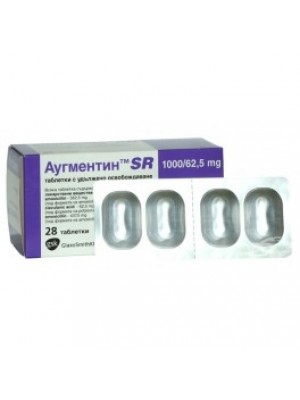
Augmentin SR table. 1 gr 28 table Each tablet contains as A..
34.00€
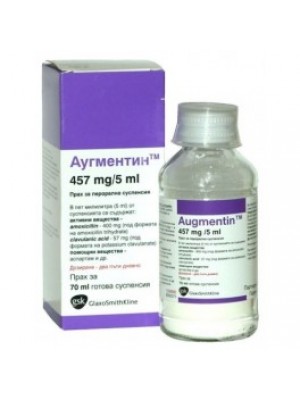
Augmentin suspension. 457 mg. / 5 ml. 70 ml. What AUGMENTI..
19.00€
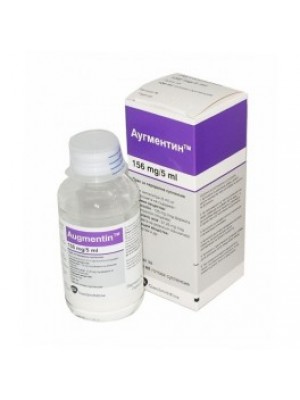
Augmentin suspension 156 mg. / 5 ml. 100 ml. What AUGMENTIN..
15.00€