
Your shopping cart is empty!
Welcome visitor you can login or create an account.
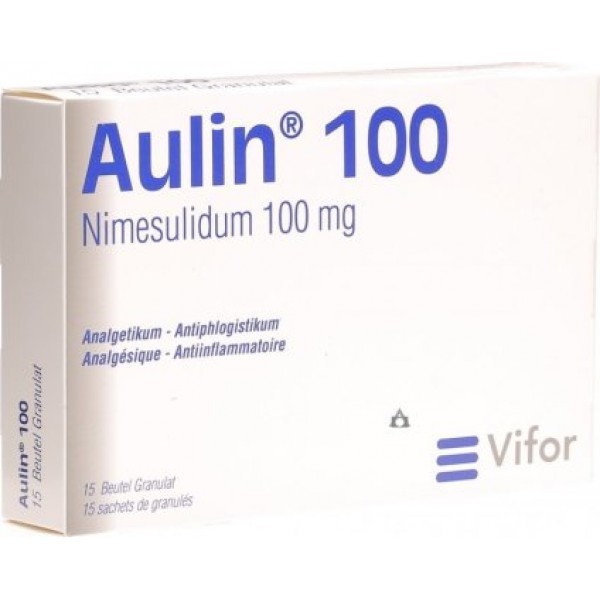
AULIN 100 mg. 9 sachets
Product Code: AULIN 100 mg. 9 sachets
Availability: In Stock
Product viewed: 2715


WHAT AULIN IS AND WHAT IT IS USED FOR
Aulin is a non-steroidal anti-inflammatory drug (NSAID) with pain-relieving properties. It is used to treat acute pain and to treat menstrual pain.
Before you prescribe Aulin, your doctor will assess the benefit of this medicine to you and the risk of developing side effects.
2. BEFORE YOU TAKE AULIN
Do not take Aulin if:
you are hypersensitive (allergic) to nimesulide or to any of the excipients (listed in section 6 at the end of the leaflet);
there are data for the following reactions after treatment with aspirin or other non-steroidal anti-inflammatory drugs:
difficulty in breathing, tightness in the chest, shortness of breath (asthma);
nasal blockage as a result of swelling of the nasal mucosa (nasal polyps);
skin rashes, urticaria;
sudden swelling of the skin or mucous membrane, such as swelling around the eyes, face, lips, mouth or throat, resulting in difficulty in breathing (angioedema);
there are data on the following manifestations following treatment with NSAIDs:
gastrointestinal haemorrhage;
perforation in the stomach or intestines;
have an ulcer or gastric or intestinal ulcer or bleeding (ulceration or at least two bleeding events);
data on brain haemorrhage (stroke);
you have another problem associated with bleeding or non-clotting of the blood;
have impaired kidney function;
take other medicines that affect the liver, paracetamol or other painkillers or non-steroidal anti-inflammatory drugs;
take drugs that lead to dependency or have habits that make you dependent on drugs or other substances;
you have alcohol dependence;
you have experienced reactions following administration of nimesulide that have led to liver function disruption;
have severe kidney failure;
have severe heart failure;
have fever or influenza (feel general pain, malaise, chills, fever or have fever);
you are pregnant after 6 months of pregnancy;
breastfeeding.
Do not give Aulin to children under 12 years of age.
Warnings:
Medicines such as Aulin may cause a slightly increased risk of heart attack ("myocardial infarction") or stroke.
The risk increases with high doses and prolonged treatment. Do not exceed the recommended dosage or duration of therapy.
If you have heart problems, have had a stroke, or if you think that these conditions are endangered (for example, if you have high blood pressure, diabetes or high cholesterol or are a smoker), discuss your treatment with your doctor or pharmacist.
If you experience severe allergic reactions such as skin rash, affecting mucous membranes or other allergy symptoms during treatment with nimesulide, stop taking the medicine immediately and consult your doctor.
If you develop gastrointestinal symptoms such as stomach pain, stomach bleeding or have black stools, immediately stop taking the medicine and consult your doctor.
Take special care with Aulin
If you develop symptoms of liver disease during treatment with nimesulide, you should stop taking nimesulide and tell your doctor immediately.
Symptoms of liver disease include loss of appetite, nausea, vomiting, abdominal pain, persistent fatigue or dark urine.
If you have ever suffered from peptic ulcer or inflammatory bowel disease such as ulcerative colitis or Crohn's disease, you should tell your doctor before you start taking Aulin.
If you develop a fever and / or flu-like symptoms during a treatment with Aulin (feeling whole body pain and chills), stop taking the product and tell your doctor.
If you suffer from mild heart disease, high blood pressure, circulatory problems or kidney problems, tell your doctor before you start taking Aulin.
If you are elderly, your doctor will periodically review you to make sure Aulin does not cause problems with the stomach, kidneys, heart or liver.
If you are planning a pregnancy, tell your doctor as Aulin may reduce fertility.
If you have an intolerance to some sugars, talk to your doctor before taking this medicine.
If you are taking any of the following medicines as they interact with Aulin:
Corticosteroids (medicines for the treatment of inflammatory diseases);
Anticoagulants, e.g. warfarin or antithrombotic agents, e.g. aspirin (medicines to prevent blood clotting);
Selective serotonin reuptake inhibitors (medicines used to treat depression);
Antihypertensives or diuretics (medicines to control blood pressure or heart disease);
Lithium (for the treatment of affective disorders);
Methotrexate (a medicine for the treatment of rheumatoid arthritis and cancer);
Ciclosporin (a medicine used after transplantation or for the treatment of immune system diseases).
Please tell your doctor or pharmacist if you are taking or have recently taken any other medicines, including medicines obtained without a prescription.
Pregnancy and breastfeeding
Ask your doctor or pharmacist for advice before taking Aulin or another medicine.
Aulin should not be taken during the last 3 months of pregnancy: it can cause problems for the baby and at birth;
If you are planning a pregnancy, tell your doctor as Aulin may reduce fertility;
If you are in the first or second trimester of pregnancy, do not exceed the dose and duration of treatment prescribed by your doctor.
Aulin should not be taken by nursing mothers.
Driving and using machines
Do not drive or operate machinery if Aulin B is dizzy or drowsy.
Important information about some of Aulin's ingredients
Aulin granules for oral suspension contain sugars. If you have been told by your doctor that you have an intolerance to some sugars, contact your doctor before taking this medicinal product.
3. HOW TO TAKE AULIN
Always follow exactly your doctor's instructions for taking Aulin. If you are not sure, talk to your doctor or pharmacist for advice.
Undesirable effects may be reduced by controlling the symptoms as low as possible for as short a time as possible.
The usual dose is one sachet of 100 mg twice a day after a meal. Take Auline for as short a period as possible, but no more than 15 days for each treatment course.
If you take more Aulin than you should
If you take or think you have taken more Aulin than you should (overdose), contact your doctor or hospital immediately. Wear the other medicine with you. In an overdose, you may experience one of the following symptoms: drowsiness, nausea, stomach pain, stomach bleeding or difficulty in breathing.
If you forget to take Aulin
Do not take a double dose to make up forgotten.
4. POSSIBLE SIDE EFFECTS
Like all medicines, Aulin can cause side effects, although not everyone gets them.
If any of the following conditions occur, stop taking the medicine and tell your doctor immediately as this may be an indication of rare serious side effects that require urgent medical attention:
stomach discomfort or pain, loss of appetite, nausea, vomiting or bleeding from the stomach or black stools;
skin irritations such as rash or redness;
wheezing or difficulty in breathing;
yellowing of the skin or whites of the eyes (jaundice);
sudden change in the amount or color of the urine;
swelling of the face, feet or legs;
constant fatigue.
General adverse reactions of non-steroidal anti-inflammatory drugs (NSAIDs)
Some non-steroidal anti-inflammatory drugs (NSAIDs) may slightly increase the risk of blockage of arterial vessels (arterial thrombosis), e.g. heart attack (myocardial infarction) or stroke (apoplexy), especially at high doses and prolonged treatment.
Fluid retention (edema), high blood pressure (hypertension) and heart failure have been reported in association with NSAID therapy.
In general, the side effects reported were related to the gastrointestinal tract (gastrointestinal reactions):
stomach ulcer and upper small intestine (peptic / gastroduodenal ulcer);
bowel perforation or gastrointestinal bleeding (which can sometimes be fatal, especially in the elderly).
Adverse reactions that may occur with Aulin:
Common (affects more than 1 in 100 people): diarrhea, nausea, vomiting, slight changes in the blood count for liver function;
Uncommon (affecting up to 1 in 100 people): difficulty breathing, dizziness, increased blood pressure, constipation, gas, stomach inflammation (gastritis), itching, rash, sweating, swelling, stomach or intestine bleeding, duodenal ulcer or stomach and burst of the ulcer;
Rare (affecting less than 1 in 1,000 people): anemia, decreased white blood cells in the blood, increased blood white blood cells (blood eosinophils), changes in blood pressure, bleeding, difficulty urinating or inability to urinate, blood urine, increased blood potassium, anxiety or nervousness, nightmares, blurred vision, rapid heartbeat, redness, skin inflammation (dermatitis), feeling uncomfortable, tired;
Very rare (affecting up to 1 in 10,000 people): severe skin reactions (known as erythema multiforme, Stevens-Johnson syndrome and toxic epidermal necrolysis) resulting in blistering of the skin and severe general malaise; kidney failure or inflammation (nephritis); disturbance of brain function (encephalopathy); reduction of blood platelets, leading to underlying bleeding or other parts of the body; black faeces due to bleeding; hepatic inflammation (hepatitis), sometimes very severe and resulting in jaundice and gallbladder arrest; allergies, including acute reactions with seizures and wheezing; asthma; lower body temperature; dizziness, headache, drowsiness; stomach pain; impaired digestion; dry mouth; rash with pruritus (hives); swelling of the face and surrounding areas, impaired vision.
Medicines such as Aulin may cause a slightly increased risk of heart attack ("myocardial infarction") or stroke.
If any of the side effects gets serious, or if you notice any side effects not listed in this leaflet, please tell your doctor or pharmacist.
5. STORING AULIN
There are no special conditions.
Keep out of the reach of children.
6. ADDITIONAL INFORMATION
What Aulin contains
One sachet contains:
Active substance: nimesulide 100 mg.
Excipients: cetomacrogol, corn starch, liquid glucose, citric acid, sucrose, orange juice.
What does Aulin look like and what does the package contain?
Aulin 100 mg granules are supplied in a laminated (ionomer / aluminum / polyethylene / paper) sachet. Sachets are placed in a cardboard box x 6; x 9; x 10; x 15; x 21, x 27, x 30 counts, together with a leaflet for the patient.
Not all pack sizes may be marketed.
Write a review
Your Name:Your Review: Note: HTML is not translated!
Rating: Bad Good
Enter the code in the box below:
Related Products
Aulin powder 100 mg. 27 powders Aulin WHAT IS AND WHAT IT I..
29.00€