Your shopping cart is empty!
Welcome visitor you can login or create an account.
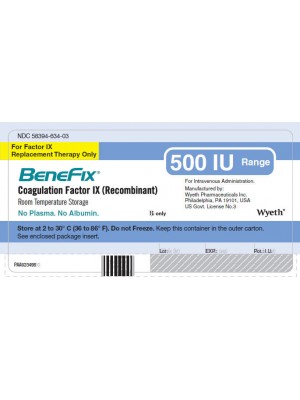
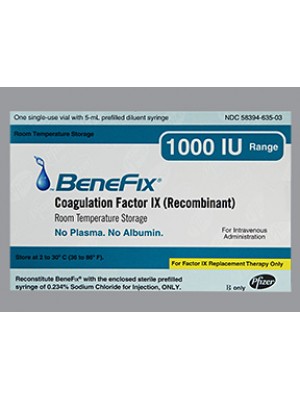
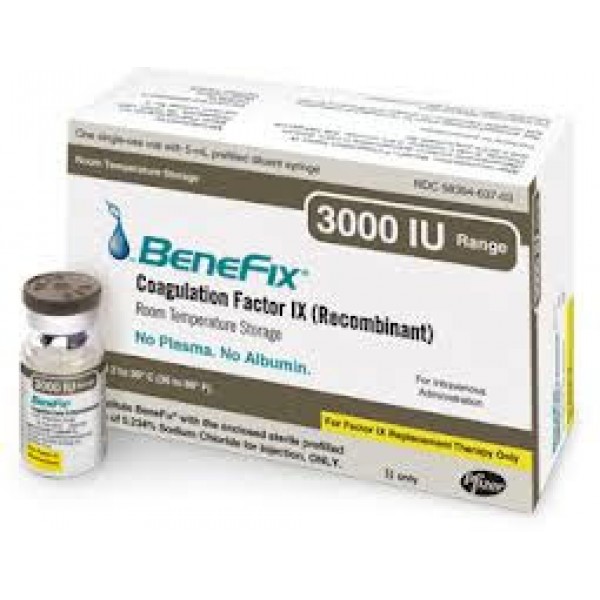
Benefix 3000IU
Product viewed: 3032


What BeneFIX is and what it is used for
BeneFIX is an injectable product containing coagulation factor IX that is produced by recombinant DNA technology. The active substance of BeneFIX is nonacog alfa. In people born with hemophilia B (Kristmas disease), there is not enough factor IX to control bleeding. BeneFIX works by replacing factor IX in patients with haemophilia B to allow their blood to clot.
BeneFIX is used to treat and prevent bleeding in patients with haemophilia B (congenital factor IX deficiency) in all age groups.
2. What you need to know before you take BeneFIX
Do not take BeneFIX
- if you are allergic to nonacog alfa or any of the other ingredients of this medicine (listed in section 6).
- If you are allergic to hamster proteins.
Warnings and precautions
- Check with your doctor immediately if your bleeding does not stop as expected.
- Allergic reactions possible. The product may contain traces of hamster protein (see Do not take BeneFIX). For factor IX products, including BeneFIX, there are potentially life-threatening anaphylactic reactions (severe allergic reactions). Early signs of allergic reactions include difficulty breathing, shortness of breath, swelling, urticaria, pruritus, generalized urticaria, tightness in the chest, wheezing, low blood pressure, blurred vision and anaphylaxis (severe allergic reaction that can cause swallowing and / , Redness or swelling of the face and / or arms).
- If allergic or anaphylactic reactions occur, stop the infusion immediately and contact a doctor immediately or seek emergency medical assistance. In case of severe allergic reactions, alternative therapy should be considered.
Anti-neutralizing activity (inhibitors) are an uncommon event in previously treated patients (PBS) receiving factor IX-containing products. However, as with all factor IX-containing products, you should be carefully monitored for the development of factor IX inhibitors while being treated with BeneFIX.
-The studies have been reported to show a link between the formation of a factor IX inhibitor and allergic reactions. Therefore, if you experience allergic reactions as described above, you should be tested for an inhibitor. It should be noted that patients with a factor IX inhibitor may be at an increased risk of anaphylaxis in subsequent treatment with BeneFIX.
- Factor IX formation in the body is controlled by the factor IX gene. Patients who have specific mutations of their factor IX gene as large deletions may be more likely to develop a factor IX inhibitor and / or to experience allergic reactions. Therefore, if you know that you have such a mutation, your doctor may monitor you more closely for signs of an allergic reaction, especially when you first start taking BeneFIX.
- Due to the risk of allergic reactions to factor IX, the initial administration of BeneFIX should be performed under medical supervision, where appropriate medical care may be provided for allergic reactions.
Even in the absence of a factor IX inhibitor, higher doses of BeneFIX than those required for other products containing plasma-derived factor IX that you may have previously received may be necessary. Therefore, a careful monitoring of plasma factor IX activity (which measures the ability of your blood to clot) should be carefully monitored to adjust dosages as needed. Contact your doctor if bleeding is not controlled at the recommended dose.
- If you suffer from liver or heart disease or have recently had surgery, there is an increased risk of blood clotting (coagulation) complications.
- It is reported for renal disease (nephrotic syndrome) after high doses of plasma-derived factor IX in patients with haemophilia B with factor IX inhibitors and a history of allergic reactions.
- There is insufficient data from clinical studies on the treatment of previously untreated patients (patients who have never been given Factor IX infusion) with BeneFIX.
-It is recommended every time you use BeneFIX to save the name and batch number of the product. You can use one of the removable labels on the vial to document the batch number in your diary or to report any side effects.
Other medicines and BeneFIX
Tell your doctor or pharmacist if you are taking, have recently taken or might take any other medicines.
Pregnancy and breastfeeding
If you are pregnant or breast-feeding, think you may be pregnant or plan to become pregnant, you should only take BeneFIX at your doctor's discretion. It is not known whether BeneFIX can harm the fetus when given to pregnant women. Your doctor may advise you to stop taking BeneFIX if you are breast-feeding or becoming pregnant.
Ask your doctor or pharmacist for advice before taking this medicine.
Driving and using machines
BeneFIX has no influence on the ability to drive or use machines.
3. How to take BeneFIX
Always take this medicine exactly as your doctor or pharmacist has told you. If you are not sure, ask your doctor or pharmacist.
Your doctor will evaluate the dose of BeneFIX you will receive. This dose and duration will depend on your individual needs for factor IX replacement therapy and how quickly your body exits factor IX, which will be checked regularly. You may notice a difference in the dose you receive if you are switching from a product containing factor IX derived from plasma to BeneFIX.
Your doctor may decide to change the dose of BeneFIX you receive during treatment.
Dissolution and application
The procedures below are given as guidelines for dissolving and administering BeneFIX. Patients should follow the specific venipuncture procedures provided by their physician.
BeneFIX is given by intravenous infusion (i.v.) after reconstitution of the powder for injection with the supplied solvent (sodium chloride solution (salt)) in the pre-filled syringe.
Always wash your hands before performing the following procedures. During the dissolution procedure, aseptic technique (ie pure and non-microorganisms) should be used.
Leave the BeneFIX freeze-dried (sublimated) vial and pre-filled syringe to reach room temperature.
2. Remove the plastic cap from the BeneFIX vial to make the central part of the rubber stopper accessible.
3. Wipe the top of the vial with the supplied alcohol swab or use another antiseptic solution and let it dry. After cleaning, do not touch the rubber stopper by hand and allow it to touch any surface.
4. Remove the protective coating from the transparent nylon pack with the vial adapter. Do not remove the adapter from the packaging.
5. Place the vial on a flat surface. Holding the adapter in the package, put it on the vial. Push firmly on the packaging until the adapter clicks into place, where the adapter blade punches the vial cap.
6.Lift up the packaging from the adapter and discard it.
7. Attach the plunger to the solvent syringe by pushing and turning with a firm motion.
8.Close the sealed plastic cap from the solvent syringe by breaking the perforation onto the cap itself. This is done by bending the cap up and down until the perforation breaks. Do not touch the inside of the cap or the tip of the syringe. You may need to put the cap back on again (if you do not use the reconstituted BeneFIX immediately), so leave it facing upside down.
9. Place the vial on a flat surface. Connect the solvent syringe to the vial adapter by inserting the syringe tip into the adapter opening and at the same time firmly pushing and turning the syringe clockwise until the connection is firm.
10. Briefly press the plunger to inject the solvent into the BeneFIX vial.
11. While the syringe is still attached to the adapter, gently swirl the vial until the powder dissipates.
12. The final solution should be checked for fine particles prior to administration. The solution should appear clear and colorless.
Note: If you use more than one BeneFIX vial per infusion, each vial should be dissolved as instructed above. The solvent syringe should be withdrawn by leaving the vial adapter in place and a separate large luer lock syringe (a device that connects the syringe to the vial) can be used to retract the reconstituted contents of each vial ).
13. As you are careful the plunger is still pressed all the way, turn the vial back. Slowly withdraw all solution in the syringe.
14.Close the syringe from the vial adapter by gently pulling it and turning it counterclockwise. Discard the vial with the adapter attached to it.
Note: If the solution is not used immediately, the syringe cap should be carefully put back. Do not touch the tip of the syringe or the inside of the cap.
BeneFIX should be administered immediately or within 3 hours of preparation. The reconstituted solution can be stored at room temperature prior to administration.
Administration (intravenous injection):
BeneFIX should be administered via the supplied pre-filled syringe or via a sterile disposable plastic luer bottle. In addition, the solution should be withdrawn from the vial via the special adapter.
BeneFIX should be injected intravenously over several minutes. Your doctor may change the recommended infusion rate to make it more tolerable.
Agglutination of red blood cells in the system / syringe has been reported with BeneFIX. No side effects have been reported with this observation. In order to minimize the possibility of agglutination, it is important to limit the amount of blood entering the system. There should be no blood in the syringe. If red blood cells stick to the system / syringe, discard the entire material (system, syringe and BeneFIX solution) and continue with new packaging.
As the use of BeneFIX by continuous infusion (drip) has not been evaluated, BeneFIX should not be mixed with infusion solutions or given as a drip.
Please dispose of all unused solution, empty vials and used needles and syringes in a suitable waste disposal container, as they may cause harm to others if they are not working properly.
If you take more BeneFIX than you should
Please contact your doctor immediately if you inject more BeneFIX than your doctor has recommended.
If you stop taking BeneFIX
Do not stop taking BeneFIX without consulting your doctor.
If you have any other questions about the use of this medicine, ask your doctor, pharmacist or nurse.
4. Possible Side Effects
Like all medicines, this medicine can cause side effects, although not everyone gets them.
Hypersensitivity / allergic reactions
Beneficial allergic type hypersensitivity reactions are possible with BeneFIX. Such reactions may include swelling of the face or throat, burning and stinging of the infusion site, chills, flushing, itching, headache, urticaria (hives), low blood pressure, lethargy, nausea, restlessness, rapid heartbeat, tightness Chest, numbness, vomiting, wheezing. In some cases these reactions progress to severe anaphylaxis.
Allergic reactions may occur along with the development of a factor IX inhibitor (see "Warnings and Precautions").
These reactions are potentially life-threatening. If allergic / anaphylactic reactions occur, stop infusing BeneFIX immediately and contact your doctor immediately or seek emergency medical advice. The type of treatment required depends on the nature and severity of the side effects (see "Warnings and Precautions").
Development of an inhibitor
Patients with haemophilia B can develop neutralizing antibodies (inhibitors) against factor IX. Significance of such inhibitors may be to increase the amount necessary to control the bleeding or to continue bleeding after treatment. In such cases, it is recommended to contact a specialized center for the treatment of haemophilia. Your doctor may want to monitor the development of an inhibitor (see "Warnings and Precautions").
Kidney disorder has been reported following high doses of plasma-derived factor IX used to induce immune tolerance in patients with haemophilia B with factor IX inhibitors and a history of allergic reactions (see Warnings and Precautions).
Thrombotic events
BeneFIX can increase the risk of thrombosis (pathological blood clots) in your body if you have risk factors for blood clots, including a permanent intravenous catheter. Serious events related to the occurrence of blood clots, including life-threatening blood clots in newborns in critical condition, have been reported during long-term infusion of BeneFIX via a central venous catheter. Cases of peripheral thrombophlebitis (pain and redness of the veins) and deep vein thrombosis (blood clots in the limbs) have also been reported; In most of these cases, BeneFIX is given by continuous infusion, which is not an approved route of administration.
Very common side effects (may affect more than 1 in 10 people)
Headache
Coughs
Increased temperature
Common side effects (may affect up to 1 in 10 people)
Hypersensitivity / allergic reactions
Dazziness, changed taste
Flebitis (pain and redness of the veins), flushing of the face
Vomiting, nausea
Rash, urticaria (hives)
Chest discomfort (including chest pain)
Infusion site reaction (including itching and redness at the infusion site), pain and discomfort at the infusion site
Uncommon side effects (may affect up to 1 in 100 people)
Development of neutralizing antibodies (inhibitors)
Cellulite at the infusion site (pain and reddening of the skin)
Drowsiness, shaking
Visual disturbances (including blurred vision, spotting / blinking)
Increased pulse, low blood pressure
Kidney infarction (stopping the blood supply to the kidney)
Adverse reactions of unknown frequency (can not be estimated from the available data)
Anaphylactic reaction
Thrombotic events (blood clotting)
Lack of response to treatment (failure to stop or prevent bleeding episodes)
Reporting of side effects
If any of the side effects gets serious, tell your doctor, pharmacist or nurse. This includes all possible side effects not listed in this leaflet. You can also report side effects directly through the national reporting system listed in Appendix V. As you report side effects, you can contribute to getting more information about the safety of this medicine.
5. How to store BeneFIX
Keep out of the reach and sight of children.
Do not use this medicine after the expiry date which is stated on the carton and vial label. The expiry date refers to the last day of that month.
BeneFIX should be stored below 30 ° C and used before the expiry date stated on the label.
Do not freeze to prevent damage to the pre-filled syringe.
Use the reconstituted solution immediately or within 3 hours.
Do not use BeneFIX if the solution is not clear or colorless.
For reconstitution, use only the pre-filled syringe provided in the pack. Other disposable sterile syringes may also be used for administration.
Do not dispose of medicines in the sewer or in the household waste container. Ask your pharmacist how to dispose of medicines you no longer use. These measures will help to protect the environment.
6. Package Contents and Additional Information
What BeneFIX contains
The active substance is nonacog alfa (recombinant coagulation factor IX).
Each BeneFIX vial contains nominally 250, 500, 1000, 1500, 2000 or 3000 IU
Nonacog alfa.
- The other ingredients are sucrose, glycine, L-histidine, polysorbate 80. A solvent (0.234% sodium chloride solution) is provided for dissolution.
After reconstitution with the supplied solvent (0.234% sodium chloride solution), each vial contains 50, 100, 200, 300, 400 or 600 IU / ml (see Table 1).
Table 1. Concentration of BeneFIX per ml of reconstituted solution
What BeneFIX looks like and contents of the pack
BeneFIX is supplied as powder for injection in a glass vial and solvent in a pre-filled syringe.
The package contains:
One vial BeneFIX 250, 500, 1000, 1500, 2000 or 3000 IU powder
One pre-filled syringe with solvent, 5 ml sterile 0.234% Sodium Chloride Injection Solution, One Piston
A sterile adapter device for the reconstitution vial
A sterile infusion set
Two alcohol swabs
One patch
Write a review
Your Name:Your Review: Note: HTML is not translated!
Rating: Bad Good
Enter the code in the box below:
Related Products