Your shopping cart is empty!
Welcome visitor you can login or create an account.
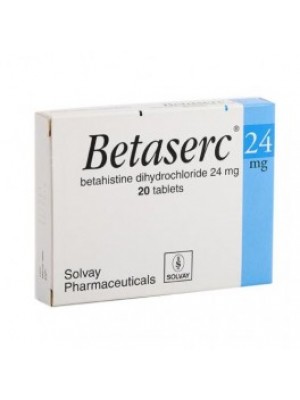
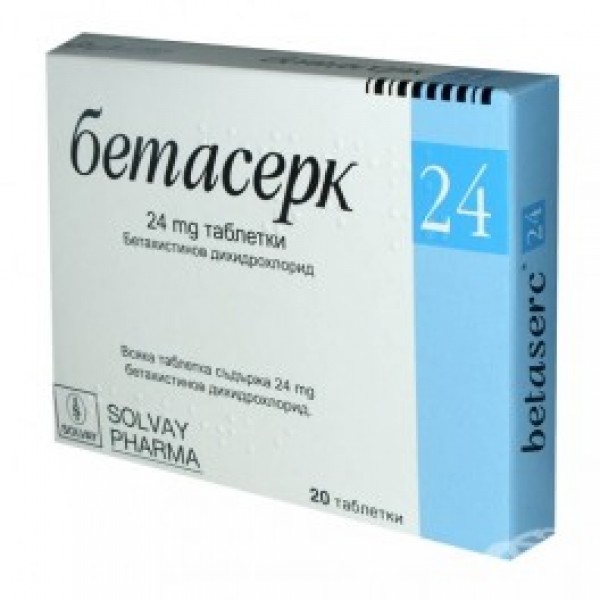
BETASERK tablets 24 mg. 20 tablets
Product Code: BETASERK tablets 24 mg. 20 tablets
Availability: In Stock
Product viewed: 1128


BETASERK tablets 24 mg. 20 tablets

BETASERK WHAT IS AND WHAT IT IS USED
Active ingredient in this medicine is betahistine. It is assumed that it increases blood flow to the inner ear, resulting in a decrease in strength and frequency of attacks of vertigo, tinnitus decreased, slow or stop hearing loss, especially when you take timely treatment.
Betaserk used to treat Meniere's disease, presenting with the following signs:
feeling dizzy (vertigo), often accompanied by nausea and vomiting
Tinnitus
hearing loss or difficulty hearing.
Feeling dizzy is when part of the inner ear, which controls balance, is not working properly.
BEFORE YOU TAKE BETASERK
Betaserk not take if:
you are hypersensitive (allergic) to betahistine or to any of the excipients.
Your doctor has told you that you have a tumor of the adrenal gland (called phaeochromocytoma)
Take special care with Betaserk
If you are a patient with asthma or have suffered from ulcers of the stomach and / or duodenum, should be carefully monitored during treatment. Betaserk not recommended for children.
Taking other medicines Betaserk
Please tell your doctor or pharmacist if you are taking shi have recently taken any other medicines, including medicines obtained without a prescription. This also applies to herbal medicines.
Tell your doctor if you are taking or have recently taken any of the following:
Antihistamines - they can (theoretically) reduce the effect of Betaserk. Also Betaserk can reduce the effects of antihistamines.
Monoamine oxidase inhibitors (MAO) inhibitors - used to treat depression or Parkinson's disease. They can enhance the effect of Betaserk.
Taking Betaserk with food and drink
You can take the tablets with or without food. Betaserk can cause mild stomach problems. The intake of food can help to reduce them.
Pregnancy and lactation
Please tell your doctor if you are pregnant or breast-feeding or intend to become pregnant! It is not known whether Betaserk affect the unborn child.
stop taking Betaserk and tell your doctor if you are pregnant or think you are pregnant.
Betaserk not take if you are pregnant unless your doctor has decided that this is necessary.
It is not known whether Betaserk passes into breast milk. Do not breastfeed if you are taking Betaserk, unless your doctor has told you otherwise.
Driving and operating machinery
Betaserk not likely to affect the ability to drive and use machines.
HOW TO TAKE BETASERK
Always Betaserk exactly as your doctor tells you. If you are unsure ask your doctor or pharmacist. Take the tablets with water.
You can take the tablets with or without food. Betaserk can cause mild stomach problems.
Take with meals can help reduce these problems.
The dose is one tablet two times daily. Take your tablets at the same time, it will help you remember to take them.
If you take a large dose Betaserk than you should:
If you take a larger dose than prescribed, or if the children accidentally take this medicine, you should call a doctor!
If you forget to take Betaserk:
If you forget to take your medicine, skip the missed dose. Take the next regular time. Do not take a double dose to make up for forgotten individual doses.
If you have any questions about using this medicine, ask your doctor or pharmacist.
POSSIBLE SIDE EFFECTS
Like all medicines, this medicine can cause side effects, although not everybody gets them.
Allergic reactions
If you have an allergic reaction, stop taking Betaserk and contact your doctor immediately or go to hospital.
Signs can be:
red skin rash or sore itchy skin
swelling of the face, stand, tongue or throat
blood pressure
loss of consciousness
difficulty in breathing
Other side effects may include: Common (affects less than 1/10 of patients)
nausea
acids
headache.
HOW TO STORE BETASERK
Shelf life - 5 years
Keep out of reach of children.
Do not use after the expiry date stated on the label! The expiry date refers to the last day of that month.
Do not store above 25 ° C.
Medicines should not be disposed of in household waste or sewage. Ask your pharmacist how to dispose of medicines no longer required. These measures will help to protect the environment.
ADDITIONAL INFORMATION
What Betaserk
The active substance is a Betaserk betahistine hydrochloride.
Other ingredients of the drug (excipients) are: lactose monohydrate, microcrystalline cellulose, mannitol, citric acid monohydrate, colloidal anhydrous silica and talc.
Write a review
Your Name:Your Review: Note: HTML is not translated!
Rating: Bad Good
Enter the code in the box below:
Related Products
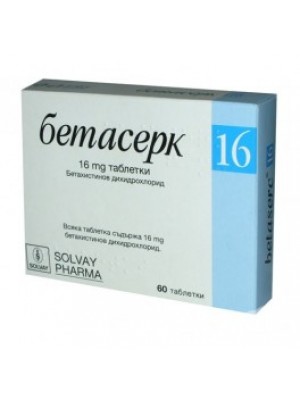
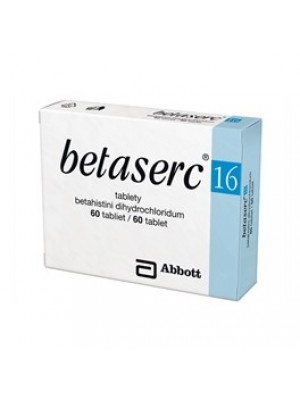
BETASERK 16 mg tablets. 60 table BETASERK WHAT IS AND WHAT I..
30.00€