Your shopping cart is empty!
Welcome visitor you can login or create an account.
Brizadopt eye drops 10 mg. / ml. 5 ml.
Product Code: Brizadopt eye drops 10 mg. / ml. 5 ml.
Availability: In Stock
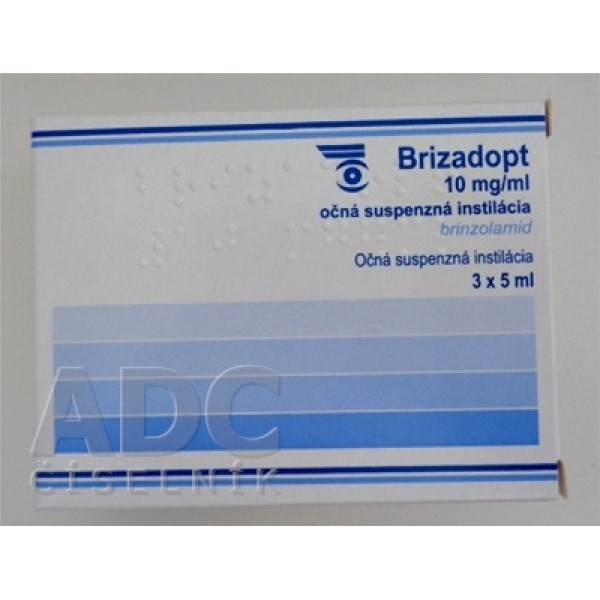
Product viewed: 2661


What is Brizadopt 10 mg / ml eye drops, suspension and what it is used for
Brizadopt 10 mg / ml eye drops, a suspension containing brinzolamide, belongs to a group of medicines called carbonic anhydrase inhibitors. It lowers the pressure in the eye.
Brizadopt 10 mg / ml eye drops suspension is designed to lower elevated intraocular pressure. Such pressure can cause a disease called glaucoma.
If the pressure in the eye is too high, it can cause damage to your eyesight.
2. What you need to know before using Brizodopt 10 mg / ml eye drops
Do not take Brizodopt 10 mg / ml eye drops, suspension:
if you have severe kidney problems;
if you are allergic to brinzolamide or any of the other ingredients of this medicine (listed in section 6);
if you are allergic to medicines called sulphonamides. EXAMPLES include drugs used to treat diabetes and infections, as well as diuretics (drainage tablets). Brizadopt 10 mg / ml eye drops, suspension may cause the same allergy;
if your blood has a too high level of acidity (a condition called hyperchloraemic acidosis).
If you have any other questions, talk to your doctor.
Warnings and precautions
Talk to your doctor or pharmacist or nurse:
if you have kidney or liver problems;
if you have dry eye or corneal problems;
if you are taking other sulphonamide medicines.
Children and adolescents
Blissadopt 10 mg / ml eye drops should not be used in newborns, children or adolescents below 18 years of age unless it is recommended by your doctor.
Other medicines and Brizadopt 10 mg / ml eye drops, suspension
Tell your doctor or pharmacist if you are taking or have recently taken or might take any other medicines, including medicines obtained without a prescription.
If you are taking other carbonic anhydrase inhibitors (acetazolamide or dorzolamide, see section 1: What is Brizadopt 10 mg / ml eye drops, suspension and what it is used for), talk to your doctor.
Pregnancy, breastfeeding and fertility
If you are pregnant or are breast-feeding, think you may be pregnant or plan to become pregnant, ask your doctor or pharmacist for advice before taking this medicine.
Women who may become pregnant should use effective contraception during treatment with Brizadopt 10 mg / ml eye drops. It is not recommended to use Brizopt 10 mg / ml eye drops, a suspension during pregnancy and lactation. Do not use Briosdop 10 mg / ml eye drops if not prescribed by your doctor.
Ask your doctor or pharmacist for advice before taking any medicine.
Driving and using machines
Do not drive or operate machinery until your vision is clear. It is possible to detect short-term vision blur after use of Brizodet 10 mg / ml eye drops suspension.
Bridavod 10 mg / ml eye drops, suspension may impair the ability to perform tasks requiring increased attention and / or physical coordination. If this occurs, be careful when driving or using machines.
Brizadopt 10 mg / ml eye drops, suspension containing benzalkonium chloride
Brizopt 10 mg / ml eye drops, a suspension containing a preservative (benzalkonium chloride) that can cause eye irritation and change the color of soft contact lenses. Contact with soft contact lenses should be avoided.
Remove the contact lenses before using Brizopt 10 mg / ml eye drops, suspension and wait for at least 15 minutes after dropping the drops before putting the lenses back.
3. How to use Brizadopt 10 mg / ml eye drops, suspension
Always use Briosodet 10 mg / ml eye drops, suspension exactly as your doctor or pharmacist has told you. If you are not sure, ask your doctor or pharmacist or nurse.
Use Bridavod 10 mg / ml eye drops, suspension only for your eyes. Do not swallow or inject.
The recommended dose is
1 drop in the affected eye or eyes, twice daily - morning and evening.
Use as much unless your doctor advises you otherwise. Use Bridavod 10 mg / ml eye drops, suspension in both eyes if this has been prescribed by your doctor. Use as long as your doctor tells you.
How to use
Take the bottle of Briozode 10 mg / ml eye drops, suspension and mirror;
Wash your hands;
Shake the bottle and unscrew the cap. After removing the cap if the protective ring is loose, remove it before using the product;
Keep the bottle with your thumb and middle finger facing down;
Tilt your head back. Dissolve the eyelid, with the fingers already cleaned, so as to form a "pocket" between it and the eye. The drop will fall into this place;
Approach the top of the bottle near the eye. Use the mirror if it makes it easy for you;
Do not touch the eye or eyelids, the surrounding area or other surfaces with the top of the bottle flapper. Drops may become dirty;
Squeeze one drop into the pocket;
After placing Bridavod 10 mg / ml eye drops, a slurry, finger press the eye in the nose corner for at least 1 minute. This will prevent Briozopt 10 mg / ml eye drops, suspension to the other parts of the body;
If you need to put drops in the other eye, repeat all the previous steps for the other eye;
Turn the cap tightly after use;
Use the bottle to the end before opening a new bottle.
If you use other eye drops, leave at least 5 minutes between Bridavod 10 mg / ml eye drops, suspension and other drops. Eyebrows should be applied last.
If you use more than the required dose of Brizopt 10 mg / ml eye drops, a suspension of
If you put too much in your eyes, immediately rinse with warm water. Do not put more drops to the next usual dose.
If you forget to use Brizopt 10 mg / ml eye drops, a suspension
Use one drop as soon as you remember and then follow the usual dosage regimen. Do not put a double dose to make up for the missed dose.
If you stop using Brizodet 10 mg / ml eye drops, a suspension
If you stop using Brizopt 10 mg / ml eye drops without having consulted your doctor, the pressure in your eye will not be controlled, which may cause loss of vision.
4. Possible side effects
Like all medicines, this medicine can cause side effects, although not everyone gets them.
The following side effects have been reported with Bridavod 10 mg / ml eye drops, suspension:
Common side effects (may affect up to 1 in 10 people):
Eye-related reactions: blurred vision, eye irritation, eye pain, eye discharge, itching in the eye, dry eye, unusual sensation in the eye, redness of the eye;
General Side Effects: Bad taste.
Uncommon side effects (may affect up to 1 in 100 people):
Eye-related reactions: light sensitivity, conjunctivitis or inflammation of the conjunctiva, eye swelling, eyelid pruritus, redness or swelling, eye growth, increased pigmentation of the eye, tired eyes, eyelid crust or increased tearing;
General side effects: delayed or decreased cardiac function, palpitations, slow heart rate, difficulty in breathing, shortness of breath, cough, decreased red blood cell count, increased blood chlorine level, dizziness, drowsiness, memory difficulties, depression, nervousness, general fatigue, fatigue, abnormal sensation, pain, trembling, decreased sexual desire, difficulty in male sexuality, cold symptoms, chest fluid collection, sinus infection, throat irritation, sore throat, abnormal or decreased sensation inflammation of the lining of the esophagus, abdominal pain, nausea, vomiting, upset stomach, rapid bowel movements, diarrhea, gas in the intestine, digestive disorders, kidney pain, muscle pain, muscle spasms, sore throat, bleeding nasal nose, nasal congestion, sneezing, rash, unusual skin sensation, itching, headache, dry mouth.
Rare side effects (may affect up to 1 in 1,000 people):
Eye-related reactions: corneal swelling, double or decreased vision, abnormal vision, decreased eye sensation, swelling around the eye, increased eye pressure, optic nerve damage;
General side effects: memory abnormalities, drowsiness, chest pain, upper respiratory tract obstruction, sinus obstruction, nasal congestion, nasal dryness, tinnitus, hair loss, common itching, panic, irritability, irregular heartbeat frequency, weakness of the body, sleep disturbances.
Not known (frequency can not be estimated from the available data):
Eye-related reactions: eyelid abnormality, visual disturbances, corneal disorders, eye allergy, decreased growth or number of lashes;
General side effects: Increased allergic symptoms, reduced sensitivity, shaking, loss or reduction of taste, decreased blood pressure, increased blood pressure, increased heart rate, pain in the joints
How to store Brizadopt 10 mg / ml eye drops, suspension
Keep out of the reach and sight of children.
Do not use this medicine after the expiry date which is stated on the bottle and the box after EXP. The expiry date refers to the last day of that month.
This medicine does not require any special storage conditions.
You should discard the bottle four weeks after the first opening to avoid infections. Write the date of opening the marked spot on the label of each bottle and cardboard box. For a bottle containing only one bottle, write only one date.
Do not dispose of medicines in the sewage system or in the household waste container. Ask your pharmacist how to dispose of medicines you no longer use. These measures will help to protect the environment.
6. Package Contents and Additional Information
What Brizadopt contains 10 mg / ml eye drops, suspension
The active substance is brinzolamide 10 mg / ml.
The other ingredients are: benzalkonium chloride, carbomer 974P, disodium edetate, mannitol, purified water, sodium chloride. Small amounts of hydrochloric acid or sodium hydroxide were added to maintain a normal level of acidity (pH level).
What Brizadopt 10 mg / ml looks like for eye drops, suspension and what the package contains
Brizadopt 10 mg / ml eye drops suspension is a white to off-white homogeneous suspension. The primary packaging is 5 ml sterile bottle of low density polyethylene (LDPE) including an applicator with a dropper of LDPE and sterile cap of high density polyethylene (HDPE) with a seal for protection against opening.
Cardboard box containing 1 or 3 bottles.
Not all pack sizes may be marketed.
Write a review
Your Name:Your Review: Note: HTML is not translated!
Rating: Bad Good
Enter the code in the box below:
Related Products