Your shopping cart is empty!
Welcome visitor you can login or create an account.
CALGEVAX 11.25 mg. 4 ampules
Product Code: CALGEVAX 11.25 mg. 10 ampules
Availability: In Stock
Product viewed: 3314


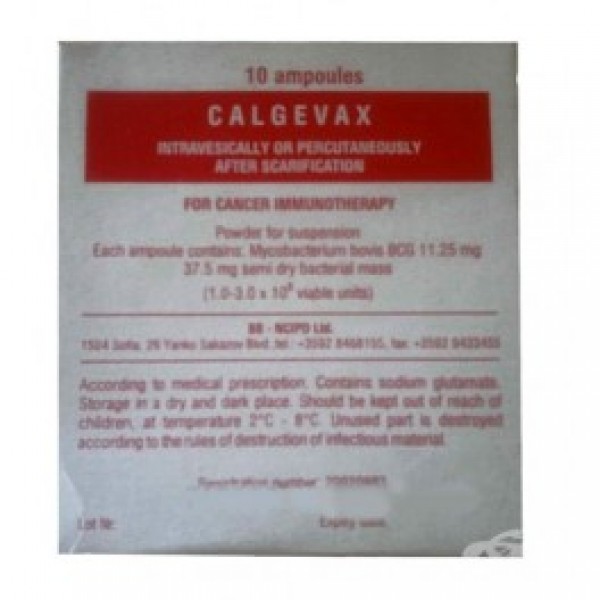
CALGEVAX 11.25 mg. 10 ampules

INGREDIENTS:
Active substance - Mycobasterium bovis BCG 11,25 mg / 37,5 mg semi-dry bacterial mass /
1.0 to 3.0 x 10 8 viable units
Excipients
glutamate
40 mg
INDICATIONS:
Intravesical:
Prevention of recurrence of superficial bladder cancer after transurethral resection;
For the treatment of carcinoma "in situ"
Transdermal:
For the treatment of malignant melanoma
For non-specific immunomodulation therapy in other cancers
CONTRAINDICATIONS:
Calgevax not apply in the following cases:
In patients with immune suppression;
Individuals with congenital or acquired immunodeficiency due to disease or cancer therapy;
For HIV - seropositive persons and in patients receiving immunosuppressive doses of steroids or other immunosuppressive agents;
In febrile states;
For urinary tract infections or massive hematuria, and in parallel the antimicrobial therapy;
For active tuberculosis positive test tuberkulonov Mantua contra only evidence of active tuberculosis infection;
Current or prior systemic BCG reaction
Special warnings:
Not recommended for use in children Kalgevaks due to insufficient data on safety and efficacy in children.
Risk / benefit be assessed carefully when the product should be used during pregnancy and lactation due to lack of clinical data in these cases. It is known that breastfeeding women with systemic BCG infection can infect her child.
EFFECTS ON ABILITY TO DRIVE AND USE MACHINES
No studies on the effects of Kalgevaks on ability to drive and use machines
DOSAGE AND ADMINISTRATION:
Intravesical administration:
CALGEVAX apply at the earliest 14 days after the biopsy, transurethral catheterization rezuktsiya or traumatic bladder. Performed under strict aseptic technique and control specialist. In any intravesical infusion using three or four vials of the product at the discretion of the treating urologist. Contents of the ampoule is dissolved in 1 ml of sterile saline, shake gently and wait until a homogeneous suspension. The mixture is extracted with a syringe and ampoule returns three times to ensure proper mixing, which reduces the formation of groups of mycobacteria. Suspensions diluted in 50 ml of sterile saline.
Apply using intravesical catheter.
Product remains in the bladder for two hours. In the first hour, every 15 minutes the patient takes one of four positions in the supine position: polulyavo spin poludyasno rotation, left side, right side.
Calgevax activity is significantly reduced by light, so it should be protected from exposure to sunlight, both before and after reconstitution. Suspensions used immediately. The standard schedule includes an intravesical infusion weekly for six weeks. Supportive care is determined on a case.
Can be used spemi following: monthly dosing for at least 6-12 months to three weekly injections of 3,6,12,18,24,30 and 36 months from the date of the first infusion.
Transdermal administration after scarification of the skin:
On the surface of 5/5 cm is made of 10 horizontal and 10 vertical lines through the injection needle. In scarify should just tear the epidermis without causing excessive bleeding.
Can be used multipunktura apparatus and adjust the depth of scarification.
The site of scarification apply 0.5 ml of a suspension prepared as follows: the content and one vial is added 0.5 ml of sterile saline at a concentration of 75 mg / ml. For a scarification using an ampule. Cleaning in place before scarification should be done with acetone, pending complete evaporation. For each scarification choose a new spot on the skin. The frequency and duration of application are determined by your doctor.
SIDE EFFECTS:
Intravesical administration:
Local reactions - transient dysuria, pollakiuria, hematuria, bacterial urinary tract infection, granulomatous prostatitis, epididymitis, orchitis.
General - fatigue, fever, chills, sweating, nausea, vomiting, headache, muscle aches, abdominal colitis, liver toxicity, uveitis, vitiligo, arthritis, leukopenia, splenomegaly.
Adverse effects of intravesical administration appear 3-4 hours after intravesical injection and are transient - last 24-72 hours.
Transdermal application:
Local - localized itching or rash, painful ulcers at the site of application, regional adenopathy.
General - fatigue, fever, chills, sweating, nausea, vomiting, glavoolie, muscle aches, abdominal colic, diffuse rash, liver toxicity, erythema nodosum, conjunctivitis, uveitis, arthritis, leukopenia, splenomegaly.
In severe side effects common to prolong the intervals between applications, such as treatment with Calgevax may be terminated at the discretion of the treating physician.
Write a review
Your Name:Your Review: Note: HTML is not translated!
Rating: Bad Good
Enter the code in the box below:
Related Products