Your shopping cart is empty!
Welcome visitor you can login or create an account.
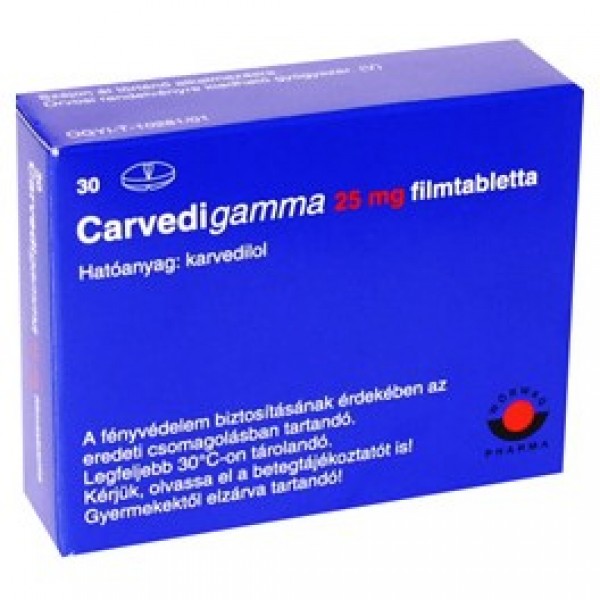
CARVEDIGAMMA 25 mg. 30 tablets
Product Code: CARVEDIGAMMA 25 mg. 30 tablets
Availability: In Stock
Product viewed: 848


CARVEDIGAMMA 25 mg. 30 tablets
WHAT CARVEDIGAMMA AND WHAT IT IS USED
Carvedigamma drug belongs to a group of alpha- and beta-blockers. Carvedigamma is used to treat high blood pressure and angina (angina pectoris). Carvedigamma be used as an accompanying therapy in heart failure, resulting in improved performance of the heart.
2. BEFORE YOU TAKE CARVEDIGAMMA
Do not take Carvedigamma:
if you are hypersensitive (allergic) to carvedilol or to any of the excipients of Carvedigamma;
if you suffer from severe heart failure expressed to be treated with intravenous (administered intravenously) drugs;
if you suffer from asthma;
if you suffer from heart failure, but you have not treated or have impaired conduction of the heart (ie. AV-block II or III level or called. sick sinus syndrome);
if you are in cardiogenic shock;
you have a very slow heartbeat or very low blood pressure;
if you have a serious violation of the acid-base balance (metabolic acidosis, acidaemia);
if you have Prinzmetal angina (unusual form of angina pectoris, which is caused by a spasm of the coronary arteries);
if you have untreated overactive adrenal glands (pheochromocytoma);
if you suffer from poor circulation in the extremities, which is expressed in coldness, pain, or intermittent claudication;
if you suffer from severe liver disease;
if you are currently being treated intravenously with drugs used to treat high blood pressure or heart problems (verapamil or diltiazem).
Take special care with Carvedigamma:
if you suffer from heart failure accompanied by:
hypotension;
poor supply the heart with blood and oxygen (ischemic heart disease) and hardening of the arteries (atherosclerosis);
and / or kidney problems. In this case the kidney function must be monitored. If necessary, the dose can be reduced;
If you are diabetic. Carvedigamma treatment can mask low blood sugar. Therefore the levels of your blood sugar should be monitored regularly;
if you have severe breathing problems not treated, the use of Carvedigamma can lead to their further deterioration;
if you use contact lenses. Use of Carvedigamma can reduce the amount of lacrimal fluid;
if you suffer from the phenomenon of Raynaud (toes or hands initially turning blue, then turn white, then turn red and become painful). Use of Carvedigamma may worsen the symptoms;
if you have overactive thyroid gland with increased secretion of thyroid hormone use Carvedigamma can mask these symptoms;
if you use Carvedigamma and you have surgery, including anesthesia (anesthesia). You should consult with your anesthesiologist before an operation;
if you have a very slow heart rate (less than 55 beats per minute);
if you are severely allergic (eg. to insect bites or food) or you undergo allergic desensitisation therapy as Carvedigamma may reduce the efficacy of the drugs used to treat such allergic reactions;
if you suffer from psoriasis.
Consult your doctor before taking Carvedigamma.
Using other medicines
Concomitant treatment with other medicines may influence the effect of Carvedigamma or be influenced by Carvedigamma.
Please tell your doctor or pharmacist if you are taking or have recently taken any other medicines, including medicines obtained without a prescription. Be sure to tell your doctor about treatment Carvedigamma if you are prescribed another drug during the treatment.
It is extremely important that your doctor knows if you are already being treated with:
Digoxin (used to treat heart failure);
Rifampicin (an antibiotic used to treat tuberculosis);
Cimetidine (medicine to treat stomach ulcers, heartburn and acid secretion);
Ketoconazole (medicine for the treatment of fungi);
Fluoxetine (medicine to treat depression);
Haloperidol (a drug for the treatment of certain mental / psychiatric disorders);
Erythromycin (antibiotic);
Ciclosporin (a drug for suppressing the immune system in order to prevent rejection reactions of the body after organ transplantation, and is also used in certain rheumatic or dermatological diseases);
Clonidine (a drug for the treatment of hypertension or migraine);
Verapamil, diltiazem, amiodarone (medicines to treat irregular heartbeat);
Quinidine, disopyramide, mexiletine, propafenone, flecainide (medicines to treat irregular heartbeat);
Other medicines to lower blood pressure. Carvedilol can enhance the effects of other blood pressure lowering drugs, which are taken together (eg. Alpha1-receptor antagonists) and drugs where reduction in blood pressure is a side effect, for example. barbiturates (medicines for treatment of epilepsy), phenothiazines (medicines used to treat psychoses), tricyclic antidepressants (medicines to treat depression), vasodilatory drugs (drugs for widening the blood vessels) and alcohol;
Insulin or oral antidiabetic drugs (means to reduce blood sugar) as their reducing effect can be strengthened and to mask the symptoms of low blood sugar;
Inhalational anesthetics (drugs used in anesthesia);
Sympathomimetic agents (drugs which increase the function of the sympathetic nervous system);
Dihydropyridines (medicines to treat high blood pressure and heart failure);
Nitrates (medicines used to treat heart disease) because they may suddenly reduce blood pressure reducing effect of carvedilol;
Neuromuscular blockers (drugs that reduce muscle tension);
Ergotamine (medicine to treat migraine);
Some tablets painkillers (NSAIDs), estrogens (hormones) and corticosteroids (adrenal hormone), as in some cases they can reduce blood pressure reducing effect of carvedilol;
Medicinal products containing reserpine, guanethidine, methyldopa, guanfacine and monoamine oxidase inhibitors (MAO - inhibitors) for the treatment of depression, as can further reduce cardiac rhythm.
Taking Carvedigamma with food and drink
Carvedigamma may enhance the effects of alcohol.
Pregnancy and lactation
Consult your doctor or pharmacist before taking any medicine.
There is a risk of harm to the fetus. Carvedigamma should be used during pregnancy only if your doctor decides it is necessary. Therefore always consult your doctor before using Carvedigamma during pregnancy. According to the results of animal studies in lactating Carvedigamma passes into breast milk and therefore should not be used during breastfeeding.
Driving and using machines
This medicinal product has minor influence on the ability to drive and use machines.
At the beginning of treatment or change of treatment may occur dizziness or fatigue.
If you feel dizzy or weak when taking the tablets, you should avoid driving or work requiring attention.
Important information about some of the ingredients of Carvedigamma
This medicine contains lactose. If your doctor has told you that you have an intolerance to some sugars, contact him before taking this medicine.
3. HOW TO TAKE CARVEDIGAMMA
Always take Carvedigamma exactly as prescribed by your doctor. If you are not sure, ask your doctor or pharmacist.
If you feel that the effect of Carvedigamma is too strong or too weak, talk to your doctor or pharmacist.
The tablets should be swallowed with at least half a glass of water. You can take the tablets with or without food. Patients with heart failure should however take the tablets with food to reduce the risk of dizziness on sudden standing.
The film-coated tablets Carvedigamma provided at a concentration of 3.125 mg, 6.25 mg, 12.5 mg and 25 mg.
High blood pressure
Dosage for adults:
The recommended dose is 1 tablet Carvedigamma 12.5 mg (corresponding to 12.5 mg carvedilol) for the first two days and then 2 tablets Carvedigamma 12.5 mg (corresponding to 25 mg carvedilol) once daily. For this determination are available and other types of packaging Carvedigamma with a larger quantity of the active substance. If necessary, the dose can then be increased stepwise at intervals of two weeks or more.
Dosage for elderly patients:
The recommended dose is 1 tablet Carvedigamma 12.5 mg (corresponding to 12.5 mg carvedilol) once daily. For this determination are available and other types of packaging Carvedigamma with a larger quantity of the active substance. If necessary, the dose can then be increased stepwise at intervals of two weeks or more.
Angina (angina pectoris)
Dosage for adults:
The recommended dose is 1 tablet Carvedigamma 12.5 mg (corresponding to 12.5 mg carvedilol) 2 times daily during the first two days and then 2 tablets Carvedigamma 12.5 mg (corresponding to 25 mg carvedilol) twice daily. For this determination are available and other types of packaging Carvedigamma with a larger quantity of the active substance. If necessary, the dose can then be increased stepwise at intervals of two weeks or more. The recommended maximum daily dose is 100 mg in two divided doses during the day.
Dosage for elderly patients:
The recommended dose is 1 tablet Carvedigamma 12.5 mg (corresponding to 12.5 mg carvedilol) 2 times daily during the first two days and then 2 tablets Carvedigamma 12.5 mg (corresponding to 25 mg carvedilol) twice daily. For this determination are available and other types of packaging Carvedigamma with a larger quantity of the active substance.
The recommended maximum daily dose is 50 mg.
heart failure
The recommended starting dose is 1 tablet Carvedigamma 3.125 mg (corresponding to 3.125 mg carvedilol) 2 times daily for two weeks. If the initial dose is well tolerated, the dose can be gradually increased at intervals of two weeks or more, initially in carvedilol 6.25 mg 2 times daily, then 12.5 mg carvedilol 2 times a day, then 25 mg of carvedilol 2 times daily. The highest tolerated dose to the patient must be established.
The recommended maximum daily dose is 25 mg carvedilol taken 2 times a day by patients weighing less than 85 kg and 50 mg carvedilol taken 2 times a day by patients weighing more than 85 kg, provided that there is no severe heart failure. Increasing the dose to 50 mg carvedilol taken 2 times daily should be performed carefully under close medical supervision.
In the beginning of therapy or as a result of increasing the dosage may appear transient worsening symptoms of heart failure, especially in patients with severe heart failure and / or visokodozirana diuretic therapy. This usually does not require discontinuation of treatment, but the dose should be increased. At the beginning of treatment or when increasing the dose, the patient should be seen by an internist or cardiologist.
In the event that carvedilol therapy is interrupted for an interval longer than two weeks, to do it must be restored with a dose of 1 tablet Carvedigamma 3.125 mg (corresponding to 3.125 mg carvedilol) twice daily and dose escalation to be progressive in accordance with the above recommendations.
Patients with impaired renal function
Although there are no data that require dose adjustment of carvedilol in patients with renal impairment, dosage should be determined individually for each patient.
Patients with moderate hepatic dysfunction
May need a dose adjustment.
If you take more dose Carvedigamma
If you take more Carvedigamma than was necessary or if children have been taking medicine by accident, please contact your doctor, hospital or emergency medical care to get the opinion of the risk and advice on action to take.
Symptoms of overdose may include feelings of faintness due to excessively low blood pressure, slow heart rate and in serious cases "palpitations". May occur difficulty in breathing, tightening of the airways, malaise, lowered level of consciousness and seizures.
If you forget to take Carvedigamma
If you forget to take a dose (or more doses), take the next dose at the normal time of its adoption. Do not take a double (or more) dose to make up for a missed dose (dose).
If you stop taking Carvedigamma
As with other beta-blockers, especially in patients with heart disease, discontinuing Carvedigamma should be a gradual dose reduction (see. "Take special care with Carvedigamma").
If you have any further questions on the use of this medicine, ask your doctor or pharmacist.
4. POSSIBLE SIDE EFFECTS
Like all medicines Carvedigamma 25 mg tablets can cause side effects, although not everybody gets them.
The frequency of possible side effects is shown in the table below:
Very common: affects more than 1 in 10 patients;
Common: occur in less than 1 in 10 but more than 1 in 100 patients;
Uncommon: occur in less than 1 in 100 but more than 1 in 1000 patients;
Rare: occur in less than 1 in 1,000, but more than 1 in 10 000 patients;
Very rare, occurring in less than 1 in 10 000 patients included. isolated cases.
Most side effects are dose-related and disappear when the dose is reduced or discontinued treatment. Some side effects occur at the beginning of treatment and disappear spontaneously during treatment.
Adverse reactions in patients with heart failure
Very common:
an increase in blood sugar levels in patients with diabetes mellitus;
fluid retention;
generalized edema;
swelling in the genital area (genital edema);
visual disturbances;
slow heart rate (bradycardia);
dizziness (eg. on sudden standing);
malaise;
diarrhea;
vomiting.
common:
low platelet count (thrombocytopenia);
dizziness.
Uncommon:
constipation.
rare:
fatigue;
breach cardiac conduction;
worsening of heart failure at the beginning of treatment;
deterioration of renal function.
Adverse reactions in patients with hypertension or angina (angina pectoris)
Very common:
dizziness (eg. on sudden standing);
tiredness;
headache;
slow heart rhythm, especially in early treatment;
dry eyes;
pain in the arms and legs.
common:
elevated cholesterol;
malaise;
stomach pain;
diarrhea.
rare:
changes in blood count (leukopenia and thrombocytopenia);
edema;
sleep disorders;
depression;
altered sensation;
cold hands and feet;
stuffy nose;
constipation;
vomiting;
impaired kidney function;
weakness.
Very rare:
visual disturbances;
eye irritation;
difficulty urinating;
impotence.
In very rare cases can be observed conduction disorders of the heart and worsening of symptoms in patients with glaucoma or suffering from the phenomenon of Raynaud (fingers or toes turning blue initially, then turn white, then turn red and become painful).
There may be skin reactions such as allergic dermatitis, rashes, itching and skin inflammation. May arise psoriasis problems or exacerbate existing psoriasis.
If any of the side effects gets serious, or if you notice other effects not listed in this leaflet, please tell your doctor or pharmacist.
5. HOW TO STORE CARVEDIGAMMA
Keep out of reach of children!
Do not store above 30 ° C!
Store in the original package to protect from light!
Do not use the medicine after the expiry date stated on the packaging. The expiry date refers to the last day of that month.
Medicines should not be disposed of via wastewater or household waste. Ask your pharmacist how to dispose of medicines no longer required. These measures will help to protect the environment.
6. FURTHER INFORMATION
What Carvedigamma 25 mg film-coated tablets
Active substance: carvedilol.
One tablet contains 25 mg of carvedilol.
Other ingredients are:
Core:
microcrystalline cellulose; lactose monohydrate; crospovidone; povidone; silica colloidal anhydrous; magnesium stearate.
Tablet coating:
hydroxypropyl cellulose; titanium dioxide (E 171); triethyl citrate; macrogol; polydextrose.
Looks Carvedigamma 25 mg film-coated tablets and contents of the pack
Appearance of Carvedigamma 25 mg tablet: white, oval, scored rug visible on both sides of the tablet carved and marked "25" on one side. The tablet can be divided into two equal halves.
Pack sizes: packs of 30, 50 and 100 tablets.
Not all pack sizes may be available in the market.
Marketing Authorisation Holder:
Worwag Pharma
Write a review
Your Name:Your Review: Note: HTML is not translated!
Rating: Bad Good
Enter the code in the box below:
Related Products
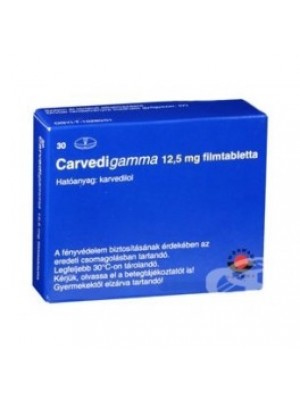
CARVEDIGAMMA 12.5 mg. 30 tablets Carvedigamma 12,5 mg Filmt..
8.00€
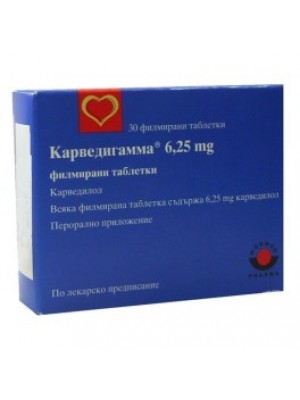
CARVEDIGAMMA 6.25 mg. 30 tablets Carvedigamma 6,25 mg Filmt..
8.00€