Your shopping cart is empty!
Welcome visitor you can login or create an account.
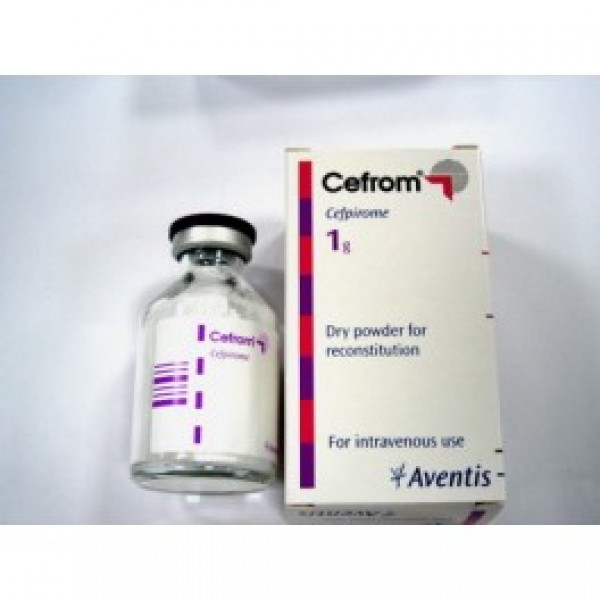
CEFROM 1g.
Product Code: CEFROM 1g.
Availability: In Stock
Product viewed: 1217


CEFROM 1g.
WHAT CEFROM AND WHAT IT IS USED?
The name of your medicine is CEFROM. The active substance cefpirome sulphate belongs to the group of medicines called antibiotics. Antibiotics kill the bacteria that cause infections.
CEFROM can be used in a wide variety of bacterial infections caused by microorganisms susceptible to it. These include infections of the chest and lungs, e. bronchopneumonia; urinary tract (kidney or bladder); skin, e. abscesses and infected wounds. It can also be used to treat infections in humans with a low number of white blood cells.
2. BEFORE YOU PRIMEMATE CEFROM
Before you apply CEFROM, please read the following questions:
- Have you experienced ever severe reaction to an antibiotic or other antibiotics, particularly penicillin?
- Are you pregnant? Do you breastfeed? Are you allergic to sodium carbonate? Aged under 12 years old? Do you have kidney disease?
Do you suffer from inflammation of the intestines (colitis)?
If any of these questions apply to you, should you not be an injection or infusion-discuss the situation with your nurse or doctor before you are given your medicine.
If you develop diarrhea during or after therapy tell your doctor
The sodium content in the product should be considered in patients niskosoleva diet. One vial contains 1 g Na - 0.105 g; in a vial 2 g contains
Na - 0.210 g, calculated with reference to the molecular weight. Pregnancy and lactation
Tsefrom should not be used in pregnancy.
Since kdto cefpirome is excreted in human milk or tsefrom treatment should be discontinued, or breastfeeding should be discontinued.
Effects on ability to drive and use machines
No data CEFROM distort the ability to drive or operate machinery.
IN CASE OF DOUBT DO NOT HESITATE TO ASK YOUR DOCTOR OR PHARMACIST.
Are you taking any other medicines?
CEFROM may interact with other medicines that might take, such as loop diuretics (used to increase urine output), aminoglycoside antibiotics (used to treat infections) and probenecid (used to control gout).
In certain cases, your doctor may order additional monitoring, but this is routine and is not cause for concern.
It is important to tell your doctor, nurse or pharmacist about all the medicines you are taking, including those bought without a prescription.
3. HOW TO TAKE CEFROM?
Your medicine will always be given to you by a doctor or nurse. This is because it must be given by injection or infusion.
Your doctor will prescribe the correct dose for you the medicine depending on the type of infection and some other diseases that you may have. If you ask the person who administered the drug, he will tell you how much and how often you are prescribed by your doctor.
What happens if you take any more?
It is unlikely that your doctor or nurse will give you a greater amount of the drug. Your doctor or nurse will monitor your progress and check the medicine you receive. Always ask if you are not sure why you get a dose of the drug.
What happens if I miss a dose?
Your doctor or nurse will have instructions on when to give you your medicine. It is unlikely that the drug should not be given to you as prescribed. If you think you may have missed a dose, talk to your nurse or doctor. It is important that the course of treatment prescribed by your doctor to be met. You may start to feel better, but it is important not to stop taking your medicine unless your doctor advises otherwise your condition may again deteriorate.
4. POSSIBLE SIDE EFFECTS
You may get a rash or itchy skin, fever, swelling of the throat, headaches, pain in the kidney area, upset stomach, mild nausea, diarrhea. If diarrhea is much worse, you should not apply more Tsefrom and other drugs and to stop.
If Tsefrom is administered as an injection, some people feel mild pain at the injection site, while the skin can be felt a burning or itching.
Some people find that their taste is changed for a short time after taking Tsefrom.
People can sometimes develop severe allergic reactions such as difficulty in breathing, swelling of the face, tongue and throat that require immediate treatment. If this happens to you, you should immediately call your doctor or nurse.
Tsefrom can sometimes have an impact on your blood, although this is very unusual. This may make you feel tired or unwell. If you take the drug more than 10 days, your doctor may ask you to do a blood test, for example for blood sugar, but it is routine and not a cause for concern.
If you think you have any of these or other side effects to your medication, immediately talk to your doctor or nurse.
5. HOW TO STORE YOUR MEDICINE?
Your medicine should not be used after the expiry date stated on the packaging.
CEFROM vials should be stored at temperatures below 25 ° C (normal room temperature), protected from light.
The reconstituted solution is stable for up to 24 hours at 2 to 8 ° C. Keep out of reach of children.
You will be required to store the drug. It will carry up your bed ready for use.
6. FURTHER INFORMATION
This is the powder, which is dissolved usually in water for injection to obtain a solution ready for use as injection or infusion ("drip").
If CEFROM is given by injection, it contains a concentration of lg cefpirome as active substance in 10 ml of solution.
If CEFROM administered as an infusion may contain a concentration of 1 g cefpirome as active substance in 50ml ml or 100ml solution. CEFROM comes in a pack of 1 g or 2 g of cefpirome. The solution for injection further comprises anhydrous sodium carbonate.
The infusion solution contains sodium carbonate anhydrous, and may contain ingredients, depending on the liquid used for your injection, which has been prescribed by your doctor. You should ask the person who makes the infusion you what it contains, in case you are allergic to any of these ingredients.
The active substance cefpirome sulphate belongs to the group of medicines called antibiotics. Antibiotics kill the bacteria that cause infections.
Dry substance Tsefrom dissolving in a glass type III vials with rubber stoppers coated and sealed with aluminum caps.
Secondary packaging - cardboard box x 1 vial
Write a review
Your Name:Your Review: Note: HTML is not translated!
Rating: Bad Good
Enter the code in the box below:
Related Products