
Your shopping cart is empty!
Welcome visitor you can login or create an account.
CITERAL 500 mg. 10 tablets
Product Code: CITERAL 500 mg. 10 tablets
Availability: In Stock
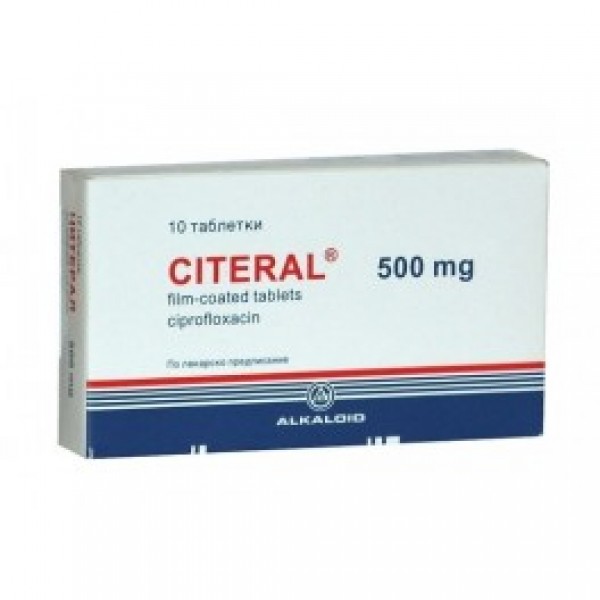
Product viewed: 2569


CITERAL 500 mg. 10 tablets
CITERAL WHAT IS AND WHAT IT IS USED?
The active substance of Citeral is ciprofloxacin. Citeral is an antibiotic of the fluoroquinolone. Citeral works by destroying certain bacteria that cause infection. It is effective against certain strains of bacteria. adults
In adults Citeral used for treatment of the following infections:
- Respiratory tract infections;
- Prolonged or repeated ear infections or sinus;
- Urinary tract infections;
- Infections of the testicles;
- Genital infections in women;
- Gastrointestinal and intra-abdominal infections;
- Infections of skin and soft tissue;
- Infections of bones and joints;
- For the treatment of infections in patients with very low numbers of white blood cells (neutropenia);
- For the prevention of infections in patients with severely reduced number of white blood cells (neutropenia);
- To prevent infections with Neisseria meningitidis; inhalation of anthrax spores.
If you have a severe infection or one that is caused by more than one species of bacteria may be prescribed another antibiotic treatment in addition to Citeral.
Children and adolescents
In children and adolescents Citeral be used under strict medical supervision for the treatment of the following infections:
- Lung and bronchial infections in children and adolescents suffering from cystic fibrosis;
- Complicated urinary tract infections, including infections that have reached the kidneys (pyelonephritis);
- Inhalation of anthrax spores.
Citeral can be used to treat other severe infections in children and adolescents when the doctor thinks it is necessary.
2. BEFORE YOU TAKE CITERAL
Do not take Citeral
If you are allergic (hypersensitive) to the active substance, to other quinolone preparations or to any of the ingredients of Citeral. If you are taking tizanidine (see section 2. Taking other medicines).
Take special care with Citeral:
Before taking Citeral Tell your doctor if:
- Suffer from kidney disease, as it may require dose adjustments;
- Suffer from epilepsy or other neurological diseases; have had problems with tendons during previous treatment with antibiotics like Citeral;
- Suffer from myasthenia gravis (a type of muscle weakness); have or have had irregular heart rhythm (arrhythmia).
In the course of treatment Citeral
Tell your doctor immediately if you happen to any of the following, while taking Citeral. Your doctor will decide whether you need to stop taking Citeral.
Severe, sudden allergic reaction (anaphylactic reaction / shock, angioedema). Even with the first dose there is little risk of a severe allergic reaction with the following signs: chest tightness, dizziness, fainting or weakness, dizziness when standing up quickly. If you experience something, stop taking Citeral and contact your doctor.
Can sometimes occur pain and swelling in the joints and tendons, especially in older patients or concomitant treatment with corticosteroids. At the first sign of pain or inflammation stop taking Citeral and keep at rest the affected joint. Avoid loading it, as this increases the risk of tendon rupture.
If you suffer from epilepsy or other neurological disorders such as cerebral ischemia or stroke, you may experience side effects associated with the central nervous system. In this case, stop taking Citeral and immediately contact your doctor.
The first intake of Citeral may experience psychiatric reactions. If you suffer from depression or psychosis, your symptoms may worsen while taking Citeral. If this happens, stop taking Citeral and immediately contact your doctor.
You may experience symptoms of neuropathy, such as pain, burning, tingling, numbness and / or weakness. If this happens, stop taking Citeral and immediately contact your doctor.
In the course of antibiotics, including Citeral even a few weeks after taking can occur diarrhea. If diarrhea is severe and continuous, or if you notice blood or mucus in the stools, stop taking Citeral as this condition can be life threatening. Do not take medicines that stop or slow down bowel movements and contact your doctor;
Tell your doctor or clinician acceptance Citeral if you do a blood test or urine.
Citeral can cause liver damage. If you notice signs such as loss of appetite, jaundice, dark urine, itchy skin, sensitive stomach, stop taking Citeral and immediately contact your doctor.
Citeral may reduce the number of white blood cells (agranulocytosis), and resistance to infection forces you to lose weight. If you experience signs of infection such as fever and serious deterioration of your general condition, or fever with signs of local infection such as sore throat / pharynx / mouth / urinary tract infection, consult your doctor immediately. It may be necessary to perform a blood test, to check the possible reduction in the number of white blood cells (agranulocytosis). It is important to tell your doctor about taking this medicine.
Tell your doctor if you or a family member suffers from glucose-6-phosphate dehydrogenase deficiency as a possible risk of anemia when taking ciprofloxacin.
Your skin becomes more sensitive to sunlight or ultraviolet light while taking ciprofloxacin. Avoid exposure to sunlight or artificial UV light such. solarium.
Taking other medicines
Please tell your doctor or pharmacist if you are taking or have recently taken any other medicines, including medicines obtained without a prescription. Citeral not take simultaneously with tizanidine, as this can lead to side effects such as low blood pressure and sleepiness. The following drugs interact with Citeral. Taking Citeral with these drugs may interfere with their therapeutic effect. Increases the likelihood of side effects.
Tell your doctor if you take:
- Warfarin or other oral anticoagulants (blood thinners);
- Probenecid (used for gout);
- Methotrexate (for certain types of cancer, psoriasis, rheumatoid arthritis);
theophylline (used in asthma);
- Tizanidine (for muscle spasticity in multiple sclerosis); clozapine (an antipsychotic); ropinirole (for Parkinson's disease); phenytoin (for epilepsy).
Citeral can increase the level of these drugs in the blood: pentoxifylline (for circulatory disorders); caffeine.
Some drugs reduce the effect of Citeral. Saoobshtete your doctor if you are taking or plan to take:
- Antacids (medicines that neutralize stomach acid); mineral supplements;
- Sucralfate (a drug for the treatment of peptic ulcer); phosphate binding polymer (sevelamer);
- Medicines or supplements containing calcium, magnesium, aluminum or iron.
If use of the above medications is crucial Citeral take about two hours before or no sooner than four hours after their admission.
Taking Citeral with food and drink
Do not take Citeral dairy (milk or yogurt) or drinks with added calcium, as they may affect the absorption of the active substance.
Pregnancy and lactation
Ask your doctor or pharmacist before taking any medicine.
Citeral intake during pregnancy should be avoided. Tell your doctor if pregnant.
Citeral not take if you are breastfeeding, as ciprofloxacin is excreted in breast milk and may harm your child.
Driving and using machines
Citeral can make you less alert. Some neurological side effects may occur. So make sure you know how you react to Citeral before driving or operating machinery. When in doubt, talk to your doctor.
3. HOW TO TAKE CITERAL?
Always take Citeral exactly as you have been told by your doctor. If you are not sure, ask your doctor shi pharmacist.
Your doctor will tell you how Citeral should take, as well as how often and how long you should take it. This depends on the type and severity of infection. Tell your doctor if you have kidney problems, because it may require a dose adjustment.
Treatment usually lasts from 5 to 21 days, but in severe infections may last longer. Take the tablets exactly as your doctor has told you. Consult your doctor or pharmacist if you are unsure how and how many tablets to take Citeral.
a) swallow the tablets with sufficient fluid. Do not chew the tablets;
b) try to take the tablets at the same time each day;
c) can take the tablets during meals or between meals. Calcium contained in the food does not affect absorption of the drug. But do not take the tablets Citeral dairy drinks or juices with added calcium. Be sure to get plenty of fluids during treatment with Citeral.
If you take more than you should Citeral
If you take more than the prescribed dose, seek medical attention immediately. If possible, take your tablets and their packaging to show the doctor.
If you forget to take Citeral
If you miss taking a dose of the dose needed to be taken immediately after the establishment of the omission. If it has already approached the time for the next dose then wait and take the due dose skip the missed like. Do not take a double dose to make up for a missed dose. Make sure you have completed your course of treatment.
If you stop taking Citeral
It is important to finish the course of treatment even if you feel better after a few days. If you stop taking the medicine too soon, it may be that your infection is not completely cured and signs her to return and even get worse. Can develop and resistance to the antibiotic.
If you have any further questions on the use of this product, ask your doctor or pharmacist.
4. POSSIBLE SIDE EFFECTS
Like all medicines, Citeral can cause side effects, although not everybody gets them.
Common side effects (less than 1 in 10 but more than 1 in 100 patients treated):
nausea, diarrhea;
joint pain in children.
Uncommon side effects (less than 1 in 100 patients but more than 1 in 1,000 patients):
fungal superinfection;
high concentration of eosinophils (a type of white blood cell); loss of appetite (anorexia); hyperactivity or anxiety
headache, dizziness, sleep disturbances, taste disturbances
vomiting, abdominal pain, indigestion (stomach heaviness, burning, belching or gas);
increased levels of some indicators in the blood (transaminases and / or bilirubin) rash, itching or hives; joint pain in adults; decreased renal function;
muscle and bone weakness (asthenia), or fever; increase the level of alkaline phosphatase in the blood.
Rare side effects (less than 1 in 1,000, but more than 1 in 10 000 patients treated):
inflammation of the bowel (colitis) due to the use of antibiotics (in very rare cases can be fatal) (see item 2. Take special care with Citeral);
changes in the number of blood cells (leukopenia, leukocytosis, neutropenia, anemia); increased or decreased number of platelets (factor blood clotting);
allergic reactions, swelling (edema), rapid swelling of the skin and mucosa (angioedema); high blood sugar (hyperglycemia);
confusion, disorientation, anxiety, abnormal dreams, depression, hallucinations;
tingling and numbness, unusual sensitivity of the senses, decreased skin sensitivity; tremor, seizures (see item 2. Take special care with Citeral) or dizziness; visually impaired;
tinnitus, hearing loss, hearing loss; rapid heart rate (tachycardia);
dilation of blood vessels (vasodilation), low blood pressure, loss of consciousness;
shortness of breath, including asthma symptoms; liver disorders, jaundice (cholestatic) or hepatitis; sensitivity to light;
muscle pain, joint inflammation, increased muscle tone or Kram; renal failure, blood or crystals in the urine (see item 2. Take special care with Citeral), inflammation of the urinary tract; fluid retention or excessive sweating;
pathological levels of clotting factors (prothrombin) or increased levels of the enzyme amylase.
Very common side effects (less than 1 in 10 000 patients treated):
special case of a reduced number of red blood cells (hemolytic anemia); dangerous drop in white blood cells (agranulocytosis); decrease the number of red and white blood cells and platelets (pancytopenia), which may be fatal; bone marrow depression, which can also be fatal;
severe allergic reactions (anaphylaxis or anaphylactic shock, which can be fatal - serum sickness);
psychiatric disorders (psychotic reactions); (see item 2. Take special care with Citeral);
migraine, disturbed coordination, uncertain gait, abnormal taste and smell, increased intracranial pressure;
breach of color vision;
inflammation of the wall of blood vessels (vasculitis); pancreatitis;
destruction of liver cells (liver necrosis) very rarely leading to life-threatening liver failure;
small pinpoint bleeding (petechiae); various skin eruptions (eg. a potentially fatal syndrome Steven Johnson and toxic epidermal necrolysis);
muscle weakness, inflammation of the tendons, tendon rupture - especially the great Achilles tendon; worsening of symptoms of myasthenia gravis (see section 2. Take special care with Citeral).
Not known (can not be estimated from the available data):
complaints of the nervous system such as pain, burning, tingling, numbness and / or weakness in the limbs
severe heart rhythm disorders, irregular heartbeat (torsades de pointes).
If any of the side effects gets serious, or if you notice other effects not listed in this leaflet, please tell your doctor or pharmacist.
5. HOW TO STORE CITERAL?
This medicinal product does not require any special storage conditions. Keep out of reach of children.
Citeral not use after the expiry date stated on the package (for expiry date abbreviation used). The expiry date refers to the last day of that month.
Medicines should not be disposed of via wastewater or household waste. Ask your pharmacist how to dispose of medicines no longer required. These measures will help to protect the environment.
6. FURTHER INFORMATION
What Citeral?
The active substance is ciprofloxacin. Citeral 250 mg: Each tablet contains 291,5 mg ciprofloxacin hydrochloride monohydrate, corresponding to 250 mg ciprofloxacin. Citeral 500 mg: Each tablet contains 583 mg ciprofloxacin hydrochloride monohydrate, corresponding to 500 mg ciprofloxacin.
Other ingredients are: Tablet core: Maize starch; cellulose, microcrystalline; magnesium stearate; crospovidone; silica colloidal anhydrous; gelatin. Tablet coating: hypromellose; macrogol 4000; Titanium dioxide E171.
Write a review
Your Name:Your Review: Note: HTML is not translated!
Rating: Bad Good
Enter the code in the box below:
Related Products
TSIPROLON table. 750 mg. 10 table TSIPROLON WHAT IS AND WHAT..
17.00€

CIPROFLOXACIN 250 mg. 20 tabletsWhat is Ciprofloxacin Actavi..
19.00€