Your shopping cart is empty!
Welcome visitor you can login or create an account.
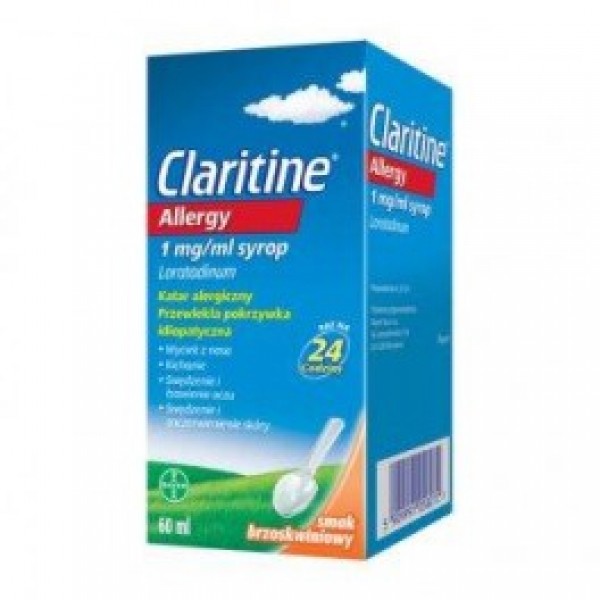
CLARITINE syrup 120ml.
Product Code: CLARITINE syrup 120ml.
Availability: In Stock
Product viewed: 1204


CLARITINE syrup 120ml.
WHAT CLARITINE AND WHAT IT IS USED
CLARITINE belongs to a class of medicines known as antihistamines. Antihistamines help to reduce allergic symptoms by preventing the effects of a substance called histamine, which is produced in the body.
CLARITINE relieves symptoms associated with allergic rhinitis (eg. Hay fever) such as sneezing, runny or itchy nose, and burning or itchy eyes.
CLARITINE can also be used in the treatment of urticaria (hives), to relieve symptoms such as itching, redness and to reduce the number and size of hives.
Relief of these symptoms lasts throughout the day and helps in the normal course of daily activities and sleep.
2. BEFORE YOU TAKE CLARITINE
Do not take CLARITINE
if you are allergic (hypersensitive) to loratadine or any of the other ingredients of CLARITINE.
Take special care with CLARITINE
Before taking CLARITINE, tell your doctor or pharmacist:
if you have liver disease.
Using other medicines
There are no known drug interactions between CLARITINE and other drugs. However, tell your doctor if you are taking or have taken recently other medicines, even those without a prescription.
laboratory tests
If you are having a skin tests for allergies you should not take Klaritin two days before testing because the drug will affect the test results.
Taking CLARITINE with food and drink
CLARITINE can be taken without regard to food. With concomitant use of alcohol Klaritin not lead to potentiation of the action of alcohol.
Pregnancy and lactation
If you are pregnant, CLARITINE intake is not recommended.
If you are breastfeeding, intake of CLARITINE not recommended. Loratadine is excreted in breast milk
Consult your doctor or pharmacist before taking any medicine.
Driving and using machines
At the recommended dose is not expected CLARITINE cause sleepiness or decreased attention.
However, very rarely some people experience drowsiness, which may affect the ability to drive and use machines.
Important information about some of the ingredients of CLARITINE
Klaritin syrup contains sucrose; if your doctor has told you that you have an intolerance to some sugars, contact your doctor before taking this product.
3. HOW TO TAKE CLARITINE
Consult your doctor or pharmacist if you are unsure.
The usual dose is:
Adults and children over the age of 12
Two teaspoons (10 ml) syrup once daily with or without food; water and other fluids are not needed to swallow the syrup.
Children from 2 to 12 years old - the dosage is determined by weight:
Body weight over 30 kg:
Two teaspoons (10 ml) syrup once daily with or without food; water and other fluids are not needed to swallow the syrup.
Weighing less than or equal to 30 kg:
One teaspoon (5 ml) syrup once daily with or without food; water and other fluids are not needed to swallow the syrup.
Patients with liver problems:
Adults and children weighing over 30 kg:
Two teaspoons (10 ml) syrup once a day every other day with or without food; water and other fluids are not needed to swallow the syrup.
Children weighing less than or equal to 30 kg:
One teaspoon (5 ml) syrup once daily every other day, with or without food; water and other fluids are not needed to swallow the syrup.
Efficacy and safety of CLARITINE in children under 2 years of age have not been established.
If you take more than the amount CLARITINE
So far not established any serious problems after an accidental overdose of Klaritin. The most common symptoms of overdose are sleepiness, increased heart rate and headaches. In case of overdose of CLARITINE, immediately call your doctor or pharmacist.
If you forget to take CLARITINE
If you forget to take your medicine on time, take it as soon as possible, then go back to your regular schedule. Do not take a double dose to make up for a missed dose.
4. POSSIBLE SIDE EFFECTS
Like all medicines, CLARITINE can cause side effects, although not everybody gets them.
The most commonly reported adverse events in children aged between 2 and 12 years are headache, nervousness and tiredness. The most commonly reported side effects in adults and adolescents were somnolence, headache, increased appetite and difficulty sleeping.
In post-marketing CLARITINE rarely been reported cases of severe allergic reaction, dizziness, irregular heartbeat, rapid heartbeat, nausea, dry mouth, upset stomach, liver problems, hair loss, rash and fatigue.
If any of the side effects gets serious, or you notice other effects not listed in this leaflet, please tell your doctor or pharmacist.
5. HOW TO STORE CLARITINE
Do not store above 25? C.
Do not freeze.
Shelf life after opening: 1 month.
Keep out of reach of children.
Do not use CLARITINE after the expiry date stated on the carton. Tell your doctor or pharmacist if you notice any change in the type of Klaritin.
Medicines should not be disposed of in wastewater or household waste. Ask your pharmacist how to dispose of medicines no longer required. These measures will help to protect the environment.
6. FURTHER INFORMATION
What CLARITINE
The active substance is loratadine 1 mg / ml.
The other ingredients are: propylene glycol, glycerin, anhydrous citric acid, sodium benzoate, sucrose, artificial aromas of peach, purified water.
CLARITINE looks like and contents of the pack?
CLARITINE syrup comes in 120 ml of dark brown glass bottles and spoon.
Write a review
Your Name:Your Review: Note: HTML is not translated!
Rating: Bad Good
Enter the code in the box below:
Related Products


DESIBEL syrup 2.5 mg. / 5 ml. 150 ml.What DESIBEL and what i..
12.00€