Your shopping cart is empty!
Welcome visitor you can login or create an account.
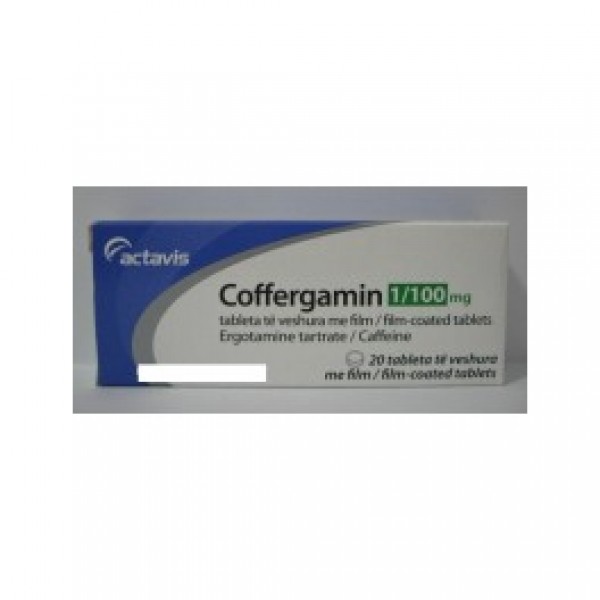
Coffergamin 20 tablets
Product Code: Coffergamin 20 tablets
Availability: In Stock
Product viewed: 1119


Coffergamin 20 tablets
What is COFFERGAMIN and what it is used
COFFERGAMIN combined medicinal product belonging to the group of so-called anti-migraine drugs. Ergotamine affects migraine headaches by changing the tone of cerebral vessels, causing them to tighten and eliminate pain originating from sensory endings in the vessel wall occurring in its expansion. Caffeine contributes to enhancing the effect of ergot.
COFFERGAMIN used to prevent and treat attacks of migraine and migraine like (histamine) headache.
2. What you need to know before taking Kofergamin
Do not take COFFERGAMIN
if you are allergic to any of the active substances or to any of the other ingredients of this medicine (listed in section 6);
in coronary insufficiency (impaired blood supply to the heart muscle);
for violations of the peripheral circulation;
if you have hypertension (high blood pressure);
in severe hepatic and renal failure;
in sepsis and other serious infections;
simultaneously with certain drugs (macrolide antibiotics, HIV protease inhibitors, for the treatment of infection with the AIDS virus, azole antifungals - see. Other medicines and point COFFERGAMIN);
simultaneously with other vasoconstrictive drugs (including ergot alkaloids, beta-blockers, sympathomimetics, sumatriptan and other 5HT1 receptor agonists);
during pregnancy and lactation.
Warnings and Precautions
In the treatment of migraine, Kofergamin is effective at reception during the first signs of migraine attacks occurring. Not suitable for treatment in the interval between migraine attacks.
Talk to your doctor or pharmacist before taking COFFERGAMIN if:
migraine attacks you occur more frequently than 2 times a month. In this case, your doctor may advise you to take another medicine with Kofergamin;
you have overactive thyroid gland, because you risk of ergotism is higher;
suffer from chronic insomnia;
experiencing anxiety, anxiety and fear;
you are aged 60 and older.
If you suffer from frequent headaches and regular use of pain medication does not help, you should contact your doctor.
To prevent the possible development of chronic headaches (MES) recommended daily doses should be observed carefully and in particular to avoid higher monthly use of funds for the treatment of migraine.
The administration of ergotamine more often than 2-3 times a week, often cause drug dependence and ergot headache. You should not take the medicine for longer than prescribed to prevent the occurrence of ergotism (pronounced narrowing of peripheral vessels, leading to symptoms of peripheral vascular disease - pain in the limbs, bruising, gangrene).
During treatment, your doctor will monitor you for possible occurrence of violations of the peripheral circulation, whereby discontinuation of treatment.
Other medicines and COFFERGAMIN
Tell your doctor or pharmacist if you are taking, you have recently taken or might take any other medicines.
Be sure to tell your doctor if you are taking the following medicines:
other medications for the treatment of headaches, particularly if they are ergot derivatives;
antiviral agents (HIV protease inhibitors) for the treatment of infection with HIV, such as amprenavir, indinavir, nelfinavir, ritonavir, saquinavir, atazanavir, efavirenz;
antifungal agents such as ketoconazole, miconazole, itraconazole, posaconazole, voriconazole;
macrolide antibiotics (eg. erythromycin, clarithromycin);
beta-blockers (metoprolol, propranolol, etc.) and triptans or m. called. 5-HT, receptor agonists (zolmitriptan, flovatriptan, sumatriptan, etc.).
When concomitant administration of medicines listed above together with Kofergamin increases the risk of vasoconstriction and poor circulation in the limbs, this risk is increased in smokers who use Kofergamin;
sympathomimetics (dopamine, epinephrine, ephedrine, salbutamol, etc.). Concurrent with Kofergamin possible strong increase in blood pressure;
stimulants of the central nervous system (incl. tea, coffee, chocolate). If taken together with Kofergamin may occur excitation, insomnia, arrhythmia;
MAO inhibitors (used to treat depression such as moclobemide). Possible occurrence of palpitations and a strong increase in blood pressure when used with Kofergamin;
fluoroquinolones, which are used for bacterial infections (ciprofloxacin, ofloxacin, moxifloxacin);
nitroglycerin (used for angina).
COFFERGAMIN with food, drinks and alcohol
No evidence of the need for special diets or restrictions on certain types of foods and beverages during treatment with this product.
Drinking alcohol during treatment may enhance headache and migraine symptoms.
Pregnancy, lactation and fertility
If you are pregnant or breast-feeding, you think you may be pregnant or planning to become pregnant, ask your doctor or pharmacist before taking this medicine.
pregnancy
Kofergamin not be used during pregnancy and lactation. For pregnant women risk of harm to the fetus.
breastfeeding
Caffeine is excreted in small amounts in milk, but can lead to hyperexcitability, insomnia and other signs of caffeine stimulation in the infant. Ergotamine also be broadcast in breast milk and can cause vomiting, diarrhea, weakened pulse and unstable blood pressure in the infant.
Driving and using machines
Dizziness and anxiety (shaking, sweating, etc.) Have been reported in some patients treated with ergot, therefore, these patients should avoid driving, operating machinery and performing activities requiring mental alertness and rapid mental and motor reactions .
Kofergamin contains lactose and wheat starch
If your doctor has told you that you have an intolerance to some sugars, contact your doctor before taking this product.
Wheat starch is suitable for people with celiac disease (gluten enteropathy). Patients with wheat allergy (different from celiac disease) should not take this product.
3. How to take Kofergamin
Always take this medicine exactly as you have been told by your doctor or pharmacist. If you're not sure, ask your doctor or pharmacist.
It is through the mouth with a small amount of liquid.
Usual doses:
Adults:
In signs of an upcoming attack or onset of a migraine attack to take 2 tablets. If the crisis is not affected in 1/2 hour take 1 tablet to a maximum of 6 tablets per day. A single dose should not exceed 4 tablets. The maximum weekly dose of 10 tablets.
Use in children and adolescents
This product is not recommended for children. Their safety and efficacy have not been established.
If you take more than the amount COFFERGAMIN
When taking a higher dose than prescribed, immediately contact a doctor!
One may observe some of the following symptoms: nausea; vomiting; numbness, pain and bruising of the limbs; weakened or inaudible heartbeat, high or low blood pressure; confusion; respiratory depression, convulsions; shock; coma.
Treatment is carried out in a hospital.
If you forget to take Kofergamin
If you miss a dose, take it at the next regular intake without increasing the dose. Do not take a double dose to make up the missed dose.
If you have any further questions on the use of this medicine, ask your doctor or pharmacist.
4. Possible side effects
Like all medicines, this medicine can cause side effects, although not everybody gets them.
Adverse reactions associated with the use of Kofergamin are caused primarily by ERGOTEH the new ingredient.
Some patients may experience the following reactions:
Common (may affect up to 1 in 10 patients):
vomiting (not migraine related), abdominal pain and dizziness.
Uncommon (may affect up to 1 in 100 patients):
tingling, numbness, reduced sensitivity, bruising, pain and weakness in the limbs, diarrhea.
Rare (may affect up to 1 in 1000 patients):
allergic reactions (such as rash, facial swelling, urticaria, and dyspnea), dizziness, slow or fast heartbeat, increased blood pressure, muscle pain, diminished or inaudible pulse ergotism (pronounced constriction of peripheral vessels, leading to symptoms of peripheral vascular insufficiency).
Rare cases of impaired blood supply to the intestine associated with chronic administration or overdose of ergotamine-containing products. Rarely can provoke headaches due to either chronic overdose or rapid discontinuation.
Very rare (may affect up to 1 in 10,000 patients):
pain in the heart area due to impaired blood supply to the heart muscle, myocardial infarction and gangrene.
Excessive use of ergotamine-containing products for an extended period can cause fibrotic changes (adhesions) in the pleura and peritoneum. There have been also rare cases of scarring of the heart valves.
If you get any side effects, contact your doctor or pharmacist. This includes any possible effects not listed in this leaflet.
5. How to store COFFERGAMIN
At temperatures below 25 ° C!
Keep out of reach of children.
Do not use this medicine after the expiry date stated on the carton. The expiry date refers to the last day of that month.
Do not dispose of medications in wastewater or household waste. Ask your pharmacist how to dispose of medicines no longer use. These measures will help to protect the environment
6. Contents of the pack and other information
What COFFERGAMIN
The active ingredients in one tablet are: ergotamine tartrate 1 mg and caffeine and 100 mg.
The other ingredients are hydroxypropyl cellulose, lactose monohydrate, corn starch, talc, magnesium stearate, sodium starch glycolate, crospovidone, methacrylic acid - methacrylate (1: 1), titanium dioxide, coloring agent E155, macrogol 6000.
COFFERGAMIN looks like and contents of the pack
Round film-coated tablets with brown.
10 pieces coated tablets packed in blisters of PVC / AL foil.
2 blisters in a cardboard box along with a leaflet.
Write a review
Your Name:Your Review: Note: HTML is not translated!
Rating: Bad Good
Enter the code in the box below:
Related Products