
Your shopping cart is empty!
Welcome visitor you can login or create an account.
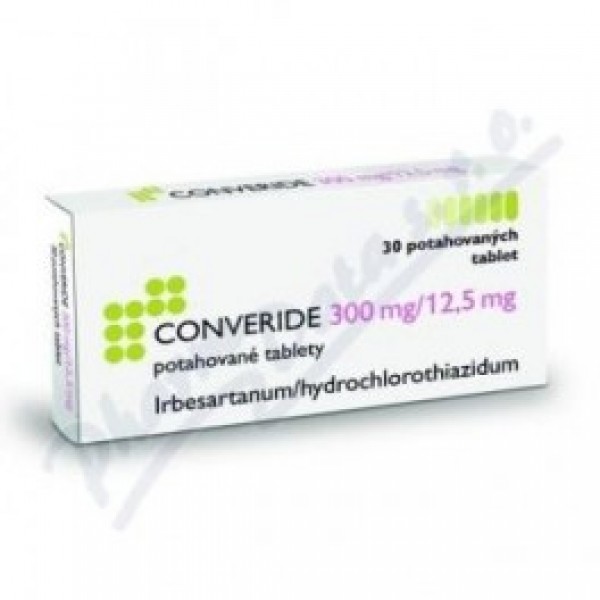
CONVERIDE 300 mg. / 12.5 mg. 30 tablets
Product Code: CONVERIDE 300 mg. / 12.5 mg. 30 tablets
Availability: In Stock
Product viewed: 1087


CONVERIDE 300 mg. / 12.5 mg. 30 tablets
What is CONVERIDE and what it is used
CONVERIDE is a combination of two active substances - irbesartan and hydrochlorothiazide. Irbesartan belongs to a group of medicines known as angiotensin-II receptor antagonists. Angiotensin-II is a substance produced by the body which binds to receptors on the blood vessels, causing them to shrink. This leads to an increase in blood pressure. Irbesartan prevents the binding of angiotensin-II to these receptors, thereby relaxes blood vessels and lower blood pressure. Hydrochlorothiazide belongs to a group of medicines (called thiazide diuretics) which increase urine production and thus lower blood pressure.
The two active substances in CONVERIDE interact to lower blood pressure more than if applied separately.
CONVERIDE is used to treat high blood pressure when treatment with irbesartan or hydrochlorothiazide does not result in adequate control of your blood pressure.
2. What you need to know before taking CONVERIDE
Do not take CONVERIDE
If you are allergic to irbesartan or any of the other ingredients of this medicine (listed in section 6);
If you are allergic to hydrochlorothiazide or other sulfonamide-derived medicines;
If you are pregnant after the third month. (It is advisable to avoid taking CONVERIDE in the early stages of pregnancy - see pregnancy section);
If you suffer from severe liver or kidney disease;
If you have difficulties in urination;
If your doctor finds that you have persistently high calcium or low potassium levels in the blood;
If you suffer from diabetes mellitus or renal impairment and are treated with medication to lower blood pressure containing aliskiren.
Warnings and Precautions
Talk to your doctor before taking CONVERIDE if any of the following apply to you:
If you suffer from excessive vomiting and diarrhea;
If you have problems with your kidneys or your transplanted kidney;
If you have heart problems;
If you have liver problems;
If you suffer from diabetes;
If you suffer from lupus erythematosus (also known as lupus or SLE);
If you suffer from primary aldosteronism (a condition associated with increased production of the hormone aldosterone, which causes sodium retention and thus increase blood pressure);
If you are taking any of these medicines used to treat high blood pressure:
ACE inhibitor (e.g. enalapril, lisinopril, ramipril), especially if you have kidney problems associated with diabetes;
aliskiren.
Your doctor may periodically check your kidney function, blood pressure and the amount of electrolytes (eg. Potassium) in your blood.
See also the information titled "Do not take CONVERIDE
You should tell your doctor if you think you are (or might become) pregnant.CONVERIDE not recommended in the early stages of pregnancy and should not be taken after the third month of pregnancy because it may cause serious harm to your baby if given during this period (see pregnancy section).
You should also tell your doctor:
If you are on restricted diet of salt;
If you have signs such as abnormal thirst, dry mouth, general weakness, drowsiness, muscle pain or cramps, nausea, vomiting, or an abnormally fast heart rate, which may be due to an increased effect of hydrochlorothiazide (contained in CONVERIDE);
If you experience increased sensitivity of the skin to the sun with symptoms of sunburn (such as redness, itching, swelling, scaling) that appear faster than usual;
If you have an operation (surgery) or receive anesthetics;
If you experience changes in vision or pain in one or both eyes while taking CONVERIDE. These may be symptoms of glaucoma, increased pressure in the eye (s). You should stop taking CONVERIDE and seek medical attention.
Children and adolescents
KONVERID should not be taken by children and adolescents (under 18 years).
Other medicines and CONVERIDE
Tell your doctor or pharmacist if you are taking or have recently taken any other medicines.
Diuretics such as hydrochlorothiazide contained in KONVERID may affect the way other medicines.CONVERIDE should not be taken with products containing lithium without close supervision by your doctor.
You may need your doctor may change the dose and / or take other precautions:
if you are taking an ACE inhibitor or aliskiren (see also information entitled "Do not take CONVERIDE" and "Warnings and Precautions").
You may need to give you a blood test if you are taking:
potassium supplements;
salt substitutes that contain potassium;
potassium-sparing medicines or other diuretics ( "water" tablets);
some laxatives;
drugs for the treatment of gout;
therapeutic vitamin supplements D;
medicines to control heart rhythm;
medicines for diabetes (oral agents or insulin);
carbamazepine (medicines to treat epilepsy).
It is also important to tell your doctor if you are taking other medicines to lower blood pressure, steroids, medicines to treat cancer, pain killers, arthritis medicines or cholestyramine and resins containing colestipol to lower blood cholesterol.
CONVERIDE with food and drink
Due to the hydrochlorothiazide in CONVERIDE, if you drink alcohol during treatment with this medicine, you may experience increased feeling of dizziness on standing up, especially when getting up from a sitting position.
Pregnancy, lactation and fertility
If you are pregnant or breast-feeding, you think you may be pregnant or planning to become pregnant, ask your doctor or pharmacist before taking this medicine.
pregnancy
Your doctor will normally advise you to stop taking CONVERIDE before you become pregnant or as soon as you know you are pregnant and will prescribe another medicine instead CONVERIDE.
CONVERIDE not recommended during pregnancy and should not be taken after the third month of pregnancy because it may cause serious harm to your baby if taken after the third month of pregnancy.
breastfeeding
CONVERIDE not recommended for mothers who are breastfeeding, and your doctor may choose another treatment if you wish to breastfeed, especially if your baby is newborn or preterm.
Driving and using machines
No studies on the effects on ability to drive and use machines. KONVERID unlikely to affect your ability to drive or operate machinery. However, sometimes during the treatment of high blood pressure may occur dizziness or faintness. If you experience any of these symptoms, consult your doctor before you drive or operate machinery.
CONVERIDE contains lactose.
If your doctor has told you suffer from an intolerance to some sugars (eg lactose), contact your doctor before taking this medicine.
3. How to take CONVERIDE
Always take this medicine exactly as your doctor has told you. If you're not sure, ask your doctor or pharmacist.
dosage
CONVERIDE recommended dose is one or two tablets a day. Usually KONVERID will be prescribed by a doctor when your previous treatment did not reduce your blood pressure enough. Your doctor will advise you how to switch from the previous treatment of CONVERIDE
Use in children
CONVERIDE should not be taken by children.
CONVERIDE should not be taken by children under 18 years of age. If a child swallows tablets, immediately contact your doctor.
Method of administration
CONVERIDE is intended for oral administration. The tablets should be swallowed with sufficient fluid (eg one glass of water). You can take CONVERIDE with or without food. Try to take your daily dose at about the same time each day. It is important to continue taking CONVERIDE until your doctor tells you otherwise.
The maximum blood pressure lowering effect is achieved 6-8 weeks after starting treatment.
If you take more than the amount CONVERIDE
If you accidentally take too many tablets, contact your doctor.
Symptoms of overdose may include: low blood pressure, fast or slow heart rate (due to irbesartan), nausea, drowsiness, muscle spasms and tangible changes in heart rate (due to hydrochlorothiazide).
If you forget to take CONVERIDE
If you accidentally miss a dose, take the next dose at the usual time. Do not take a double dose to make up the missed dose.
If you stop taking CONVERIDE
If you have any further questions on the use of this medicine, ask your doctor or pharmacist.
4. Possible side effects
Like all medicines, this medicine can cause side effects, although not everybody gets them. Some of these reactions may be serious and require medical attention.
Rare (may affect up to 1 in 1000 people):
in patients taking irbesartan reported allergic skin reactions (rash, urticaria), as well as localized swelling of the face, lips and / or tongue.
If any of the above symptoms or shortness of breath, stop taking CONVERIDE and contact your doctor immediately.
In clinical trials in patients receiving CONVERIDE reported the following adverse reactions:
Common side effects (may affect up to 1 in 10 people):
nausea / vomiting;
abnormal urination;
fatigue;
dizziness (including when getting up from sitting or lying down);
blood tests may show elevated levels of an enzyme that is estimated muscle and heart function (kreatininkinaza) or elevated levels of substances by that measure kidney function (blood urea nitrogen, creatinine).
If any of these side effects causes you problems, talk to your doctor.
Uncommon side effects (may affect up to 1 in 100 people):
diarrhea;
low blood pressure;
fainting;
rapid pulse;
redness;
swelling;
sexual dysfunction (problems with sexual performance);
Blood tests may show decreased levels of potassium and sodium in the blood.
If any of these side effects causes you problems, talk to your doctor.
Adverse reactions reported after marketing of irbesartan / hydrochlorothiazide
Some side effects have been reported since marketing of irbesartan / hydrochlorothiazide.
Side effects of unknown frequency (frequency can not be established from the available data) are:
headache, ringing in the ears, cough, taste disturbance, indigestion, pain in joints and muscles, liver function and impaired renal function, increased levels of potassium in the blood and allergic reactions such as rash, hives, swelling of the face, lips, mouth , tongue or throat.
In addition, they have been reported uncommonly (may affect up to 1 in 100 people):
cases of jaundice (yellowing of the skin and / or whites of the eyes).
As with all combinations of the two active substances can not be excluded adverse reactions caused by each of the ingredients.
Side effects associated with irbesartan:
Uncommon (may affect up to 1 in 100 people):
In addition to the adverse effects listed above are reported cases of chest pain.
Side effects associated with hydrochlorothiazide
Not known (frequency can not be established from the available data):
Loss of appetite; stomach irritation; stomach cramps; constipation; jaundice (yellowing of the skin and / or whites of the eyes); inflammation of the pancreas, which is characterized by severe pain in the upper stomach, often accompanied by nausea and vomiting; sleep disturbances; depression; blurred vision; lack of white blood cells which can lead to frequent infections, fever; low number of platelets (blood cells responsible for blood clotting); low number of red blood cells (anemia), which is characterized by fatigue, headaches, shortness of breath during physical exertion, dizziness and pallor; kidney disease; lung problems including pneumonia or fluid retention in the lungs; increased skin sensitivity to sunlight; inflammation of blood vessels; skin disease which is characterized by flaking of the skin all over the body; cutaneous lupus erythematosus, which is characterized by rash, which may appear on the face, neck and the scalp; allergic reactions; weakness and muscle spasm; lowering of blood pressure when changing the position of the body; swelling of the salivary glands; high levels of blood sugar; sugar in the urine; elevated levels of some fats in the blood; high levels of uric acid in the blood, which may cause gout.
It is known that with increasing dose of hydrochlorothiazide is possible to increase the number of side effects associated with it.
5. How to store CONVERIDE
Keep out of reach of children.
When the product is packaged in opaque PVC / PVDC-Alu blisters: This medicinal product does not require any special storage conditions. Store in the original container to protect from moisture.
When the product is packaged in transparent PVC / PE / PVDC-Alu blisters: This medicinal product does not require any special storage conditions. Store in the original container to protect from moisture and light.
Do not use this medicine after the expiry date stated on the carton and blister after "EXP". The expiry date refers to the last day of that month.
Write a review
Your Name:Your Review: Note: HTML is not translated!
Rating: Bad Good
Enter the code in the box below:
Related Products

Co-IRBESO table. 150 mg. / 12.5 mg What is Co-Irbeso and wha..
19.00€

Co-IRBESO table. 300 mg. / 12.5 mg. 30 table What is Co-Irbe..
36.00€

CO - IRBESAN 300 mg. / 12.5 mg. 28 tabletsWhat is Co-IRBESAN..
25.00€
KONVERID 300 mg. / 12.5 mg. 30 tabletsWhat KONVERID and what..
19.00€