
Your shopping cart is empty!
Welcome visitor you can login or create an account.
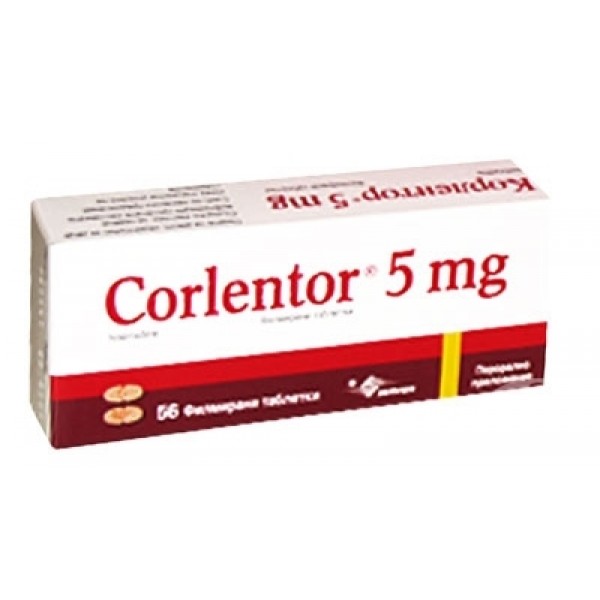
CORLENTOR 5 mg. 56 tablets
Product Code: CORLENTOR 5 mg. 56 tablets
Availability: In Stock
Product viewed: 3807


Corlentor 5 mg film-coated tablets
The active substance is ivabradine (as hydrochloride).
Corlentor 5 mg: one film-coated tablet contains 5 mg ivabradine (corresponding to 5.390 mg ivabradine hydrochloride).
The excipients in the tablet core are: lactose monohydrate, magnesium stearate (E470B), corn starch, maltodextrin, colloidal silicon dioxide (E 551), and tablet shell: hypromellose (E464), titanium dioxide 171), macrogol 6000, glycerol (E422), magnesium stearate (E470B), yellow iron oxide (E172), red iron oxide (E172).
WHAT IS THE CORRELANT AND WHAT IT IS USED
What is Corlentor
Corlentor 5 mg tablets are oblong, pink-orange, film-coated tablet with scored lines on both sides, engraved with "5" on one side and on the reverse.
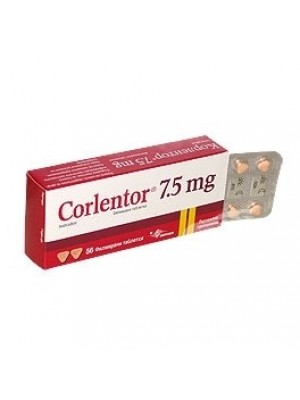
Corrector 7.5 mg tablets are pink-orange triangular film-coated tablets engraved with "7.5" on one side and on the other side. The tablets are supplied in 14, 28, 56, 84, 98, 100 or 112 tablets in cartridges. Not all types of packaging may be available on the specific market.
What is Corlentor used for?
Corlentor is a cardiac medicinal product that is used to treat stable angina pectoris that causes chest pain when beta-blockers are inappropriate (such as atenolol, propranolol, metoprolol, etc. for high blood pressure, heart rhythm disturbances or angina pectoris). For stable angina pectoris (commonly called "angina"): Stable angina is a heart disease that occurs when the heart does not get enough oxygen. It usually occurs between 40 and 50 years of age. The most common symptom of angina is chest pain or discomfort. Angina is more likely to occur when the heart beats faster in situations such as physical stress, emotions, cold or after eating. This acceleration of heart rate can cause chest pain in people who suffer from angina.
How does Corlentor work?
The cornea acts mainly by decreasing with a certain number of beats per minute of heart rate. This reduces the heart's need for oxygen, especially in situations where an angina attack is more likely to occur. In this way, Corletor helps to control and reduce the number of angina attacks.
2. BEFORE YOU START TO TAKE A Corlentor
Do not Take Corlentor
If you are hypersensitive (allergic) to ivabradine or any of the other ingredients in Corlentor; If your heart rate before treatment is lower (less than 60 beats per minute);
If you suffer from cardiogenic shock (a heart condition being treated in a hospital);
If you suffer from a heart rhythm disorder; If you have acute myocardial infarction;
If you suffer from too low blood pressure
If you suffer from unstable angina (a severe form in which chest pains are very common and occur with physical effort and rest);
If you suffer from severe heart failure (when your heart is unable to function normally); If you have a pacemaker; If you have severe liver problems; If you are currently taking medicines to treat fungal infections (such as ketoconazole, itraconazole), macrolide antibiotics (such as yozamycin, clarithromycin, telithromycin or erythromycin given orally), medicines to treat infections with the AIDS virus (such as nelfinavir, ritonavir) Or unfazodone (a medicine used to treat depression) (see "Taking other medicines"); If you are pregnant If you are breastfeeding. Be especially careful with Corletor:
If you suffer from a heart rhythm disorder,
If you have complaints such as tiredness or shortness of breath (this could mean that your heartbeat is too slow)
If you are currently taking diltiazem, verapamil,
If you are taking QT prolonging medicines to treat heart rhythm disorders or other conditions (see the products listed under "Taking other medicines"),
If you suffer from permanent atrial fibrillation (a type of irregular heartbeat)
If you have recently had a stroke,
If you suffer from mild to moderate low blood pressure,
If you suffer from chronic heart failure (heart failure to function normally)
If you suffer from chronic retinal disease,
If you suffer from moderate hepatic impairment,
If you suffer from severe kidney failure.
If any of the above applies to you, talk to your doctor before taking or while taking Corrector.
Taking Corlentor with food and fluids:
Limit the consumption of grapefruit juice during treatment with Corletor.
Pregnancy:
Do not take Corlentor if you are pregnant or planning to become pregnant (see "Do not take a pacemaker.") If you are pregnant and have taken Corlentor, talk to your doctor.Talk to your doctor or pharmacist before taking any medicine.
Breastfeeding:
Do not take Corlentor if you are breast-feeding (see "Do not take Corlentor)
Taking other medicines:
Please tell your doctor or pharmacist if you are taking or have recently taken any other medicines, even those that are not prescribed. Tell your doctor if you are taking any of the following medicines, as you may need to adjust Correlator dose or medical follow-up:
Diltiazem, verapamil (high blood pressure or angina pectoris)
Fluconazole (an antifungal agent) Rifampicin (an antibiotic)
Barbiturates (in case of difficult sleep or epilepsy) Phenytoin (in epilepsy)
Hypericum perforatum or St John's wort (herbal treatment for depression)
QT prolonging agents for the treatment of heart rhythm disorders or other conditions, such as:
Quinidine, disopyramide, ibutilide, sotalol, amiodarone (for the treatment of heart rhythm disorders)
Bepridil (for the treatment of angina pectoris) Some types of medicines to treat anxiety, schizophrenia or other psychoses (such as pimozide, ziprasidone, sertindole)
Antivirals (such as mefloquine or halofantrine)
Erythromycin IV (antibiotic) Pentamidine (antiparasitic agent) Cisapride (against gastro-oesophageal reflux)
3. HOW TO TAKE A CORLENTOR
Always follow your doctor's instructions on how to take Corlentor. You should check with your doctor or pharmacist if you are not sure about anything. The usual recommended starting dose is the Cortisor tablet of 5 mg twice daily, which, if necessary, is increased to 1 tablet of 7.5 mg twice a day. Your doctor will decide which dose is right for you. The usual dose is one tablet in the morning and one tablet in the evening.
In some cases (eg, if you are older), your doctor may prescribe a half dose, ie, half a 5 mg Corrigor tablet (corresponding to 2.5 mg ivabradine) in the morning and half a 5 mg tablet in the evening. Should be taken during meals. If you think that the effect of Corlentor is too strong or too weak, talk to your doctor or pharmacist. The co-ordinator is not intended for use in children and adolescents younger than 18 years of age.
If you take more than the prescribed amount of Corletor:
A large dose of Corlentor could cause shortness of breath or fatigue due to too much delay in your heartbeat. If this happens, contact your doctor immediately.
If you skip to take Correlator:
If you miss a dose of Corlentor, take the next dose at the usual time. Do not take a double dose to compensate for the missed dose. The calendar printed on the blister containing the tablets is intended to remind you when you took the previous Correlator tablet.
4. POSSIBLE SIDE EFFECTS
As with all medicinal products, Corletor may cause unwanted side effects. Very common side effects reported with Corlenor are luminous visual phenomena (short periods of increased brightness caused most often by sudden changes in light intensity). Other common side effects include changes in the way the heart works (manifestations such as heart rate delays), headache, dizziness, blurred vision and palpitations, and extraordinary heart attacks that are unusual. Also, nausea, constipation, diarrhea, dizziness, shortness of breath and muscle cramps are rarely reported. If you notice any side effects not mentioned in this leaflet, please tell your doctor or pharmacist.
5. STORING OF THE CORLENTOR
Keep out of the reach of children. This medicinal product does not require any special storage conditions. Do not use after the expiry date which is stated on the carton and the blister.
Write a review
Your Name:Your Review: Note: HTML is not translated!
Rating: Bad Good
Enter the code in the box below:
Related Products


The Brazilian Ginseng, also called Suma, is a herb that, due..
38.00€