Your shopping cart is empty!
Welcome visitor you can login or create an account.
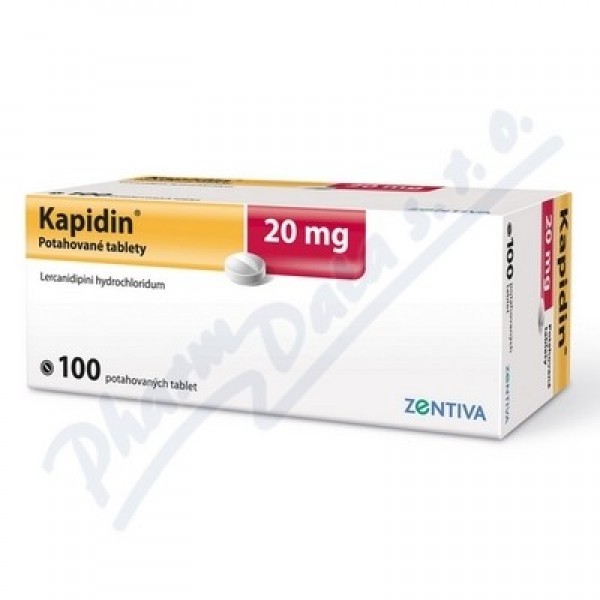
KAPIDIN 20 mg. 30 tablets
Product viewed: 3329


WHAT KAPIDIN AND WHAT IT IS USED?
Kapidin belongs to a group of medicines called calcium antagonists that block the entry of calcium into muscle cells of the heart and blood vessels that carry blood from the heart / artery /. Penetration of calcium in these cells leads to a contraction of the heart and arteries to narrow. By blocking the entry of calcium, calcium channel blockers decrease the heart and dilate the arteries, reducing blood pressure in this way.
Kapidin is prescribed to treat your high blood pressure, also known as hypertension.
BEFORE YOU TAKE KAPIDIN
Do not take Kapidin
- If you are allergic to lercanidipine or to any of the ingredients of Kapidin
- If you have had allergic reactions to medicines that are similar to Kapidin tablets
- If you suffer from certain heart conditions
- Uncontrolled heart failure
- Impaired blood flow from the heart
- Unstable angina pectoris
- If you previously had a heart attack less than a month
- If you have severe liver or kidney problems
- If you are taking drugs that are inhibitors of CYP3A4 isoenzyme
- Antifungal medicines
- Antivirals
- Along with another drug called cyclosporine
- With grapefruit and grapefruit juice
- If you are pregnant, you want to become pregnant, or you are a woman of childbearing age and not using contraceptives
- If you are breastfeeding
Take special care with Kapidin
It is necessary to consult your doctor before taking Kapidin tablets:
- If you have other heart disorders or have a pacemaker
- If you have angina pectoris, lerkandipin in very rare cases can lead to increased frequency of seizures to be longer and more severe. In isolated cases have been reported myocardial infarction
- If you have liver problems or kidney problems or are on dialysis
ADMISSION OF KAPIDIN with food and drink
You should not eat grapefruit or grapefruit juice, as this may increase the effect of Kapidin. If you consume alcohol along with Kapidin may experience dizziness / fainting, tiredness, weakness. The reason for this is that the drug taken with alcohol may lower blood pressure
Pregnancy and lactation
Ask your doctor before taking any medicine.
If you take Kapidin and you think you may be pregnant, talk to your doctor.
Kapidin not take if you are pregnant, planning to become pregnant or are of child-bearing age and not using contraceptives.
Do not take kapidin if you are breastfeeding.
Driving and using machines
Kapidin has negligible effect on ability to drive and use machines. However, it is possible to occur side effects such as dizziness, weakness, fatigue and rarely somnolence. You must be careful until you know how you react to kapidin.
Important information about some of the ingredients of kapidin
Kapidin contains lactose monohydrate. If the doctor tells you that you have an intolerance to some sugars, contact your doctor before taking this medicine.
HOW TO TAKE KAPIDIN
The usual dose is one Kapidin 10 mg tablet daily at the same time each day, preferably in the morning at least 15 minutes before breakfast, since the consumption of foods high in fat significantly increases the concentrations of drug in the blood.
Your doctor will decide whether to increase your dose to 1 Kapidin 20 mg tablet daily if necessary. Preferably tablets should be swallowed whole with 1/2 cup water. The scoreline only to facilitate breaking for ease of swallowing and not to divide into two equal doses.
Kapidin not recommended for children and adolescents under 18 years.
If you take more than the amount Kapidin
immediately contact for advice a doctor, the nearest hospital casualty department or the center of Toxicology.
POSSIBLE SIDE EFFECTS
Uncommon - headache, dizziness, increased heart rate, palpitations, flushing, swelling of the ankles.
Rare - drowsiness, weakness, fatigue, nausea, vomiting, diarrhea, abdominal pain, indigestion, rash, muscle pain, separation of excessive urine
Very rare isolated cases - lowering blood pressure, which can lead to seizure, allergic reactions, swelling of the gums, increased cost and liver enzymes in the blood, lowering blood pressure, which may result in dizziness, vertigo or fainting, frequent urination, chest pain and heart attack.
MORE INFORMATION:
The active substance is lercanidipine hydrochloride
One 10 mg tablet contains 10 mg lercanidipine hydrochloride equivalent to 9.4 mg lercanidipine
One 20 mg tablet contains 20 mg lercanidipine hydrochloride, equivalent to 18.8 mg lercanidipine
Other ingredients are: tablet core: magnesium stearate, povidone, sodium starch glycolate, lactose monohydrate, cellulose microcrystalline.
Film-coated tablets 10 mg, macrogol, polyvinyl alcohol, talc, titanium dioxide, ferric oxide, yellow.
10 mg film-coated tablets: Macrogol, polyvinyl alcohol, talc, titanium dioxide, iron oxide yellow, iron oxide red.
Write a review
Your Name:Your Review: Note: HTML is not translated!
Rating: Bad Good
Enter the code in the box below:
Related Products
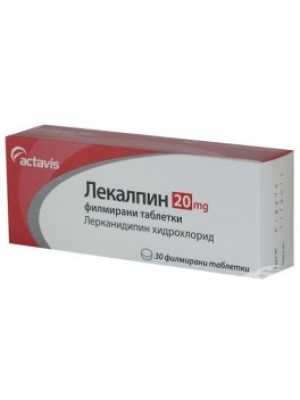
LEKALPIN table. 20 mg. 30 tablets LEKALPIN WHAT IS AND WHAT ..
16.00€