Your shopping cart is empty!
Welcome visitor you can login or create an account.
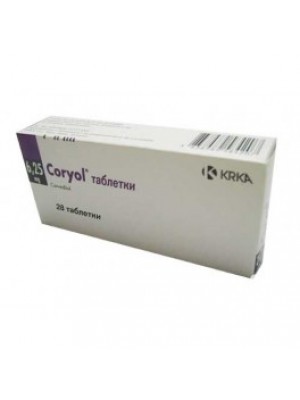
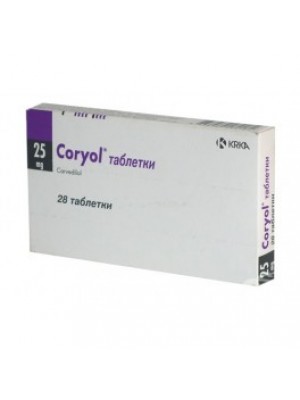
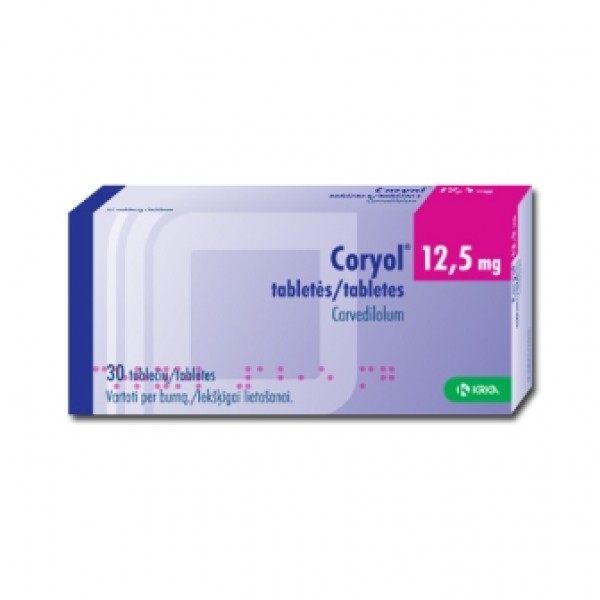
Coryol 12.5 mg. 28 tablets
Product viewed: 3385


What is Coryol and what is it used for?
Coriol tablets contain a medicine called carvedilol, which belongs to a group of medicines called beta-blockers.
Coryol is used:
For the treatment of high blood pressure (hypertension). High blood pressure can cause various cardiovascular diseases. Your doctor has prescribed Coriol in order to prolong your life and reduce the risk of heart attack and cerebral hemorrhage. If your doctor has prescribed this, you can take Coriol with another medicine with a blood pressure lowering effect.
To protect against chest pain (angina). Even if you take Coriol, you must continue to follow the diet and do the exercises that your doctor has given you.
In patients with chronic heart failure.
2. What do you need to know before you start to take Coriol?
Do not take Coriol:
If you are allergic to carvedilol or any of the other ingredients of this medicine (listed in section 6).
If your heart failure is severely impaired (you have heavy fluid retention or you are breathless even when you are sitting) and you are treated with venous medications to help your heart work.
If you have a slow heart beating or some other heart rhythm disorder (for example, a "heart block").
If you have very low blood pressure.
If you have ever had wheezes due to asthma or other lung diseases.
If you have severe liver problems.
You have a problem with the level of acidity in your blood ("metabolic acidosis").
If you are not sure, talk to your doctor or pharmacist before taking Corrigel.
Warnings and precautions
Talk to your doctor or pharmacist before taking Coriol:
if you have lung problems;
if you have kidney problems; if you have diabetes (high blood sugar); if you wear contact lenses;
if you have problems with blood vessels (peripheral vascular disease); if you have ever had thyroid problems;
if you have ever had a serious allergic reaction (for example, sudden edema resulting in difficulty in breathing or swallowing, swelling of the hands, feet and ankles or severe rash);
you have an allergy and you are being treated for desensitization;
you have circulatory problems in your fingers and toes (Raynaud's phenomenon); you have a skin condition called "psoriasis" after taking medicines called beta-blockers;
you have a type of angina called "Princeton variant angina," you have a tumor of one of the adrenal glands (pheochromocytoma).
If any of these apply to you or if you are not sure, talk to your doctor or pharmacist before taking Corrigel.
Other drugs and Coriol
Tell your doctor or pharmacist if you are taking, have recently taken or might take any other medicines. This includes medicines that are bought without a prescription and herbal medicines. This is because Coriol can affect the way some medicines work. Also, some other medicines can affect the way Corriol works.
In particular, tell your doctor or pharmacist if you are taking any of the following medicines:
other heart or blood pressure medicines, including drainage tablets (diuretics), calcium antagonists (eg diltiazem, verapamil or amiodarone), medicines to control irregular heart rhythm, digoxin and reserpine.
Coriol should not be used during intravenous treatment with verapamil or diltiazem;
monoamine oxidase inhibitors (MAOIs) such as isocarboxide and phenelzine (used to treat depression);
fluoxetine and paroxetine (used to treat depression);
medicines to treat diabetes such as insulin or metformin;
clonidine (used to treat high blood pressure, migraine and face during menopause);
rifampicin (used to treat infections);
cimetidine (used to treat indigestion, heartburn and stomach ulcers);
ciclosporin (used after organ transplantation);
non-steroidal anti-inflammatory drugs (NSAIDs);
bronchodilators beta-agonists (used to treat tight chest pain and wheezing due to asthma or other chest illness).
Operations
If you are going to have surgery, tell your doctor that you are taking Coriol. This is necessary because some anesthetics can lower blood pressure and it may become too low.
Pregnancy, breastfeeding and fertility
If you are pregnant or are breast-feeding, think you may be pregnant or plan to become pregnant, ask your doctor or pharmacist for advice before taking this medicine.
Do not take Coriol if you are pregnant, trying to become pregnant or breast-feeding unless your doctor tells you that you can.
Driving and using machines
You may feel dizzy while taking Coriol. This is most likely to happen when you start treatment, or if your treatment changes, and when you drink alcohol. If this happens to you, do not drive
Chronic heart failure
You should take your tablets at the same time of the day as you eat. Initial dose is very low: 3,125 mg twice daily.
Your doctor will increase the dose carefully until you receive the most appropriate dose.
The highest recommended dose is 25 mg twice a day. If you weigh more than 85 kg, you can take a maximum of 50 mg twice a day.
Cordil is usually taken as an adjunct to other medicines to treat heart failure. If you feel bad after each dose (for example, if you feel tired or your breathing is more difficult) talk to your doctor as soon as possible.
Your doctor may decide to prescribe less than the usual dose if you have heart failure or if you take another medicine at the same time.
If you take more Coriol than you should
If you take more Coriol than you should, or someone else takes your Coriol, you should consult a doctor immediately or go to a hospital right away. Take the medicine pack with you.
The following reactions may develop if you take more tablets than you should: slow heartbeat, dizziness or light-headedness, shortness of breath, wheezing or severe tiredness.
If you fail to take Cornol
If you miss a dose, take it as soon as possible. However, if the next dose is near, skip the previous dose and take the usual dose at the scheduled time.
Do not take a double dose to make up for the missed dose.
If you stop taking Coriol
Do not stop taking Coriol without consulting your doctor. He will tell you to stop taking Coriol for about 1 to 2 weeks.
If you have any further questions on the use of this medicine, ask your doctor or pharmacist.
4. Undesirable effects
Like all medicines, this medicine can cause side effects, although not everyone gets them.
Contact your doctor immediately if you experience any of the following side effects:
Severe allergic reactions, which may include sudden swelling of the throat, face, lips and mouth. This can cause difficulty in breathing or swallowing.
Chest pain accompanied by dyspnoea, sweating and nausea.
Rarely water discharge (urination) with swelling of the legs, indicating kidney problems.
Very low blood sugar (hypoglycaemia) that can cause loss of consciousness and convulsions.
Very common (may affect more than 1 in 10 people):
Feeling dizzy.
Headache.
Feelings of weakness and fatigue.
Problems with the heart. Signs include chest pain, fatigue, shortness of breath and swelling of the hands and feet.
Low blood pressure. Signs include dizziness or fainting.
Feeling dizzy with headaches and a feeling of weakness and fatigue are usually mild and more likely to develop at the beginning of your treatment.
Common (may affect up to 1 in 10 people):
Infections of the respiratory tract (bronchitis), lungs (pneumonia), nose and throat (upper respiratory tract). Signs include wheezing, shortness of breath, tightness in the chest and sore throat.
Urinary tract infections, which can cause urination problems. Low red blood cell count (anemia). Signs include fatigue, pale skin, increased heartbeat (palpitations) and shortness of breath.
Increase weight.
Increased cholesterol levels (indicated by a blood test).
Loss of blood sugar control in people with diabetes.
A sense of oppression.
Problems with vision, pain or dry eyes due to fewer tears.
Fun heart beat.
Feeling dizzy or faint after standing up.
Retention of liquids. Signs include: swelling of your body, swelling of parts of your body, such as your hands, feet, ankles and legs, and increasing the blood you have in your body.
Blood circulation problems in the arms and legs. Signs include cold hands and feet, bruising and legs, numbness and pain in the fingers and leg pain, which gets worse when walking.
Increased blood pressure.
Breathing problems.
Mood or vomiting.
Diarrhea.
Gastrointestinal / indigestion.
Pain, possibly in the arms and legs.
Kidney problems, including changes in urinary frequency.
Uncommon (may affect up to 1 in 100 people):
Disturbed sleep.
Failure.
Tingling or numbness of the hands or feet.
Skin problems, including skin rashes, which may include a large part of your body, urticaria (hives), itching and dry skin spots.
Hair loss.
Inability to get an erection (erectile dysfunction).
Constipation.
Rare (may affect up to 1 in 1,000 people):
Low Platelet counts in your blood. Signs include easy bruising and bleeding from the nose.
Clogged nose, flu-like symptoms.
Dry mouth.
Very rare (may affect up to 1 in 10,000 people):
Low number of all white blood cell types. Signs include infections of the mouth, gums, throat and lungs.
Allergic reactions (hypersensitivity). Signs may include difficulty breathing or swallowing caused by sudden swelling of the throat or face or Swelling of the hands, legs and ankles. Changes in liver function tests.
Severe skin reactions (erythema multiforme, Stevens-Johnson syndrome and toxic epidermal necrolysis) may occur. Flushing, often associated with blisters, may appear on the skin or mucous membranes, such as the inside of the mouth,
genital areas or eyelids. They may appear initially as round spots often with centrally located blisters that can progress to peeling large areas of the skin and can be life-threatening. These serious skin reactions are often preceded by headaches, fever and pain in the body (flu-like symptoms).
Some women may have difficulty controlling urination (urinary incontinence). After stopping treatment, this usually disappears.
How to store Coriol?
Keep out of the reach and sight of children.
Do not use this medicine after the expiry date which is stated on the carton after EXP. The expiry date refers to the last day of that month.
This medicinal product does not require any special storage conditions.
Do not dispose of medicines in the sewage system or in the household waste container. Ask your pharmacist how to dispose of medicines you no longer use. These measures will help to protect the environment.
6. Package Contents and Additional Information
What Corriol contains:
The active substance is carvedilol. Each tablet contains 6.25 mg, 12.5 mg or 25 mg of carvedilol.
The other ingredients are: sucrose, lactose, povidone K 25, colloidal anhydrous silica, crospovidone, magnesium stearate (E572).
What does Coryol look like and what does the package contain?
The 6.25 mg tablets are oval, slightly biconvex, white, scored on one side and imprinted with "S2" on the other side. The tablet can be divided into two equal halves.
The 12.5 mg tablets are: oval, slightly biconvex, white, scored with one and imprinted "S3" on the other side. The tablet can be divided into two equal halves.
The 25 mg tablets are round, slightly biconvex, white, with a line on one side. The tablet can be divided into two equal halves. Coriol tablets are available in cartons of 28 tablets in blister packs.
Write a review
Your Name:Your Review: Note: HTML is not translated!
Rating: Bad Good
Enter the code in the box below:
Related Products