Your shopping cart is empty!
Welcome visitor you can login or create an account.
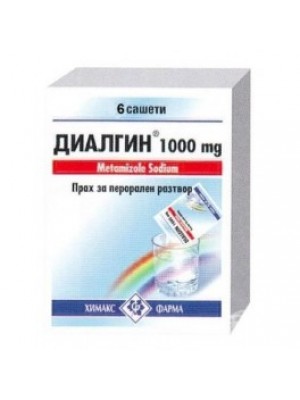
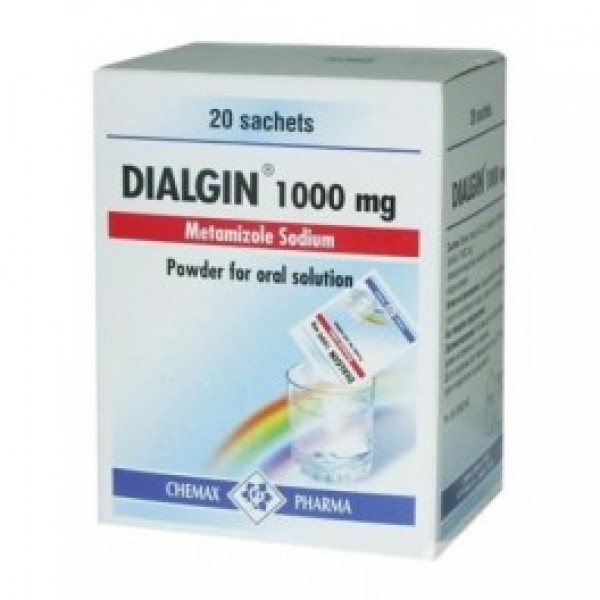
DIALGIN 1000 mg. 20 sachets
Product viewed: 4940


DIALGIN 1000 mg. 20 sachets
WHAT DIALGIN 1000 mg IS AND WHAT IT IS USED
• If pain
For short-term symptomatic treatment of pain from different backgrounds and with different intensity when other agents are contraindicated: headache, migraine, toothache, joint and muscle pain; post-traumatic and post-operative pain, renal and biliary colic; cancer pain.
• For life-threatening lowering of high body temperature, when the other agents are ineffective or contra-indicated.
2. BEFORE YOU TAKE DIALGIN 1000 mg
Do not take Dialgin 1000 mg
This medicine should not be accepted in the following cases:
- Hypersensitivity to metamizole or to any of the excipients;
- Hypersensitivity to the same group;
- Severe liver and kidney disease;
- Hypersensitivity to pyrazolone derivatives;
- Allergic reactions to aspirin or other anti-inflammatory drugs, rhinitis, urticaria, asthma;
- Blood dyscrasias;
- Disorders of the hematopoietic system, including aplastic anemia (anemia due to impaired formation of blood cells by the bone marrow)
agranulocytosis (a significant reduction in the number of certain white blood cells) or leukopenia (reduction in the total number of white blood cells);
- Porphyria (congenital disease impaired formation of red blood cells);
genetic deficiency of glucose-b-phosphate dehydrogenase (congenital disease which is manifested by destruction of red blood cells);
- Pregnancy (last trimester);
- Children under 15 years of age.
Take special care with Dialgin 1000 mg
- Gastrointestinal disorders (ulcer, bleeding, perforation);
- Impaired renal function;
- Hypertension;
- Fluid retention and edema;
- Impaired liver function;
- Serious infectious diseases;
- Concurrent use of chlorpromazine;
- It is possible when taking the drug appeared red-colored urine;
- To monitor indicators of blood cell counts in cancer patients;
- Treatment with chlorpromazine be used after consulting a doctor;
- In patients with acute renal failure Dialgin dose should be reduced (preferably one sachet per day).
Taking other medicines
Please tell your doctor or pharmacist if you are taking or have recently taken any other medicines, including medicines obtained without a prescription.
- Plasma levels of cyclosporine were reduced when administered with Dialgin;
- Dialgin can reduce the natriuretic and antihypertensive effects of ACE inhibitors;
- Dialgin may increase the plasma concentrations of lithium and lithium cause toxicity;
- Neuroleptics, tranquilized products potentiate the analgesic effect;
- Antidepressants, oral contraceptives, allopurinol - slow metabolism and may increase its toxicity;
- Combination with chlorpromazine may increase the risk of severe hypothermia;
- Co-administration with coumarin anticoagulants (drugs to reduce blood clotting) reduces their effectiveness;
- There is a risk of harm to the WBC in the simultaneous acceptance of the product with medicines that suppress bone marrow function, as products containing gold and anticancer products.
Taking Dialgin 1000 mg with food and drink
No evidence of restrictions.
Pregnancy and lactation
Pregnancy: Ask your doctor or pharmacist before taking any medicine. Not recommended for use Dialgin 1000 mg in pregnancy, and in the last three months use is contraindicated.
Lactation: The use of this product during the lactation should be avoided, as its metabolites are excreted in human milk. If you need to take it, breast-feeding should be discontinued.
Driving and using machines
No data Dialgin influence on the ability to drive and use machines.
Important information about some of the ingredients of Dialgin 1000 mg
This product contains Manitol E 421 (3270 grams). There may be less pronounced laxative.
3. HOW TO TAKE DIALGIN 1000 mg
The contents of the sachet 1 was dissolved in a glass of water and drunk.
Adults and children over 15 years: Recommended 1 sachet 1-3 times daily. Maximum daily dose is 3 sachets (3 g).
Dialgin should be used for the shortest possible period of time.
For children under 15 years of age - with a prescription.
If you take more than the amount Dialgin 1000 mg
If you think you take a higher dose than necessary, contact your doctor or other health care professional or visit the nearest hospital.
If you forget to take Dialgin 1000 mg
If you miss a dose do not take a double dose to make up the missed dose. This can increase the risk of side effects with you.
If you stop taking Dialgin 1000 mg
If you have any further questions on the use of this product, ask your doctor or pharmacist.
4. POSSIBLE SIDE EFFECTS
Like all medicines, Dialgin 1000 mg can cause side effects, although not everybody gets them.
Adverse reactions are classified according to frequency and system organ - class.
MedDRA frequency meets: Very common (> 1/10), common (> 1/100, <1/10), uncommon (> 1/1000, <1/100), rare (> 1/10000 to <1 / 1000), very rare (<1/10000), not known - from the available data can not be estimated.
Blood and lymphatic system
Rare - leukopenia, hemolytic anemia, purpura
Very rare - agranulocytosis, thrombocytopenia;
Respiratory, thoracic and mediastinal disorders
Rare - provoking an asthma attack, bronchospasm, dyspnea.
gastrointestinal disorders
Not known - nausea, vomiting.
Renal and urinary
Very rare - proteinuria, oliguria, polyuria, interstitial nephritis.
Metabolism and nutrition
Not known - decreased appetite
cardiac disorders
Uncommon - hypotension.
Not known - tachycardia, cyanosis.
Skin and subcutaneous tissue disorders
Uncommon: skin exanthema
Rare: hypersensitivity reactions, hives and other skin reactions, swelling of edema, anaphylactic shock (very rare, especially after parenteral administration of the product or after oral administration of high doses of metamizole in patients with hypersensitivity to metamizole).
Nervous system disorders
Rare - at high doses epileptiform convulsions
Not known - dizziness
Hepatobiliary disorders
Very rare - hyperbilirubinemia
Not known - cholestasis, jaundice
If any of the side effects gets serious, or you notice other effects not listed in this leaflet, please tell your doctor or pharmacist.
5. HOW TO STORE DIALGIN 1000 mg
Keep out of reach of children.
Store in a dry place at temperatures below 25 ° C.
Do not use Dialgin 1000 mg after the expiry date stated on the carton. The expiry date refers to the last day of that month. Medicines should not be disposed of in wastewater or household waste. Ask your pharmacist how to dispose of medicines no longer required. These measures will help to protect the environment.
6. FURTHER INFORMATION
What Dialgin 1000 mg
- The active ingredient is sodium 1000mg metamizole
- The other ingredients are: mannitol, sodium cyclamate, silica colloidal anhydrous and strawberry
fragrance
Looks Dialgin 1000 mg and contents of the pack
Dialgin 1000 mg of a white powder for oral solution packaged in sachets of a triple layer film.
20 sachets in a carton
b sachets in a carton
Write a review
Your Name:Your Review: Note: HTML is not translated!
Rating: Bad Good
Enter the code in the box below:
Related Products