Your shopping cart is empty!
Welcome visitor you can login or create an account.
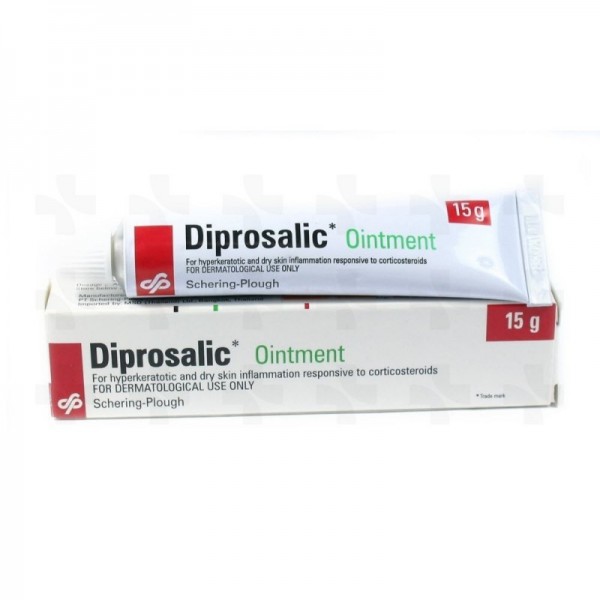
Diprosalic ointment 15 g.
Product Code: Diprosalic ointment 15 g.
Availability: In Stock
Product viewed: 1596


What is Diprosalic and what it is used for
Diprosalic ointment contains betamethasone (such as dipropionate) and salicylic acid in a paraben-free base. Betamethasone belongs to the group of potent corticosteroids. Salicylic acid helps to eliminate dry, flaky skin.
Diprosalic ointment is used to relieve inflammation in some corticosteroids, dry, accompanied by hyperkeratosis dermatoses, such as: psoriasis, chronic atopic dermatitis, neurodermatitis, eczema, seborrheic dermatitis in the hairy occipital dermatitis.
2. What you need to know before using Diprosalic
Do not use Diprosalic
- if you are allergic to betamethasone, salicylic acid or any of the other ingredients of this medicine (listed in section 6);
- if you are allergic to other products containing corticosteroids;
- if you suffer from rosacea or perioral dermatitis;
- if you suffer from a bacterial, viral (herpes simplex, chicken pox, shingles) or fungal skin infection;
- on large areas of the body as this can increase the amount absorbed;
- more often or for a longer period than your doctor has prescribed.
Warnings and precautions
Talk to your doctor or pharmacist before using Diprosalic.
- if you have any other illness, such as diabetes;
- if your skin gets worse, if it looks infected or severely dried.
- Avoid contact with eyes, mucous membranes (eg in the mouth or inner surface of the nose) and in the area of inguinal folds.
Contact your doctor if you have blurred vision or other visual disturbances.
Other medicines and Diprosalic
Please tell your doctor or pharmacist if you are taking, have recently taken or might take any other medicines, including medicines obtained without a prescription.
Pregnancy, breastfeeding and fertility
If you are pregnant or breast-feeding, think you may be pregnant or are planning to become pregnant, ask your doctor or pharmacist for advice before using this medicine.
Driving and using machines
Has no effect.
3. How to use Diprosalic
Always use this medicine exactly as your doctor has told you. Your doctor determines the dose of Diprosalic and, if necessary, may change it during treatment. If you are not sure, ask your doctor or pharmacist.
Apply a thin layer of Diprosalic Ointment to the affected area of the skin, usually twice a day (morning and evening) or as prescribed by your doctor.
Do not bandage or compress on the treated surface unless your doctor advises you. Avoid application to deep skin wounds, open wounds, burns, damaged skin. Wash your hands after using this medicine.
Your doctor will advise you when to stop using Diprosalic.
Use in children and adolescents
The use of topical corticosteroids in children should be limited to the minimum necessary to achieve a therapeutic effect. Because topical corticosteroid treatment can affect growth and development in children, they should only be administered after careful evaluation of the risk / benefit ratio. In general, the use of betamethasone dipropionate is not recommended in children below 12 years of age.
If you use more Diprosalic than you should
Diprosalic should only be used at the recommended dosage. Contact your doctor if you have used Diprosalic over large areas of the body or for a longer period than prescribed. Get medical attention immediately if you accidentally swallow Diprosalic.
If you forget to use Diprosalik
If you forget to use Diprosalic as prescribed, insert the medicine as soon as possible and then return to the regular regimen.
If you stop using Diprosalik
If you have any further questions on the use of this medicine, ask your doctor or pharmacist.
4. Possible side effects
Like all medicines, this medicine can cause side effects, although not everybody gets them. Contact your doctor if any of the following side effects are of concern to you: burning, itching, irritated or dry skin, inflammation or redness of the face, increased hair, acne, discoloration, thinning of the skin and easy bleeding, stretch marks , pain, blurred vision, or other signs of inflammation that you have not seen before.
Some patients may experience side effects that are not listed but are characteristic of the systemic use of cortisone-type drugs.
Additional side effects in children and adolescents
Pediatric patients may exhibit a higher sensitivity to topical corticosteroids, which causes suppression of the hypothalamic-pituitary-adrenal axis (CKD). They are more sensitive than the elderly to exogenous corticosteroid effects due to the higher rate of absorption due to the relatively larger skin surface relative to body weight.
In some cases, the following undesirable effects have been reported in children treated with topical corticosteroids: suppression of CKD, Cushing's syndrome, growth retardation, decreased weight gain, intracranial pressure, which includes fontanel protrusion, headache and bilateral papillosis.
Children and adolescents who are required to use this medicinal product should be closely monitored by their physician, as the medicine is absorbed through the skin and may affect growth or other undesirable effects.
How to store Diprosalic
Store below 25 ° C.
Shelf life after opening the package: 3 months.
Keep out of the reach and sight of children.
Do not use this medicine after the expiry date which is stated on the carton. The expiry date refers to the last day of that month.
Do not dispose of medicines in sewage or household waste. Ask your pharmacist how to dispose of medicines you no longer use. These measures will help to protect the environment.
6. Contents of the pack and other information
What Diprosalic ointment contains
- The active substances are: 0.5 mg / g betamethasone (such as betamethasone dipropionate) and 30 mg / g salicylic acid.
- The other ingredients are: liquid paraffin, white soft paraffin.
What Diprosalik looks like and contents of the pack
The drug is available in metal tubes containing 15 g ointment.
Each tube, together with the information leaflet, is placed in a cardboard box.
Write a review
Your Name:Your Review: Note: HTML is not translated!
Rating: Bad Good
Enter the code in the box below:
Related Products
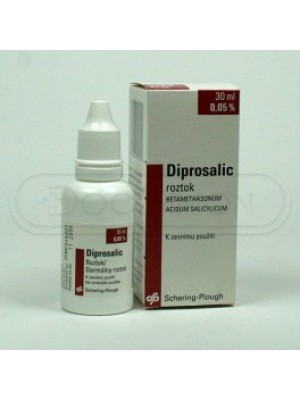
DIPROSALIC lotion 0.05% 30 ml.WHAT DIPROSALIC AND WHAT IT IS..
14.00€