Your shopping cart is empty!
Welcome visitor you can login or create an account.
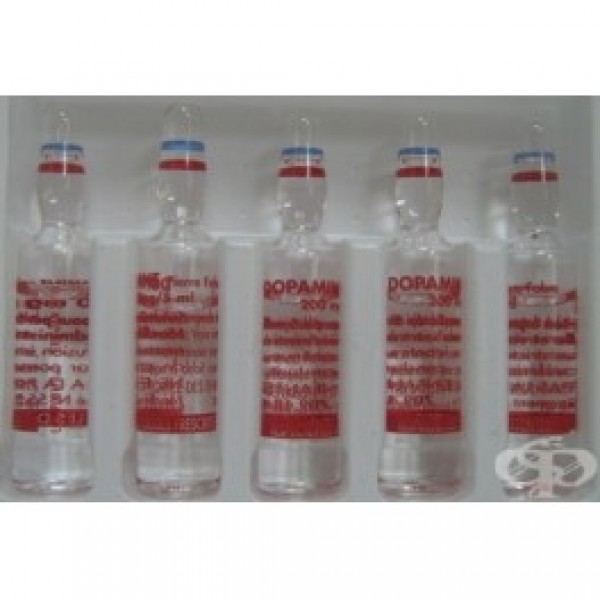
DOPAMINE 200 mg. 10 ampoules
Product Code: DOPAMINE 200 mg. 10 ampoules
Availability: In Stock
Product viewed: 1021


DOPAMINE 200 mg. 10 ampoules
Name of the medicinal product
Dopamin 1%
Dopamin 4%
2. Qualitative and quantitative composition of the active substance
1% concentrate for infusion contains: dopamine hydrochloride - 10 mg / ml 4% concentrate for infusion contains: dopamine hydrochloride - 40 mg / ml
3. Formulation
Concentrate for infusion
4. Clinical data
4.1. evidence
• postoperative, post-traumatic or septic shock
• shock in myocardial infarction
• severe heart failure
• acute renal failure (in some cases)
• hypotension unrelated to hypovolemia
4.1. Dosage and method of administration
Postoperative, post-traumatic or septic shock
Dosing in children and adolescents up to age 18
The initial dose of 2 to 5 (mcg / kg / min .You can be increased at intervals of 15 -30 min to 10 mcg / kg / min. In children it is recommended that the product be administered by an infusion pump.
Adults
The initial dose of 1-5 mg / kg / min intravenously may be increased at intervals of 15-30 min, until it reaches the optimum, providing the desired increase in blood pressure and urine output recovery.
Shock in myocardial infarction
Adults
The initial dose of 2-5 mg / kg / min intravenously; . It may be increased to 10 mcg / kg / min.
Severe heart failure
Adults
Initial dose of 0.5 - 1 mg / kg / min; optimal -1-3 mcg / kg / min. If necessary, a possible increase of 5 mcg / kg / min. Higher doses do not enhance the diuretic effect.
Acute renal failure
Adults and children
1- 1.5 g / kg / min. Treatment can be initiated with lower doses gradually increased to the maximum - 5 mcg / kg / min. Higher doses do not enhance the diuretic effect.
Hypotension unrelated to hypovolemia
Dosage in children
Premature babies, infants
The recommended initial dose is 10 ug / kg / min. Lower doses also increase blood pressure, but the effect is short-lived;
By age 18 2-20 mcg / kg / min.
Infusion begins with doses of 2-3 mg / kg / min and gradually increased if necessary.
Adults
2-10 mcg / kg / min (optimal dosage for controlled volemiya). In exceptional cases, this dose may be increased at intervals of 15-30 minutes to the maximum 50 (mcg / kg / min, which should not be exceeded.
During the infusion blood pressure, pulse and urine output to be monitored carefully.
4.3. Contraindications
• hypersensitivity to product ingredients
• pheochromocytoma
• severe arrhythmia, ventricular fibrillation
• thyrotoxicosis
4.4. Special warnings and precautions for use
• Use with caution in patients treated with MAO inhibitors. In these cases, the dose should be 1/10 of generally applicable. In patients with angina pectoris need increased attention.
• In patients under general anesthesia with halogenated anesthetics (cyclopropane, halothane, etc.). Dopamine should be used carefully to avoid the appearance of ventricular arrhythmia.
• In patients with cardiac arrhythmia possible exacerbation. In this case, dose reduction or discontinuation of the product.
• Separate ventricular ectopic strikes can be effectively influenced with lidocaine.
• Before the appointment of dopamine is necessary to normalize the volume of blood and acid-base balance and to take measures to balance the respiratory parameters (hypoxia, hypercapnia).
• Due to highly localized reaction leading to tissue necrosis, during infusion is possible hemorrhage. In the case of penetration outside the veins, the treatment of choice for limiting the spread of tissue necrosis is injection of phentolamine (5-10 mg in 15 ml saline) around the site of penetration of a thin needle for subcutaneous injection.
• In patients with a history of peripheral vascular disease application of the product increases the risk of myocardial infarction.
• Do not administer intra-arterial!
4.5. Interactions
• when co-administered with MAO inhibitors, the action of dopamine is potentiated and prolonged
• concomitant use with furazolidin potentiate a-adrenergic effect of the product
• phenothiazines inhibit the central dopamine
• phenytoin increases the hypotensive action of dopamine
• metoclopramide, pimetidin, dehidrobenzperidol reduced vasodilatory effect of dopamine on renal blood vessels
• albuterol can induce the action of dopamine and cause arrhythmia
4.6. Pregnancy and lactation
pregnancy
Still not enough studies embryotoxic and teratogenic effects of dopamine in humans. Animal studies showed no teratogenicity, but when administered to pregnant rats survival of offspring was reduced. Studies on animals have shown that dopamine crosses the placental barrier. In monkeys and sheep decreased blood flow in the arteries of genitaliite.Dopamin administered to pregnant women increases the contractions of the uterus. Pregnancy is not contraindicated for treatment with dopamine when there is a life-threatening indication.
Safety for use during pregnancy:
By category
breastfeeding
No information about the passage of dopamine in human milk.
Breastfeeding is not a contraindication to treatment with dopamine in a life-threatening situation
4.7. Effects on ability to drive and use machines
No known.
4.8. Adverse reactions
Possible manifestation common to all sympathomimetic side effects.
4.9. overdose
The wide range of therapeutic doses of dopamine (2-20 mcg / kg / min to a maximum dose of 50 mcg / kg / min) makes it impossible to determine the toxic dose leading to symptoms of overdose:
• disorders in the circulatory system: elevation of blood pressure above the initial value
• arrhythmias such as ventricular premature strokes, ventricular ectopic hit tachycardia and ventricular fibrillation (can occur even after therapeutic doses)
• chest pain and anginal pain
• less myocardial infarction
• vasoconstriction of peripheral vessels can lead to pallor or cyanosis of the hands and feet
• symptoms of central nervous system are anxiety and insomnia
• symptoms from the gastrointestinal tract are nausea, vomiting, stomach pain
Tackling the symptoms of overdose include discontinuation of dopamine, monitoring vital signs (blood pressure, pulse, respiration, diuresis) and pharmacological treatment of overdose (in some cases symptoms of overdose decreased after discontinuation of the product and does not need pharmacological treatment ).
In case of high or very sharp increase in blood pressure can be applied to sodium nitroprusside intravenous infusion; nifedipine orally or B-blockers (labetalol, propranolol), oral or intravenously;
In ventricular arrhythmia first choice is lidocaine and the second - procainamide, propranolol, disopyramide.
5. Pharmacological
ATC code: C 01 CA
5.1 Pharmacodynamic properties
Dopamine is a natural monoamine produced in the CNS intermediately connection to metabolize adrenaline (A) and the precursor of noradrenaline (NA). It has mixed effects - expanding renal, visceral, coronary and intracranial blood vessels and stimulates the p-1 adrenergic receptors in the heart. The result of this effect, after low doses of dopamine (to 2mkg / kg / min) is increasing renal flow (glomerular filtration rate), increasing the excretion of sodium and increase diuresis.
At medium doses (5-10 mg / kg / min) were stimulated beta-1 adrenergic receptors which produce positive inotropic effect.
At high doses (10 to 20 mcg / kg / min) and the stimulation of - adrenergic receptors is reflected in the constriction of peripheral blood vessels and increased blood pressure. Doses above 20 mcg / kg / min lead to a sharp reduction in renal flow and urine output.
The dependence of the effects of dopamine on its dosing allows product to be used for treatment of shock of various origins
5.2. Pharmacokinetic properties
Upon intravenous administration action of dopamine starts very sharply after about 5 minutes. The effect is of very short duration - approximately 10 minutes. In the body penetrates widely. The volume distribution are higher in newborns :: 1.8 1 / kg, at bebetai detsa- 1.81 -2.45 1 / kg.Pri adults as opposed to premature babies, is not observed a significant passage of kryvno-brain barrier.
75% of the dopamine metabolized in the liver, kidney and plasma of monoamine oxidase (MAO) and catechol-O-methyltransferase (COMT) to an inactive derivative of metabolit- homovanillic acid (HVK). Adrenergic receptors in 25% of the dopamine was converted to noradrenalin.Okolo 80% of the dose is eliminated through urine for about 24 hours in the form of metabolites homovanillic acid and noradrenaline-Only a small part is eliminated nepromenena.Plazmeniyat half-life T1 / 2 of dopamine is about 2 min
The overall half-life T 1/2 is 7- 26 min in children and about 7 min in adults.
6. Pharmaceutical particulars
6.1.Spisak of excipients and their of veterinary
l% p-p 4% p-p
Dopamine hydrochloride 10.0 mg 40.0 mg
Sodium metabisulphite 2.5 mg 10 mg of
Disodium edetate 0.25 mg 0.25 mg
Water for injections ad 1 ml to 1ml
6.2 Incompatibilities
• Dopamine does not apply to alkaline solutions due to inactivation.
• Do not apply with ampicillin, amikacin, gentamicin, tobramycin, furosemide, indomethacin, iron prpodukti, alteplase.
6.3.Srok life
3 years.
After dilution with saline or 5% glucose shelf life is 24 hours.
6.4. Special storage conditions
Do not store above 25 0 C. Protect from light.
Keep out of reach of children.
6.5. Container
5 ampoules of 5 ml in a blister. Two blisters in a cardboard box with all the indications and information leaflet.
6.6. Recommendations for use
Dopamine is used only in a hospital setting. Administered intravenously via an infusion pump or a drip. Dilution using saline or 5% glucose solution. The amount of dilution depends on the route of administration (infusion pump, or a drip infusion). When dopamine infusion pump was diluted to 20 or 50 ml with physiological saline or 5% glucose solution, and for drip infusion to 500 ml with the same diluent. Usually diluted 200 mg dopamine (4 ampoules of 1% solution or 1 ampoule of 4% solution). The infusion depends on the dose calculated for 1 kg body weight for 1 hour. Do not apply more than 60 hours.
Tan tint in the solution makes it unsuitable for use due to decomposition of the active ingredient.
Write a review
Your Name:Your Review: Note: HTML is not translated!
Rating: Bad Good
Enter the code in the box below:
Related Products

NANIPRUS ampoules 30 mg. 10 ml.Naniprus is a medicine for ra..
12.00€
D - mannose 500 mg. 120 capsulesDescription:Dopa Mucuna - L-..
75.00€