Your shopping cart is empty!
Welcome visitor you can login or create an account.
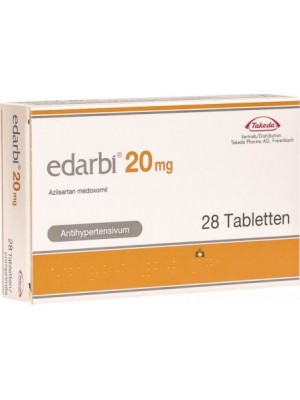
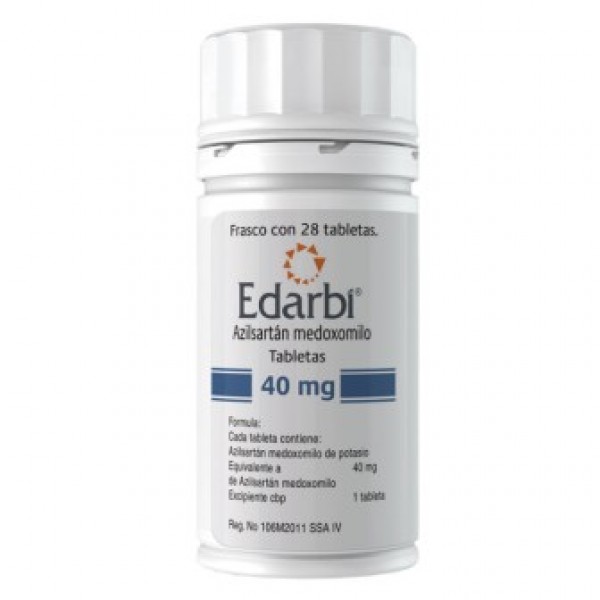
EDARBI 40 mg. 28 tablets
Product viewed: 4800


WHAT EDARBI IS AND WHAT IT IS USED FOR
Edarbi contains an active substance called azilsartan medoxomil and belongs to a class of medicines called angiotensin II receptor antagonists (AIIRAs). Angiotensin II is a substance that is naturally formed in the body and causes blood vessels to contract and thus increases blood pressure. Edarbi blocks this effect, which causes blood vessels to relax, and this helps to lower blood pressure.
This medicine is used to treat high blood pressure (essential hypertension) in adult patients (over 18 years of age).
2. BEFORE YOU TAKE EDARBI
DO NOT take Edarbi:
If you are allergic (hypersensitive) to azilsartan medoxomil or any of the other ingredients of Edarbi (see section 6);
If you are pregnant after the third month (It is better to avoid using Edarbi and in early pregnancy - see the section on pregnancy).
Take special care with Edarbi
Before taking or while taking Edarbi, tell your doctor if:
You have kidney problems;
Are on dialysis or you have had a recent kidney transplant;
Have severe liver disease;
Have heart problems (including heart failure, recent heart attack (heart attack));
You have ever had a stroke (stroke);
Have low blood pressure or feel dizzy;
Vomit, have recently had severe vomiting, or have diarrhea;
Have elevated levels of potassium in your blood;
You have adrenal gland disease called primary hyperaldosteronism;
You have been told that you have a narrowing of the heart valves (called aortic or mitral valve stenosis) or that the thickness of your heart muscle is increased above normal (called "obstructive hypertrophic cardiomyopathy").
You should tell your doctor if you think you are pregnant (or you may become pregnant).
Edarbi is not recommended in early pregnancy and should not be taken after the third month of pregnancy, as it may cause serious harm to your child if used during this period (see section Pregnancy).
As with all other angiotensin II receptor antagonists, azilsartan may be less effective in lowering blood pressure in black patients.
Children and adolescents
There is no experience with Edarbi in children and adolescents under 18 years of age. Therefore, Edarbi should not be used in children or adolescents.
Taking other medicines
Please tell your doctor or pharmacist if you are taking or have recently taken any other medicines, including medicines obtained without a prescription.
Edarbi may affect the action of some other medicines and some medicines may affect the effect of Edarbi.
Tell your doctor if you are taking any of the following medicines:
Lithium (a medicine for mental illness);
Non-steroidal anti-inflammatory drugs (NSAIDs), such as ibuprofen, diclofenac or celecoxib (medicines to relieve pain and inflammation);
Aspirin (acetylsalicylic acid) if you take more than 3 g per day (a pain and inflammation-relieving medicine);
Medicines that increase the concentration of potassium in your blood; They include potassium supplements, potassium-sparing medicines (some drainage tablets) or salt substitutes containing potassium;
Heparin (a medicine for blood thinning);
Diuretics (drainage tablets);
Other medicines to lower blood pressure.
Pregnancy and breastfeeding
Pregnancy
You should tell your doctor if you think you are pregnant (or you may become pregnant). Your doctor will usually advise you to stop taking Edarbi before you become pregnant or as soon as you know you are pregnant and will advise you to take another medicine instead of Edarbi.
Edarbi is not recommended in early pregnancy and should NOT be taken if you are pregnant after the third month because it can cause serious harm to your baby if used after the third month of pregnancy.
Breastfeeding
Tell your doctor if you are breast-feeding or intend to breast-feed. Edarbi is not recommended for mothers who are breast-feeding and your doctor may prescribe another treatment if you want to breast-feed, especially if your baby is newborn or was born prematurely.
Driving and using machines
Edarbi is unlikely to have an effect on driving and operating machinery. However, some people may feel tired or dizzy when taking Edarbi and if this happens to you, do not drive or use any tools or machines.
3. HOW TO TAKE EDARBI
Always take Edarbi exactly as your doctor has told you. If you are not sure, ask your doctor or pharmacist. It is important that you continue to take Edarbi every day.
Edarbi is taken orally. Take the tablet with plenty of water.
You can take Edarbi with or without food.
The usual starting dose is 40 mg once a day. Your doctor may increase this dose to a maximum of 80 mg once a day depending on how your blood pressure is affected;
In very old patients (75 years and older), the doctor may recommend a lower starting dose of 20 mg once a day;
If you have mild or moderate liver disease, your doctor may recommend a lower starting dose of 20 mg once a day;
In patients who have recently lost fluids eg due to vomiting or diarrhea or taking drainage tablets, the doctor may recommend a lower starting dose of 20 mg once a day;
If you suffer from other concomitant diseases, such as severe kidney disease or heart failure, your doctor will decide on the most appropriate starting dose.
Your blood pressure lowering will be measurable within 2 weeks of onset of treatment, and your full dose will be monitored after 4 weeks.
If you take more Edarbi than you should
If you take too many tablets or if someone else takes your medicine, contact your doctor immediately. You may experience weakness or dizziness if you have taken more than you need.
If you forget to take Edarbi
Do not take a double dose to make up for the missed dose. Just take the next dose at the usual time.
If you stop taking Edarbi
If you stop taking Edarbi, your blood pressure may rise again. So do not stop taking Edarbi before first consulting your doctor for alternative treatment.
If you have any further questions on the use of this medicine, ask your doctor or pharmacist.
4. POSSIBLE SIDE EFFECTS
Like all medicines, Edarbi can cause side effects, although not everyone gets them.
Stop taking Edarbi and seek immediate medical attention if you get any of the following allergic reactions that occur rarely (less than 1 in 1,000 people):
Difficulty in breathing or swallowing or swelling of the face, lips, tongue and / or throat (angioedema);
Itching with raised areas of the skin.
Other possible side effects include:
Common side effects affecting less than 1 in 10 people:
Dizziness;
Diarrhea;
Increased blood creatine phosphokinase (muscle damage indicator).
Uncommon side effects affecting less than 1 in 100 people:
Low blood pressure, which may make you feel weak or dizzy;
Feeling tired;
Swelling of the hands, ankles or feet (peripheral edema);
Increased serum creatinine in the blood (an indicator of renal function);
Elevated uric acid in the blood (an indicator of renal function).
Rare side effects affecting less than 1 in 1,000 people:
Changes in blood counts including decreased levels of red blood cell protein (hemoglobin).
When Edarbi is taken with chlorthalidone (drainage tablet), elevated levels of certain substances in the blood (such as creatinine) that are indicators of renal function are common (less than 1 in 10 people). Low blood pressure is also common.
Swelling of the hands, ankles or soles is more common (in less than 1 in 10 people) when Edarbi is taken with amlodipine (a calcium channel blocker to treat hypertension) than when Edarbi is taken alone (less From 1 in 100 people). The incidence of this event is highest when amlodipine is taken alone.
If any of the side effects gets serious, or if you notice any side effects not listed in this leaflet, please tell your doctor or pharmacist.
HOW TO STORE EDARBI
Keep out of the reach and sight of children.
Do not use Edarbi after the expiry date which is stated on the carton after EXP. The expiry date refers to the last day of that month.
Store Edarbi in the original package in order to protect from light and moisture. This medicinal product does not require any special storage conditions.
Medicines should not be disposed of via wastewater or household waste. Ask your pharmacist how to dispose of your unnecessary medicines. These measures will help to protect the environment.
6. ADDITIONAL INFORMATION
What Edarbi contains
The active substance is azilsartan medoxomil (like potassium) of 20 mg, 40 mg or 80 mg.
The other ingredients are mannitol, fumaric acid, sodium hydroxide, hydroxypropylcellulose, croscarmellose sodium, cellulose, microcrystalline and magnesium stearate.
What Edarbi looks like and contents of the pack
Edarbi are white round tablets with debossed "ASL" on one side and "20", "40" or "80" on the other.
Edarbi is supplied in blisters, each blister of either 14 tablets or 15 tablets in a cardboard box containing:
14, 28, 30, 56, 90 or 98 tablets of 20 mg;
14, 28, 30, 56, 90 or 98 tablets of 40 mg;
14, 28, 30, 56, 90 or 98 tablets of 80 mg.
Not all pack sizes may be marketed.
Write a review
Your Name:Your Review: Note: HTML is not translated!
Rating: Bad Good
Enter the code in the box below:
Related Products