Your shopping cart is empty!
Welcome visitor you can login or create an account.
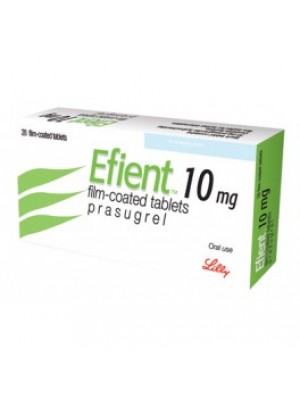
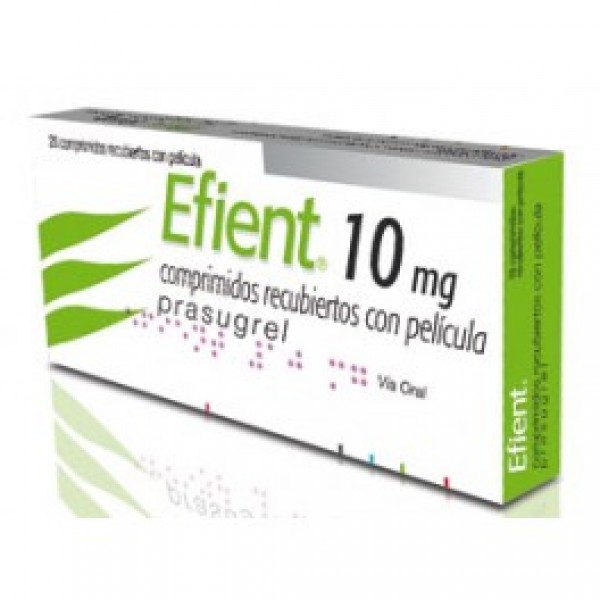
EFIENT 10 mg. 14 tablets
Product Code: EFIENT 10 mg. 14 tablets
Availability: In Stock
Product viewed: 1025


EFIENT 10 mg. 14 tablets
What is Efient and what it is used
Efient belongs to a group of medicines called anti-platelet agents. Platelets are very small cell particles that circulate in the blood. When a blood vessel is damaged, for example if it is cut, platelets clump together to help form a blood clot (thrombus). Therefore, platelets are essential to help stop bleeding. If clots form within a hardened blood vessels such as arteries, they can be very dangerous as they can cut off the blood supply, causing a heart attack (myocardial infarction), stroke or death. Clots in arteries supplying blood to the heart may also reduce the blood supply, causing unstable angina (severe chest pain).
Efient inhibits the clumping of platelets and so reduces the risk of blood clots.
You have been prescribed Efient, because you have already had a heart attack or unstable angina and you have been treated with a procedure to open blocked arteries in the heart. You may also have one or more stents placed to keep open a blocked or narrowed artery supplying blood to the heart. Efient reduces the risk to have a future heart attack or stroke or of dying from one of these atherothrombotic events.
Your doctor will also give you acetylsalicylic acid (eg. Aspirin) - another antiplatelet agent.
2. What you need to know before taking Efient
Do not take Efient
if you are allergic (hypersensitive) to prasugrel or any of the other ingredients of Efient. An allergic reaction may be recognized as a rash, itching, swollen face, swollen lips or shortness of breath. If this happens to you, tell your doctor immediately;
if you have a medical condition that is currently causing bleeding, such as bleeding from your stomach or intestines;
if you have ever had a stroke (stroke) or transient ischemic attack (TIA);
if you have severe liver disease.
Warnings and Precautions
You should tell your doctor before taking Efient, if any of the situations listed below applies to you:
if you have an increased risk of bleeding, for example:
aged 75 years or more. Your doctor should prescribe a daily dose of 5 mg, as there is a higher risk of bleeding in patients older than 75 years;
recent serious injury;
recent surgery (including some dental procedures);
recent or recurrent bleeding from the stomach or intestine (eg. gastric or colonic polyps);
body weight less than 60 kg. Your doctor should prescribe a daily dose of 5 mg Efient, if you weigh less than 60 kg;
kidney disease or moderate liver problems;
intake of certain drugs (see. "Taking other medicines" below);
planned surgery (including some dental procedures) in the next seven days. Your doctor may advise you to stop taking Efient temporarily due to an increased risk of bleeding;
if you have had an allergic reaction (hypersensitivity) to clopidogrel or any other antiplatelet agents, please tell your doctor before starting treatment with Efient. If you then take Efient and experience allergic reactions that may occur as rash, itching, swollen face, swollen lips or shortness of breath, you are obliged to tell your doctor immediately.
While taking Efient:
You should tell your doctor immediately if you develop a condition called thrombotic thrombocytopenic purpura (TTP or) that includes fever and bruising under the skin that may appear as red dots the size of a pinpoint with or without unexplained extreme tiredness, disorientation time and place, yellowing of the skin or eyes (jaundice) (see. section 4 "Possible side Effects").
Other medicines and Efient
Please tell your doctor if you are taking or have recently taken any other medicines, including medicines obtained without a prescription, dietary supplements and herbal remedies. It is particularly important to tell your doctor if you are taking clopidogrel (antiplatelet agent), warfarin (anticoagulant) or "non-steroidal anti-inflammatory drugs" for pain and fever (such as ibuprofen, naproxen, etoricoxib). If given together with Efient, these drugs may increase the risk of bleeding.
While being treated with Efient, take other medicines unless your doctor resolve.
Efient with food and drink
Efient may be taken with or without food.
Pregnancy and lactation
Tell your doctor if you are pregnant or think you may be pregnant while you are taking Efient. You should use Efient only after discussing with your doctor the potential benefits and any potential risks to your unborn child. If you are breastfeeding, ask your doctor or pharmacist before taking any medicine.
Driving and using machines
No studies on the effects of Efient on the ability to drive and use machines. Efient is unlikely to affect the ability to drive and use machines.
Efient contains lactose. If ever doctor has told you that you have an intolerance to some sugars, contact your doctor before you start taking this medicine.
3. How to take Efient
Always take Efient exactly as your doctor tells you. If you are not sure, ask your doctor or pharmacist.
Your doctor will tell you how many Efient tablets to take. The usual dose of Efient is 10 mg per day. You will start the treatment with a single dose of 60 mg.
If you weigh less than 60 kg or you are older than 75 years, the dose is 5 mg Efient per day. Your doctor will also tell you to take acetylsalicylic acid - (s) he will tell you the exact dose to take (usually between 75 mg and 325 mg daily).
Taking Efient was not dependent on food intake. Take your dose at the same time each day. Do not break or crush the tablet.
It is important to tell your doctor, dentist and pharmacist that you are taking Efient. Efient should not be used in children and adolescents under 18 years of age.
If you take more dose of Efient
Call your doctor or go straight to the nearest hospital as you may be at risk of excessive bleeding. Show the doctor your pack of Efient.
If you forget to take Efient
If you miss your scheduled daily dose, take Efient when you remember. If you forget your dose for an entire day, just resume taking Efient at its usual dose the next day. Do not take two doses in one day. For packages of 14, 28, 56, 84 and 98 tablets you can check the day on which you last took a tablet of Efient, by referring to the calendar printed on the blister.
If you stop taking Efient
Do not stop taking Efient, without consulting your doctor. It is especially important to check with your doctor before stopping Efient, because both the risks and benefits are based on regular use.
If you have any further questions on the use of this product, ask your doctor or pharmacist.
4. Possible side effects
Like all medicines, Efient can cause side effects, although not everybody gets them.
Contact your doctor immediately if you notice any of the following:
sudden numbness or weakness in the hands, feet or face, especially if one side of the body;
sudden disorientation of time and place, difficulty speaking or understanding others;
sudden difficulty in walking or loss of balance or coordination;
sudden dizziness or sudden severe headache with no known cause.
All of the above may be signs of a stroke. Stroke is an uncommon side effect of Efient in patients who have never had a stroke or transient ischemic attack (TIA).
Also contact your doctor immediately if you notice any of the following:
fever and bruising under the skin that may appear as red dots the size of a pinpoint with or without unexplained extreme tiredness, disorientation to time and place, yellowing of the skin or eyes (jaundice) (see. section 2 "What you should know before taking Efient ");
rash, itching, swollen face, swollen lips / tongue, or shortness of breath. These may be signs of an allergic reaction (see. Section 2 "What you should know before taking Efient").
Tell your doctor immediately if you notice any of the following:
Blood in your urine;
Rectal bleeding, blood in your stools or black stools;
Uncontrolled bleeding, for example from a wound.
All of the above may be signs of bleeding is the most common side effect of Efient. Although uncommon, severe bleeding can be life threatening.
Common side effects (affects 1 to 10 users in 100):
Bleeding in the stomach and intestines;
Bleeding from the puncture site with a needle;
Nosebleeds;
Skin rash;
Small red bruises on the skin (ecchymosis);
Blood in the urine;
Hematoma (bleeding under the skin at the injection site or in the muscle, causing swelling);
Low hemoglobin or red blood cells (anemia);
Bruise.
Uncommon side effects (affects 1 to 10 users in 1000):
Allergic reaction (rash, itching, swollen lips / tongue, or shortness of breath);
Spontaneous bleeding from the eye, rectum, gums or in the abdomen around the internal organs;
Bleeding after surgery;
Coughing up blood;
Blood in the stool.
Rare side effects (affects 1 to 10 users in 10,000):
Low number of platelets in the blood;
Subcutaneous hematoma (bleeding under the skin causing swelling).
If any of the side effects gets serious, or you notice other effects not listed in this leaflet, please tell your doctor or pharmacist.
5. How to store Efient
Keep out of the reach and sight of children.
Do not use Efient after the expiry date stated on the blister and carton after "EXP". The expiry date refers to the last day of that month.
Store in the original package to protect from air and moisture.
Do not dispose of medications in wastewater or household waste. Ask your pharmacist how to dispose of medicines no longer required. These measures will help to protect the environment.
6. Contents of the pack and other information
What Efient
The active substance is prasugrel.
Efient 10 mg: Each tablet contains 10 mg of prasugrel (as hydrochloride).
Efient 5 mg: Each tablet contains 5 mg prasugrel (as hydrochloride).
Other ingredients are: microcrystalline cellulose, mannitol (E421), croscarmellose sodium, hypromellose (E464), magnesium stearate, lactose monohydrate, titanium dioxide (E171), triacetin (E1518), iron oxide red (only tablets of 10 mg) (E 172 ), iron oxide yellow (E172) and talc.
Write a review
Your Name:Your Review: Note: HTML is not translated!
Rating: Bad Good
Enter the code in the box below:
Related Products
CLOPIDOGREL GSK . 75 mg. 30 tablets GSK CLOPIDOGREL WHAT IS..
25.00€
Clopidogrel 75 mg. 30 tablets ACCORDWHAT CLOPIDOGREL ACCORD ..
35.00€