
Your shopping cart is empty!
Welcome visitor you can login or create an account.
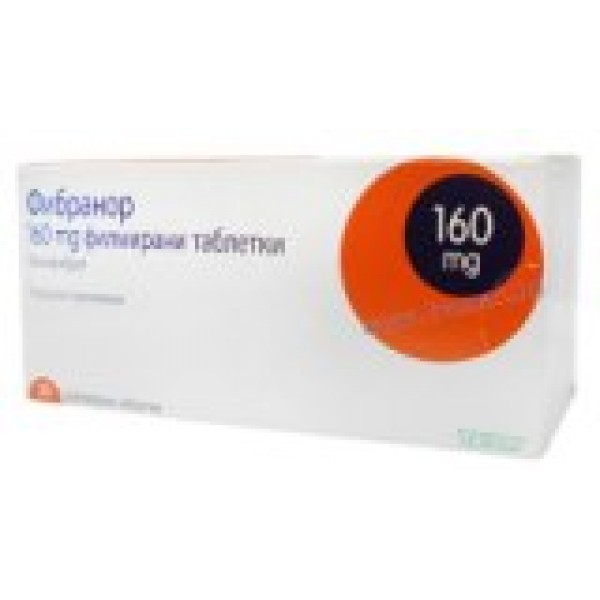
Fibranor 160 mg. 30 tablets
Product Code: Fibranor 160 mg. 30 tablets
Availability: In Stock
Product viewed: 4912


What Fibranor is and what it is used for
Fibranor belongs to a group of medicines widely known as fibrates. These medicines are used to lower the level of fat (lipids) in the blood, for example, for fat called triglycerides.
Fibranor is used together with a low-fat diet and other non-medication methods, such as sports and weight reduction, in order to lower blood fat levels.
2. What you need to know before you take Fibranor
DO NOT take Fibranor:
if you are allergic to fenofibrate or any of the other ingredients of this medicine (listed under b);
if you are allergic to peanuts or soybeans or products containing them (see "Important information about some of the ingredients of Fibranor" below);
if you have a proven light allergy (allergic reaction caused by sunlight or UV light) or phototoxic reactions (skin damage caused by exposure to sunlight or UV light) during treatment with fibrates (lipid-modified medicines) or ketoprofen (anti-inflammatory medicine);
if you have severe kidney problems;
if you have liver disease or gallbladder disease;
if you have inflammation of the pancreas (inflammation of the pancreas leads to severe abdominal pain).
Warnings and precautions
Talk to your doctor or pharmacist before taking Fibranor:
if you are older than 70 years old;
if you or your blood relatives have or have had a muscular disease
if you have kidney disease;
if you have impaired kidney function;
if you have decreased thyroid function (hypothyroidism);
if you take large amounts of alcohol;
if you have already taken other fibrates or statins (another type of lipid-modifying medicine), or you are taking oral contraceptives (birth control pills).
These factors may increase the risk of developing muscle problems during treatment with fenofibrate. If you get unexplained muscle pain, muscle weakness or muscle weakness, you should call your doctor immediately. This is because the very rare cases of muscle problems can be serious.
Your doctor may require a regular blood test to control the function of your kidneys and liver.
Sometimes, in patients taking fenofibrate, pancreatitis (inflammation of the pancreas leading to severe abdominal pain) occurs: please read "Do NOT take Fibranor" above and section 4 below).
Children and adolescents
Fenofibrate is not recommended for use in children below 18 years as there is insufficient clinical data.
Other drugs and Fibranor
Tell your doctor or pharmacist if you are taking, have recently taken or might take any other medicines.
It is very important to tell your doctor or pharmacist if you are using any of the following medicines:
blood thinner anticoagulants (eg warfarin): may increase the risk of bleeding;
cyclosporine that suppresses the immune system: may affect the function of your kidneys;
statins or fibrates that are other lipid-modifying medications: you may increase the risk of muscle problems (see "Warnings and Precautions") above.
Fibranor with food and beverages
Always take Fibranor during meals as it will not work completely if you are taking it on an empty stomach.
High cholesterol levels in your blood (hypercholesterolemia) require you to take special care even if high cholesterol does not change the way you feel. You must follow the dietary recommendations given to you by your doctor while you are taking this medicine.
Pregnancy and breastfeeding
If you are pregnant or are breast-feeding, think you may be pregnant or plan to become pregnant, ask your doctor or pharmacist for advice before taking this medicine.
Because the experience with Fibranor during pregnancy is not enough, you should take Fibranor only if your doctor considers it absolutely necessary.
It is not known whether fenofibrate passes into breast milk. Therefore, you should not take Fibranor until you are breast-feeding.
Driving and using machines
Fenofibrate has no or negligible influence on the ability to drive or operate machinery.
Important information about some of the ingredients of Fibranor
This medicine contains soy lecithin. If you are allergic to peanut or soy, do not use this medicine (see "Do not take Fibranor" above).
This medicine contains sugar called lactose. If you have been told by your doctor that you have an intolerance to some sugars, consult with your doctor before taking this product.
3. How to take Fibranor
Always take this medicine exactly as your doctor or pharmacist has told you. If you are not sure, ask your doctor or pharmacist.
Your doctor will determine the right concentration of the active substance for you depending on your condition, your current treatment and your personal risk profile.
The recommended dose is one tablet per day for an adult
Use in children
This medicinal product is not recommended for use in children as there is insufficient clinical data.
Application method
Oral use.
Swallow the tablets whole with water. It is important to take the tablets during a meal because it is less effective if taken in the fasting state.
To treat elevated blood cholesterol levels, you should follow the dietary recommendations given to you by your doctor while you are taking this medicine.
Duration of treatment
Remember, to be effective fenofibrate, it should be taken regularly for as long as your doctor has recommended, even if it continues for a very long time. Do not stop taking this medicine until your doctor tells you to.
If you take more Fibranor than you should
If you accidentally take too many tablets or think a child has swallowed any tablets, call your nearest Emergency Medical Service immediately or tell your doctor.
If you have forgotten to take Fibranor
If you forget to take Fibranor, take it with your next meal unless the next dose is approaching. Do not take a double dose to make up for the missed dose.
If you have any further questions on the use of this medicine, ask your doctor or pharmacist.
4. Possible side effects
Like all medicines, this medicine can cause side effects, although not everyone gets them.
Stop taking Fibranor and talk to a doctor immediately if you notice any of the following side effects as you may need urgent treatment:
Uncommon: can affect up to 1 in 100 people
Stomach pain - this may be a sign that your pancreas is inflamed (pancreatitis);
Chest pain and shortness of breath - these may be signs of a blood clot in the lungs (pulmonary embolism);
Pain, redness or swelling of the feet - these may be signs of a blood clot in the legs (deep vein thrombosis).
Rare: may affect up to 1 in 1,000 people
Allergic reaction - Signs may be swelling of the face, lips, tongue or throat, which may cause difficulty breathing;
Yellowing of the skin and whites of the eyes (jaundice) or elevation of liver enzymes - these may be signs of liver inflammation (hepatitis);
Not known (frequency can not be estimated from the available data)
Cramps, soreness, tenderness or muscle weakness - these may be signs of muscle inflammation or muscle decay, which can cause kidney damage or even death.
Stop taking Fibranorr and go to the doctor immediately if you notice any of the side effects above.
Other side effects are:
Common: may affect up to 1 in 10 people
diarrhea;
exhausting (flatulence);
nausea
vomiting;
elevated levels of hepatic enzymes in the blood - established by studies.
Uncommon: may affect up to 1 in 100 people
headache;
gall stones;
muscle breakdown;
reduced sexual desire
rash, itching or red spots on the skin;
increases in creatinine (produced by the kidneys) - established by studies.
Rare: may affect up to 1 in 1,000 people
hair loss;
feeling dizzy (vertigo);
feeling tired (fatigue);
increased urea (produced by the kidneys) - established by studies;
increased sensitivity of the skin to sunlight, ultraviolet lamps or solariums;
a decrease in hemoglobin (which carries oxygen in the blood) and white blood cells - is determined by studies.
Not known: frequency can not be estimated from the available data
severe skin rash with redness, bruising and swelling of the skin, which resembles heavy burns;
prolonged lung problems;
complications due to stomachs in the gallbladder;
if you get any unusual breathing discomfort, tell your doctor immediately.
. How to store Fibranor
Keep out of the reach and sight of children.
Do not use this medicine after the expiry date which is stated on the carton and blister after EXP. The expiry date refers to the last day of that month.
Store below 25 ° C.
Store in the original package. Store the blisters in the carton.
Do not dispose of medicines in the sewage system or in the household waste container. Ask your pharmacist how to dispose of medicines you no longer use. These measures will help to protect the environment.
6. Package Contents and Additional Information
What Fibranor contains
The drug substance is fenofibrate.
The other ingredients are microcrystalline cellulose; povidone K-30; povidone K-25; croscarmellose sodium; crospovidone; sodium starch glycolate (type A); sodium lauryl sulfate; lactose monohydrate; colloidal anhydrous silica; sodium stearyl fumarate; partially hydrolyzed poly (vinyl alcohol); titanium dioxide (E171); talc; soy lecithins
What does Fibranor look like in the packaging
Film-coated tablet: White to off-white, film-coated tablet debossed with "93" on one side and "7331" on the other side
Fibranor 160 mg film-coated tablets are available in packs of 1.1, 56, 60, 84, 90 and 100 film-coated tablets.
Not all pack sizes may be marketed.
Write a review
Your Name:Your Review: Note: HTML is not translated!
Rating: Bad Good
Enter the code in the box below:
Related Products

Lipantil Micro caps. 160 mg. 30 capsules Lipid-lowering drug..
21.00€
CHOLIB 145 mg. / 20 mg. 30 tabletsWhat is Cholib and what it..
28.00€

What's in the tablets?
Each white film modified-release t..
27.00€