Your shopping cart is empty!
Welcome visitor you can login or create an account.
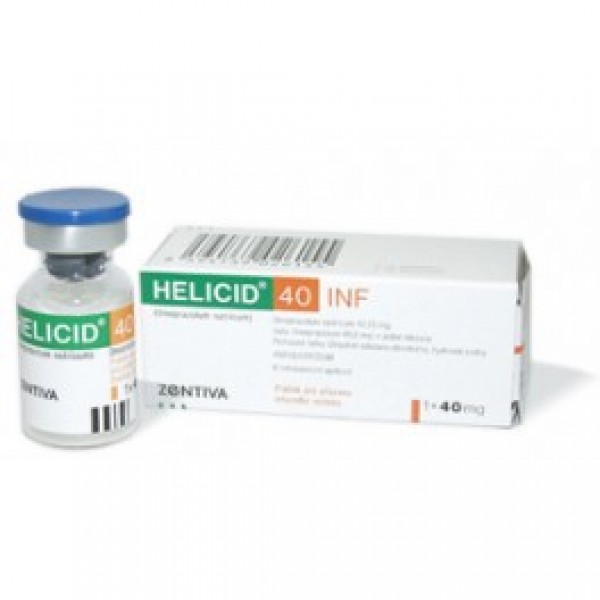
HELICID 40 mg vial.
Product Code: HELICID 40 mg vial.
Availability: In Stock
Product viewed: 977


HELICID 40 mg vial.

Active substance :
Omeprazole sodium 42,55 mg, corresponding to omeprazole 40 mg in 1 bottle.
Excipients:
Disodium edetate dihydrate, sodium hydroxide.
Formulation and packaging
Powder for solution for infusion
Pharmacotherapeutic group
antiulceratives
action
Omeprazole, a racemic mixture of two optically active isomers , reduces the secretion of hydrochloric acid by a very specific mode of action. Omeprazole is a specific inhibitor of the acid pump in the parietal cell . It is activated quickly and the reversible control of gastric acid secretion can be achieved after a once daily administration.
pharmacokinetics
distribution
The volume of distribution (Vd) of omeprazole in healthy individuals is 0,3 1/kg and a similar value is observed in patients with renal failure. In elderly patients and patients with hepatic insufficiency, this value is slightly reduced. About 95 % of the omeprazole
proteins.
Metabolism and Elimination
The average half-life of the terminal phase of elimination of free drug fraction after intravenous administration (tl / 2 el) is 40 minutes and did not change during prolonged therapy. Total plasma clearance of omeprazole (Clp) is 0,3-0,6 l / min.
Omeprazole is completely metabolised by the cytochrome 450 (CYP), mainly in the liver. The main part of metabolism linked to a specific isoform of CYP2C19 (S-mephenytoin hydroxylase). The main metabolite of omeprazole - hydroxyomeprazole is formed here .
Metabolites of omeprazole are not pharmacologically active . Almost 80% of an oral dose is excreted in urine as metabolites and the rest of the faeces , through bile secretion .
witness
Helicid 40 for intravenous infusion indicated for those described below, indicates , when oral therapy is not appropriate or possible . Treatment should be short , eg . 2-3 days, and can be followed by oral therapy with omeprazole.
- For the treatment of duodenal and gastric ulcers ;
- For the treatment of gastric and duodenal ulcers and erosions due to the use of nonsteroidal anti-inflammatory drugs (NSAIDs);
- For the treatment of reflux esophagitis ;
- Eradication of Helicobacter pylori (Hp) in duodenal ulceration ;
- For the symptomatic treatment of reflux esophagitis ;
- For the treatment of functional dyspepsia caused mainly by dysregulation of acid secretion in the stomach ;
- For the treatment of syndrome Zollinger-Ellison;
- To prevent aspiration of gastric contents , in the case where there is such a risk during anesthesia ( syndrome Mendelson).
Contraindications
Known hypersensitivity to omeprazole or to any of the excipients.
Special warnings and precautions for use
In the presence of troublesome symptoms ( weight loss for unknown reasons , repeated vomiting , dysphagia , haematemesis or melena ) with diagnosed or suspected stomach ulcer, must be ruled out any possibility of a malignant etiology, as treatment with omeprazole may alleviate symptoms of disease and prevent the correct diagnosis .
Reduced because of the antisecretory effect of PPIs acid secretion in the stomach leads to an increase in the number of bacteria present in physiological gastrointestinal tract. Treatment with these agents can lead to a slight increase in the risk of gastrointestinal infections caused by strains such as Salmonella and Campylobacter.
The results of three epidemiological studies indicate that omeprazole has no adverse effect during pregnancy on the fetus and newborn . Helicid ® 40 INF may be prescribed during pregnancy .
Omeprazole passes into the milk of nursing mothers , but it is possible to affect the baby when you respect the recommended dosage .
Omeprazole probably not affect your ability to drive and use machines.
drug Interactions
Absorption of some medicines can be affected by the reduction of acidity in the stomach. Therefore, it can be assumed that the absorption of the ketoconazole or itraconazole may be reduced during treatment with Helicid, analogously as in the use of other anti-secretory agents or antacids .
Omeprazole is extensively metabolized in the liver by the enzyme system cytochrome P450 2C19 (CYP2C19) and therefore may slow elimination of diazepam , warfarin (R- warfarin) and phenytoin , ie substrates for CYP2C19. Patients taking concomitant warfarin or phenytoin should be regularly monitored ; It may be necessary reduction in the dose of warfarin and phenytoin. However, concomitant administration of 20 mg omeprazole daily orally did not affect plasma concentrations of phenytoin in patients continuously treated with phenytoin. In patients continuously treated with warfarin, concomitant use of omeprazole orally no change in prothrombin time.
Plasma concentrations of omeprazole and clarithromycin are increased during concomitant use , but there were no interactions with metronidazole and amoxicillin. These antibacterial agents used in combination with omeprazole for eradication of Helicobacter pylori.
Dosage and method of administration
Alternative to oral therapy
In patients for whom oral therapy is inappropriate or impossible recommended Helicid ® INF 40 is administered intravenously once daily . In patients with syndrome Zollinger-EIlison recommended starting dose 60 mg / day intravenously. At higher dosage is required dose individualization . If it is necessary to administer doses above 60 mg per day is recommended that the dose be divided into two separate doses.
Prevention of aspiration of gastric contents
Preference is given to Helicid ® INF 40 1 hour before surgery. If operation continues for more than 2 hours , it is necessary to repeat the dose.
There is no need dosage adjustment in patients with renal insufficiency.
The biological half-life of omeprazole is prolonged in patients with hepatic insufficiency . Therefore, 10-20 mg daily dose may be sufficient in these patients.
In elderly patients do not need dosage adjustment . Experience of applying Helicid ® 40 INF infusions in children is limited .
Directions:
40 INF Helicid ® should be administered as an intravenous infusion over 20 to 30 minutes or more. The contents of 1 vial should be dissolved in 100 ml of physiological saline or 5% glucose solution for infusion . Prepared infusion solution should be used within 12 hours, respectively, to 6 hours if used as the solvent is physiological saline solution , respectively, of the glucose infusion . The solution is ready for use immediately after preparation.
preparation:
A) 5 ml of solution from the infusion bag or bottle to a syringe .
B ) To a powder for making an infusion solution , which contains the sodium salt of omeprazole, the solution was added by syringe. The vial is shaken until complete dissolution of the solid .
B) The resulting solution is drawn back into the syringe.
D) The solution is transferred to the infusion bag or bottle using a syringe.
E) actions of a) to d) are repeated in this way until the transfer of the powder for solution for infusion in the infusion solution.
An alternative method for the preparation of an infusion solution in an infusion bag :
A) A bilateral flowing needle. One end of the needle is mounted at the entrance of the infusion bag , the other - the vial of lyophilized cake.
B ) The solid is dissolved by repeatedly transferring infusion vial back into the infusion bag .
B) The needle and the vial is removed after the transfer of the powder in the infusion bag.
overdose
In clinical studies were administered daily intravenous doses up to 270 and 650 mg for more than 3 days without signs of dose-related adverse reactions.
Undesirable effects
Adverse reactions are usually mild and reversible. The following adverse reactions have been observed in clinical research and clinical practice , in many cases , the relationship to treatment with omeprazole has not been definitively established. Depending on the frequency of their appearance , they are divided as follows: Common ( > 1%), uncommon ( 0.1-1% ) and rare (<0.1 %).
Common: headache, diarrhea, constipation , abdominal pain, nausea / vomiting , vomiting and flatulence .
Uncommon : dizziness, paresthesia , somnolence , insomnia, dizziness , rash and / or itching , hives , anxiety, elevated liver enzymes.
Rare : reduced number of white blood cells and platelets , agranulocytosis, pancytopenia, symptoms of hypersensitivity as angioedema, interstitial nephritis, anaphylactic shock, hyponatremia , reversible state of confusion, irritability , aggression , depression and hallucinations , especially in severely ill patients taste disturbances, encephalopathy in patients with pre-existing severe liver disease , blurred vision * , dry mouth , stomatitis, candidiasis , hepatitis with or without jaundice , liver failure , hair loss, increased sweating , peripheral edema , photosensitivity , erythema multiforme, Stevens syndrome -Johnson, toxic epidermal necrolysis , joint pain , muscle weakness, muscle pain, gynecomastia.
* Irreversible damage to the eye has been reported in isolated cases of critically ill patients , who were given omeprazole injection , especially in high doses. Causal link between the damage to the eye and the administration of omeprazole has not been established .
storage
Store at temperatures below 25 ° C in the original package .
Outside the secondary packaging ( carton ) vials should be protected from light and can be stored at normal room light up to 24 hours. Prepared infusion solution should be used within 12 hours if this is used in a saline solution and up to 6 hours after the preparation , if it is used in a 5% glucose solution for infusion.
Given the microbial purity of the solution for infusion , it must be used immediately , if the reconstitution is not carried out under aseptic conditions .
In normal room lighting solutions prepared for infusion may be used without special precautions.
Expiration date
2 years
attention
Do not use after the expiry date printed on the package . Keep out of reach of children!
Write a review
Your Name:Your Review: Note: HTML is not translated!
Rating: Bad Good
Enter the code in the box below:
Related Products