Your shopping cart is empty!
Welcome visitor you can login or create an account.
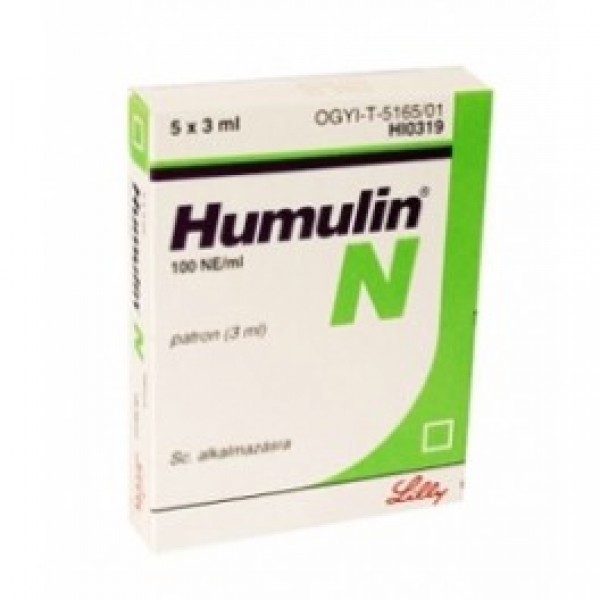
Humulin N 300 IU 3 ml
Product Code: Humulin N 300 IU 3 ml
Availability: In Stock
Product viewed: 1469


Humulin N 300 IU 3 ml
GENERIC NAME OF THE MEDICINAL PRODUCT
Insulin human
Formulations
Suspension for injection in a cartridge / OptiSet-preloaded pen.
Cloudy, white, aqueous suspension.
Qualitative and quantitative composition
Insulin human rDNA (insulin human, rDNA) (produced by recombinant DNA
technology. 1 ml contains 100 IU of insulin human.
1 cartridge / OptiSet contains 3 ml, equivalent to 300 IU.
One IU (International Unit) corresponds to 0,035 mg of anhydrous human insulin.
2. CLINICAL DATA
Witness
Treatment of diabetes mellitus.
Dosage and method of administration
Represents the intermediate (a long-acting insulin SPC).
Dosage is individual and determined in accordance with the needs of the patient.
The individual insulin requirement is usually between 0.3 and 1,0 IU / kg / day. The daily need for insulin may be higher in patients with insulin resistance (eg during puberty or due to obesity) and lower in patients with residual endogenous insulin production.
The physician determines whether any one or more daily injections. Insulin can be
used alone or mixed with fast-acting insulin. In intensive insulin therapy suspension can be used as basal insulin (evening and / or morning injection) with fast-acting insulin at mealtimes.
Optimized glycemic control in patients with diabetes delays the onset of complications. It is therefore recommended frequent monitoring of blood glucose.
Dose adjustment
Concomitant illness, especially infections and feverish conditions, usually increases the patient's insulin requirements.
Renal or hepatic impairment may reduce insulin requirement.
Dosage adjustment may be necessary if patients change their physical activity or their usual diet.
Dosage adjustment may be necessary when converting patients from one insulin preparation to another.
Application
For subcutaneous use. Insulin suspensions are never to be administered intravenously. Subcutaneously in the thigh. If convenient can also be used abdomen gluteal region or the deltoid muscle.
Subcutaneous injection in the thigh in a slower and less variable absorption than other injection sites.
Injection into a lifted skin fold minimizes the risk of unintended intramuscular injection.
The needle should remain under the skin for at least 6 seconds to make sure the entire dose is injected.
Injection sites should be rotated within an anatomic region in order to avoid lipodystrophy.
Contraindications
Hypersensitivity to the active substance or to any of the excipients. Hypoglycemia.
Special precautions for use
Inadequate dosing or discontinuation of treatment, especially in type 1 diabetes, may lead to hyperglycaemia.
Usually, the first symptoms of hyperglycaemia develop gradually over a period of hours or days. Include thirst, frequent urination, nausea, vomiting, drowsiness, flushed dry skin, dry mouth, loss of appetite and breath smelling of acetone.
In patients with type 1 diabetes, untreated hyperglycaemic events eventually lead to diabetic ketoacidosis, which is potentially lethal.
Hypoglycaemia may occur if the insulin dose insulin requirement.
Omission of a meal or unplanned, strenuous physical exercise may lead to breakthrough
of hypoglycaemia.
Patients who have a significant improvement in blood glucose control, eg. by intensified insulin therapy, may experience a change in their usual warning symptoms of hypoglycaemia, and therefore they should be notified.
Usual warning symptoms may disappear in patients with longstanding diabetes.
Transferring a patient to another type or brand of insulin should be done under strict medical supervision. Changes in strength, brand (manufacturer), type (fast-, dual-, long-acting insulin etc.), origin (animal, human insulin analogue) and / or method of manufacture (recombinant DNA versus animal source insulin ) may require dose adjustment. In case you need a dose adjustment when switching patients to mixed insulin, this can occur with the first dose or during the first few weeks or months.
As with any insulin therapy, may experience reactions at the injection site, which include pain, itching, hives, swelling and inflammation. Continuous rotation of the injection site within a given area may help to reduce or prevent these reactions. Reactions usually resolve in a few days to a few weeks.
Before traveling between different time zones, the patient should be advised to consult a doctor as it may require administration of insulin and meals at different times.
Insulin suspensions should not be used in insulin infusion pumps.
Interactions
The following substances may reduce insulin requirements:
Oral hypoglycaemic agents (OHA), monoamine oxidase (MAO-inhibitors), non-selective beta-blockers, angiotensin converting enzyme (ACE) inhibitors, salicylates, alcohol, anabolic steroids and sulphonamides.
The following substances may increase insulin requirement:
Oral contraceptives, thiazides, glucocorticoids, thyroid hormones and beta-sympathomimetics, growth hormone and danazol.
Beta-blockers may mask the symptoms of hypoglycaemia and delay recovery.
Octreotide / lanreotide may both decrease and increase insulin requirement.
Alcohol may intensify and prolong the hypoglycaemic effect of insulin.
Use during pregnancy and lactation
There are no restrictions on the treatment of diabetes with insulin during pregnancy, as insulin does not cross the placental barrier.
Both hypoglycaemia and hyperglycaemia, which can occur in patients with inadequately controlled diabetes therapy, increase the risk of malformations and death in utero. It is therefore recommended greater control of the treatment of diabetes when planning pregnancy and during pregnancy.
Usually during the first trimester of pregnancy reduces insulin requirements and subsequently increase during the second and third quarters.
After delivery, insulin requirements return rapidly to pre-pregnancy.
Insulin treatment of the nursing mother presents no risk to the baby. You, however, need dosage adjustment.
Effects on ability to drive and use machines
As a result of hypoglycemia, the patient's ability to concentrate and react may be
worse. This may constitute a risk in situations where these abilities are of special importance (eg driving a car or operating machinery).
Patients should be advised to take precautions to avoid hypoglycaemia whilst driving. This is especially important for those who have reduced or absent awareness of the warning signs of hypoglycaemia or have frequent episodes of hypoglycaemia. In such cases, you should carefully consider the advisability of driving.
Adverse reactions
As with other insulin products, in general, hypoglycaemia is the most frequently occurring adverse reaction. It may occur if the insulin dose is too high in relation to the insulin requirement. Severe hypoglycaemia may lead to unconsciousness and / or convulsions and may result in temporary or permanent impairment of brain function or even death.
Nervous System
Uncommon-Peripheral Neuropathy
Fast improvement in blood glucose control may be associated with a condition termed "acute painful neuropathy", which is usually reversible.
Eye Disorders
Very rare - Refraction disorders
Upon initiation of insulin therapy, may occur refractive errors.
These symptoms are usually transient.
Uncommon - Diabetic retinopathy
Long-term improved glycemic control decreases the risk of progression of diabetic
retinopathy. However, intensification of insulin therapy with abrupt
improvement in glycemic control may cause temporary worsening of diabetic
retinopathy.
Skin and subcutaneous tissue disorders
Uncommon - Lipodystrophy
Lipodystrophy may occur at the injection site, if you do not rotate injection sites within an area.
General disorders and administration site conditions
Uncommon - Reactions at the injection site
Reactions at the injection site (redness, swelling, itching, pain and hematoma at the injection site) may occur during treatment with insulin. Most reactions are transitory and disappear during treatment.
Uncommon - Oedema
Upon initiation of insulin therapy, may occur edema. These symptoms are usually
transient.
Immune System
Uncommon - Urticaria, rash
Very rare - Anaphylactic reactions
Symptoms of generalized hypersensitivity may include generalized skin rash, itching, sweating, gastrointestinal upset, angioneurotic edema, shortness of breath, palpitations, low blood pressure and fainting / loss of consciousness.
Generalised hypersensitivity reactions are potentially life threatening.
Overdose.
When insulin can not accurately determine the dosage. Hypoglycaemia may develop
the following successive stages:
Mild hypoglycaemic episodes can be treated by oral administration of glucose or sugar-containing foods. It is therefore recommended to diabetics carry sugar lumps, sweets, biscuits or fruit juice with sugar.
Severe hypoglycaemic episodes, where the patient has become unconscious, can be treated by glucagon (0.5 to 1 mg), intramuscularly or subcutaneously by a trained person or glucose given intravenously by a medical professional.
Intravenously is also necessary to 10-15 minutes if the patient does not respond to glucagon.
After regaining consciousness, it is recommended to give oral carbohydrates to prevent relapse.
Pharmacological
Pharmacokinetic properties:
Insulin in the blood stream has a half-life of several minutes. Therefore action profile of insulin preparation is determined solely by its absorption characteristics.
This process is influenced by several factors (eg insulin dosage, route and site, thickness of subcutaneous fat, type of diabetes). So there are significant differences in the pharmacokinetics of insulin products between patients and in the same patient.
Absorption
The maximum plasma concentration of insulin is reached within 2-18 hours after subcutaneous administration.
Distribution
No profound binding to plasma proteins, except circulating anti-insulin antibodies (if available).
Metabolism
It was found that human insulin is degraded by insulin protease or insulin-degrading enzymes and possibly protein disulfide isomerase. A number of cleavage (hydrolysis) molecule of human insulin, none of the metabolites formed following the cleavage are active.
Elimination
The terminal half-life is determined by the rate of absorption from the subcutaneous tissue. Therefore, the terminal half-life (t ½) is a measure of the absorption rather than elimination per se of insulin from plasma (t ½ of insulin into the bloodstream a few minutes). Studies have found that t ½ is approximately 5-10 hours.
Pharmacodynamic properties:
Pharmacotherapeutic group: Insulins and analogues for injection, intermediate-acting, insulin (human).
The blood glucose lowering effect of insulin is due to the facilitated uptake of glucose into muscle and fat cells after binding to insulin receptors on cells and simultaneous inhibition of glucose from the liver.
In the long-acting insulin action occurs within 1 ½ hours, reaches a maximum effect within 4-12 hours and the duration of action is approximately 24 hours
PHARMACEUTICAL PARTICULARS
Expiration date
30 months when stored between 2 ° C - 8 ° C. 6 weeks when used or when carried as a spare (below 30 ° C).
Special precautions for storage
Before use: Store in a refrigerator (2 ° C - 8 ° C).
Do not store them in or too near the freezer section or cooling
element.
Do not freeze.
During use: do not refrigerate. Do not store above 30 ° C.
Keep the cartridge in the outer carton to protect from light.
Keep away from excessive heat and sunlight.
Recommendations for use
Insulin preparations which have been frozen should not be used.
After removing insulin from the refrigerator it is recommended to let it reach room temperature (below 25 ° C) before resuspending the insulin as instructed for first time use.
Insulin suspensions should not be used if they do not appear uniformly white and cloudy after resuspension.
Write a review
Your Name:Your Review: Note: HTML is not translated!
Rating: Bad Good
Enter the code in the box below:
Related Products