
Your shopping cart is empty!
Welcome visitor you can login or create an account.
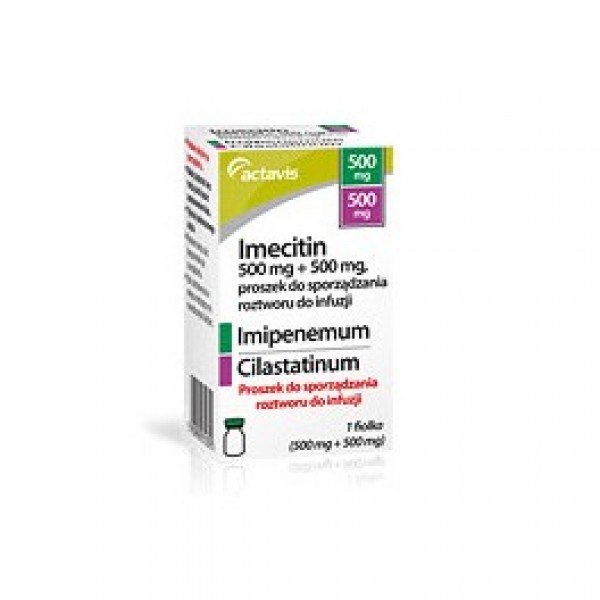
IMECITIN 500 mg. / 500 mg. 20 ml.
Product Code: IMECITIN 500 mg. / 500 mg. 20 ml.
Availability: In Stock
Product viewed: 985


IMECITIN 500 mg. / 500 mg. 20 ml.
WHAT IMECITIN AND WHAT IT IS USED FOR?
Imetsitin belongs to a group of medicines called "carbapenem antibiotics". For adults and children aged one year and over he kills many bacteria (microorganisms) that cause infections in various parts of the body.
Treatment
Your doctor has prescribed Imetsitin because you have one (or more) of the following infections: Infections of abdominal infections affecting the lungs (pneumonia) Infections that you received during or after birth Complicated urinary tract infections Complicated skin infections and soft tissue
Imetsitin can be used in the treatment of patients with low levels of white blood cells that have fever that is suspected to be due to bacterial infection.
Imetsitin can be used to treat bacterial infections of the blood, which are assumed to be associated with the type of infection mentioned above.
2. BEFORE YOU TAKE IMECITIN
Do not take Imecitin:
if you are allergic (hypersensitive) to imipenem, cilastatin or any other ingredient of Imetsitin.
if you are allergic (hypersensitive) to other antibiotics such as penicillins, cephalosporins or carbapenems
Caution when taking Imetsitin
Tell your doctor about any illness you have or have had including:
- Allergies to medicines, including antibiotic (sudden life-threatening allergic reactions require immediate treatment) colitis or other gastrointestinal disease of the central nervous system such as localized tremors or epileptic seizures, liver problems, kidney or urinary tract
It is possible to get a positive result when testing (test Coombs), which indicates the presence of antibodies that may destroy red blood cells. Your doctor will discuss this with you.
Tell your doctor if you use medicines containing valproic acid or sodium valproate (see. Taking other medicines below).
Children
Imetsitin not recommended in children under one year old or children with kidney problems.
Taking other medicines:
Please tell your doctor or pharmacist if you are taking or have recently taken any other medicines, including medicines obtained without a prescription.
Tell your doctor if you are taking ganciclovir which is used to treat some viral infections.
Also, tell your doctor if you are taking valproic acid or sodium valproate (used to treat epilepsy, bipolar disorder, migraines or schizophrenia) or drugs blood thinners such as warfarin.
Your doctor will decide whether you should use Imetsitin in combination with these medicines.
Pregnancy and lactation
If you are pregnant or plan to become pregnant, it is important to tell your doctor about this before you start treatment with Imetsitin. Application of Imetsitin in pregnant women has not been studied. Imetsitin should not be used during pregnancy unless your doctor decides the potential benefit justifies the potential risk to the fetus.
If you are breastfeeding or plan to breastfeed, it is important to tell your doctor about this before you start treatment with Imetsitin. Small amounts of this medicine may pass into breast milk and affect the baby. Therefore, your doctor will decide whether you should use Imetsitin while breastfeeding.
Ask your doctor or pharmacist before taking any medicine.
Driving and using machines
Some of the side effects associated with use of this product (such as seeing, hearing or feeling things that are not, dizziness, drowsiness and dizziness) may affect some patients' ability to drive or operate machinery (see. Section 4).
Important information about some of the ingredients of Imetsitin
Imetsitin 250 mg / 250 mg powder for solution for infusion.
This product contains less than 1 mmol sodium (23 mg) per dose, which means that the product is essentially free of sodium.
Imetsitin 500 mg / 500 mg powder for solution for infusion.
This medicinal product contains 1,6 mmol (or 37,6 mg) sodium per dose. This should be taken into consideration by patients on a controlled diet intake of sodium.
3. HOW TO TAKE IMECITIN?
Imetsitin will be prepared and will be administered by a doctor or other medical professional, your doctor will decide how much Imetsitin need.
Adults and adolescents
In adults and adolescents, the usual dose of Imetsitin is 500 mg / 500 mg every 6 hours or 1000 mg / 1 000 mg every 6 or 8 hours. If you have kidney problems, or if you weigh less than 70 kg, your doctor may reduce your dose.
Children
In children aged over one year, the usual dose is 15/15 or 25/25 mg / Kg / dose every 6 hours. Not recommended for use Imetsitin in children aged 1 year and children with kidney problems.
Method of administration
Imetsitin administered intravenously (into a vein) for about 20-30 minutes for a dose of <500 mg / 500 mg, or about 40-60 minutes for a dose> 500 mg / 500 mg.
If you use more than the amount Imetsitin
Symptoms of overdose may include seizures, convulsions, tremors, nausea, vomiting, low blood pressure and slow heart rate. If you are worried that you may have been given too much Imetsitin, immediately contact your doctor or other healthcare professional.
If you forget to use Imetsitin
If you are concerned that you may have missed a dose, contact your doctor or another healthcare professional.
Do not take a double dose to make up the missed dose. If you stop using Imetsitin
Do not stop taking Imetsitin until your doctor tells you to stop.
If you have further questions on the use of this product, ask your doctor or pharmacist.
4. POSSIBLE SIDE EFFECTS
As with all medicines, Imecitin can cause side effects, although not in all patients.
The frequency of adverse reactions listed below is defined using the following system: Very common: affects more than 1 user in 10 Common: affects 1 to 10 users in 100 Uncommon: affects 1 to 10 users in 1,000 Rare: affects 1 to 10 users in 10,000 Very rare: affects less than 1 user in 10,000 Not known: from the available data can not be estimated
Common
- Nausea, vomiting, diarrhea. It seems that nausea and vomiting developed more frequently in patients with low white blood cell count
- Strong, painful to touch swelling and redness of the vein
- Rash
- Abnormal liver function, which is found in blood tests Increase in certain white blood cells
Uncommon:
- Local flushing
- Local pain, and form a solid lump at the site of injection
- Itchy skin
- Urticaria
- Fever
- Blood disorders affecting blood cells, which are usually detected in a blood test (symptoms may be fatigue, pale skin and delayed delivery of bruises formed by injury)
- Disorders of kidney function and liver, and abnormal blood tests, which are found in blood tests Tremors and uncontrollable muscle twitching - Seizures
- Psychiatric disorders (such as mood swings and impaired judgment) Seeing, hearing or feeling things that are not there (hallucinations) Confusion Dizziness, somnolence
Lowering blood pressure
Rare:
- Allergic reactions including rash, swelling of face, lips, tongue and / or throat (with difficulty in breathing) and / or low blood pressure. If such adverse reactions occur during or shortly after application of Imetsitin, the drug should be discontinued immediately and contact your doctor.
- Scaling of skin (toxic epidermal necrolysis)
- Severe skin reactions (Stevens-Johnson and erythema multiforme)
- Severe skin rash with peeling skin and hair loss (exfoliative dermatitis)
- Fungal infections (thrush)
- Discoloration of the teeth and / or tongue
- Inflammation of the colon with severe diarrhea
- Taste disorders
- Inability of the liver to perform its functions Inflammation of the liver
- Inability of the kidneys to perform their functions Changes in the amount of urine discoloration of urine Brain damage, numbness (pins and needles), localized tremor Hearing Loss
Very rare:
- Severe impairment of liver function due to inflammation (fulminant hepatitis), inflammation of the stomach or intestines (gastroenteritis) Inflammation of intestine with bloody diarrhea (hemorrhagic colitis)
- Redness and swelling of the tongue, expansion of the normal bumps on the tongue, which gives him the "hairy" appearance, heartburn, sore throat, increased saliva Abdominal pain
- Feelings of dizziness (vertigo), headache Tinnitus (tinnitus) pain in several joints, weakness
- Irregular heartbeat, fast or too strong heartbeat
- Discomfort in the chest, difficulty breathing, an unusually rapid and shallow breathing, pain in the upper part of the spine
- Redness, bruising of the face and lips, change in skin texture, increased sweating Vaginal itching in women Changes in the number of blood cells
- Worsening of a rare disease associated with muscle weakness (worsening of myasthenia gravis)
If any of the side effects gets serious, or if you notice any not listed in this leaflet, please tell your doctor.
5. HOW TO STORE IMETSITIN?
Keep out of the reach and sight of children.
Do not use the powder for solution for infusion after the expiry date stated on the carton and vial ("EXP"). The date of the expiry date refers to the last day of that month.
For powder in vials Imetsitin not require special storage conditions.
After reconstitution:
Diluted solutions should be used immediately. The time between the beginning of reconstitution and the end of intravenous infusion should not exceed two hours.
The reconstituted solution should not be frozen.
Medicines should not be disposed of via wastewater or household waste. Ask your pharmacist how to dispose of medicines no longer required. These measures will help to protect the environment.
6. FURTHER INFORMATION
What Imecitin?
The active substances are imipenem (as monohydrate) and cilastatin (as sodium salt) Each vial Imetsitin 250 mg / 250 mg powder for solution for infusion contains 250 mg of imipenem (265 mg as imipenem monohydrate) and 250 mg cilastatin (265 mg as cilastatin sodium salt) . Each vial Imetsitin 500 mg / 500 mg powder for solution for infusion contains 500 mg of imipenem (530 mg as imipenem monohydrate) and 500 mg cilastatin (530 mg as cilastatin sodium salt). The excipient is sodium hydrogen carbonate.
Write a review
Your Name:Your Review: Note: HTML is not translated!
Rating: Bad Good
Enter the code in the box below:
Related Products
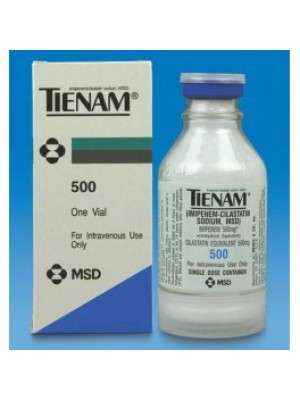
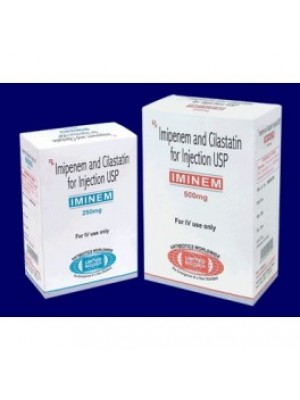
Imipenem 500 mg. / 500 mg. 20 ml. 5 vialsWhat is imipenem / ..
89.00€