Your shopping cart is empty!
Welcome visitor you can login or create an account.
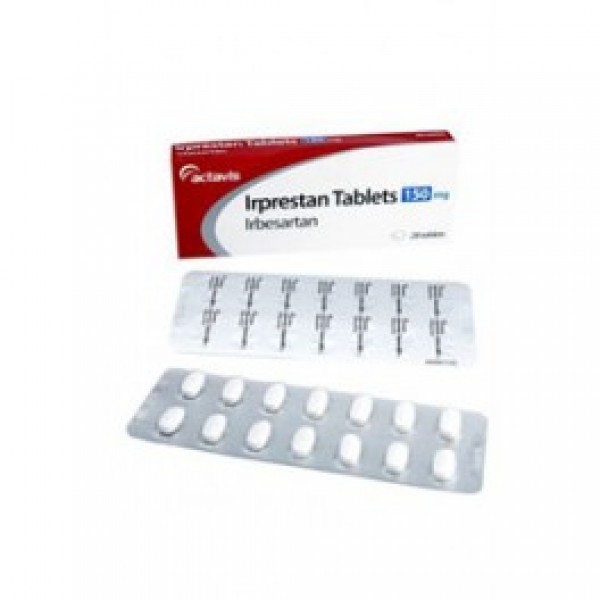
IRPRESTAN 150 mg. 30 tablets
Product Code: IRPRESTAN 150 mg. 30 tablets
Availability: In Stock
Product viewed: 1201


IRPRESTAN 150 mg. 30 tablets
WHAT IRPRESTAN AND WHAT IT IS USED
Irprestan belongs to a group of medicines known as angiotensin II receptor antagonists. Angiotensin-II is a substance produced in the body and which binds to receptors in blood vessels, causing them to tighten. This leads to an increase in blood pressure. Irprestan prevents the binding of angiotensin-II to these receptors, resulting in relaxation of blood vessels, and a lowering of blood pressure. Irprestan slows the decrease of kidney function in patients with high blood pressure and type 2 diabetes.
Irprestan used:
for the treatment of hypertension (essential hypertension);
to protect the kidney in patients with hypertension and type 2 diabetes who have laboratory evidence of impaired renal function.
2. BEFORE YOU TAKE IRPRESTAN
Do not take Irprestan
if you are allergic (hypersensitive) to irbesartan or any other ingredients of Irprestan;
if you are pregnant for more than 3 months. (It is better to avoid taking Irprestan and in early pregnancy - see pregnancy section).
Irprestan should not be used in children and adolescents (under 18 years).
Take special care with Irprestan
Tell your doctor if the following apply to you:
if you suffer from excessive vomiting or diarrhea;
if you have kidney problems;
if you have heart problems;
if you are taking Irprestan for the treatment of diabetic nephropathy. In this case, the physician may require regular blood tests, in particular for measuring the amount of potassium in the blood in the case of impaired renal function;
if you have surgery or receive anesthetics.
You should tell your doctor if you are pregnant or may become pregnant. Irprestan not recommended in early pregnancy and must not be taken if you are pregnant for more than three months, as the drug can harm your baby if taken at this stage (see pregnancy section).
Taking other medicines
Please tell your doctor or pharmacist if you are taking or have recently taken any other medicines, including medicines obtained without a prescription. Irprestan do not normally interact with other medicines.
You may need to do a blood test if you take:
potassium supplements;
salt substitutes that contain potassium;
potassium-sparing medicines (such as certain diuretics);
medicines containing lithium.
If you take certain painkillers, called non-steroidal anti-inflammatory drugs, the effect of irbesartan may be reduced.
Taking Irprestan with food and drink
Irprestan can be taken with or without food. The tablets should be swallowed with a glass of water.
Pregnancy and lactation
Ask your doctor or pharmacist before taking any medicine.
pregnancy
You should tell your doctor if you are pregnant or may become pregnant. Your doctor will normally advise you to stop taking Irprestan before you become pregnant or as soon as you know you are pregnant and will advise you to take another medicine instead Irprestan.
Irprestan not recommended in early pregnancy and must not be taken when you go three months pregnant, as it may cause serious harm to your baby if taken after the third month of pregnancy.
breastfeeding
Tell your doctor if you are breastfeeding or plan to breastfeed. Irprestan not recommended for mothers who are breast-feeding so that your doctor can recommend another medicine if you want to breast-feed, especially if your baby is newborn, or was born prematurely.
Driving and using machines
No studies on the effect of the drug on the ability to drive and use machines. Irprestan unlikely to affect your ability to drive and use machines. However, it is possible sometimes occur dizziness or fatigue during treatment of high blood pressure. If you feel, talk to your doctor before exercising such activities.
3. HOW TO TAKE IRPRESTAN
Always take Irprestan exactly as prescribed by your doctor. If you are not sure, ask your doctor or pharmacist.
It is available in packs of: 75 mg, 150 mg, 300 mg.
Method of administration
Irprestan is administered orally and can be taken on an empty stomach or with food. The tablets should be swallowed with a glass of water. Try to take your daily dose at the same time each day. It is important to continue taking Irprestan until your doctor tells you otherwise.
Patients with high blood pressure
The usual dose is 150 mg once daily. Later, the dose may be increased to 300 mg daily depending on the blood pressure response.
Patients with high blood pressure and type 2 diabetes with kidney disease
In patients with high blood pressure and type 2 diabetes, 300 mg once a day is preferred maintenance dose for the treatment of diabetes-related kidney disease.
The doctor may recommend a lower dose, especially when starting treatment in certain patients such as those on hemodialysis or patients over 75 years.
The maximum effect on blood pressure lowering is reached 4-6 weeks after starting treatment.
Children should not take Irprestan
Irprestan should not be given to children (<18 years).
If you take more dose Irprestan
If you take more than the required number of tablets, or a child swallows them, you should immediately contact your doctor. Symptoms of overdose include hypotension and tachycardia; bradycardia.
If you forget to take Irprestan
If you accidentally miss a daily dose, just take the next dose at the usual time. Do not take a double dose to make up the missed dose.
If you have any further questions on the use of this product, ask your doctor or pharmacist.
4. POSSIBLE SIDE EFFECTS
Like all medicines, Irprestan can cause side effects, although not everybody gets them.
Some of these reactions can become serious and require medical attention.
As with other similar drugs in patients irbesartan Rare cases of allergic skin reactions (rash, urticaria), as well as localized swelling of the face, lips and / or tongue. If you experience any of these symptoms or start breathless, stop taking Irprestan and contact your doctor immediately.
The frequency of adverse reactions described below are defined as follows:
Very common: affects more than 1 in 10 treated patients;
Common: 1 to 10 of 100 patients treated;
Uncommon: 1 to 10 in 1,000 patients;
Rare: 1 to 10 of 10,000 treated patients;
Very rare: affects less than 1 in 10,000 treated patients;
Not known: frequency can not be estimated from the available data.
Adverse reactions reported in clinical studies with patients treated with irbesartan, are as follows:
Very common: if you suffer from high blood pressure and type 2 diabetes with kidney disease, blood tests may show an increased level of potassium.
Common: dizziness, nausea / vomiting, fatigue and blood tests that indicate increased levels of an enzyme that measures the muscle and heart function (creatine kinase). In patients with high blood pressure and type 2 diabetes with kidney disease was also reported dizziness when getting up from a lying or sitting position, low blood pressure when getting up from a lying or sitting position, pain in joints or muscles and decreased levels of a protein in red blood cells (hemoglobin).
Uncommon: heart rate increased, flushing, cough, diarrhea, indigestion / heartburn, sexual dysfunction (problems with sexual intercourse), pain in the chest area.
For some side effects reported after irbesartan is marketed, but is not known frequency.
These side effects are: headache, taste disturbance, ringing in the ears, muscle cramps, pain in joints and muscles, abnormal liver function, increased levels of potassium in the blood, impaired kidney function, and inflammation of small blood vessels, which mainly affects the skin (a condition known as leukocytoclastic vasculitis).
If any of the side effects gets serious, or if you notice other effects not listed in this leaflet, please tell your doctor or pharmacist.
5. HOW TO STORE IRPRESTAN
Keep out of reach of children.
Irprestan not use after the expiry date stated on the carton and on the blister packaging for tablets. The expiry date refers to the last day of that month.
For this medicinal product does not require special storage conditions.
Medicines should not be disposed of via wastewater or household waste. Ask your pharmacist how to dispose of medicines no longer required. These measures will help to protect the environment.
6. FURTHER INFORMATION
What Irprestan
The active substance is irbesartan / irbesartan. Each tablet contains 75 mg, 150 mg or 300 mg irbesartan.
Other ingredients are:
core: croscarmellose sodium (E468), microcrystalline cellulose (E460), hypromellose (E464), mannitol (E421), magnesium stearate (E572), silica colloidal anhydrous (E551).
tablet coating: hydroxypropyl cellulose (E463), hypromellose (B464), macrogol 6000, titanium dioxide (E171).
Write a review
Your Name:Your Review: Note: HTML is not translated!
Rating: Bad Good
Enter the code in the box below:
Related Products