Your shopping cart is empty!
Welcome visitor you can login or create an account.
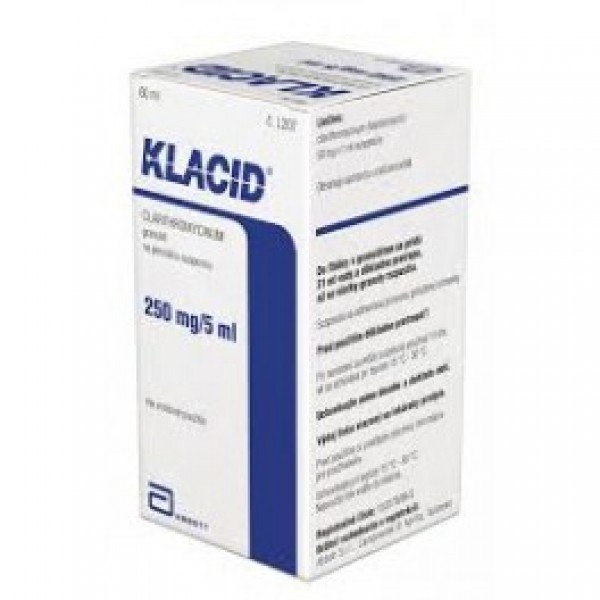
Klacid syrup 250mg. / 5ml. 60 ml.
Product Code: Klacid syrup 250mg. / 5ml. 60 ml.
Availability: In Stock
Product viewed: 2112


Klacid syrup 250mg. / 5ml. 60 ml.
WHAT Klacid granules for oral suspension AND WHAT IT IS USED
Klacid granules for oral suspension is an antibiotic belonging to the group of so-called macrolide antibiotics. Antibiotics are drugs that inhibit or stop the growth of certain microorganisms (bacteria) that cause the occurrence of various infections.
Klacid granules for oral suspension is indicated for the treatment of infections caused by microorganisms sensitive to it. This includes:
Infections of the upper respiratory tract (pharyngitis, sinusitis);
Infections of the lower respiratory tract (bronchitis, pneumonia);
Acute otitis media;
Infections of the skin and subcutaneous tissue (impetigo, folliculitis, cellulitis, abscesses);
Distributed or localized infections caused by certain types of mycobacteria (Mycobacterium avium or Mycobacterium intracellulare; localized infections of Mycobacterium chelonae, Mycobacterium fortuitum and Mycobacterium kansasii).
As with other antibiotics before prescribing Klaricid granules for oral suspension, your doctor will take into consideration the frequency of resistance (resistance of microorganisms to an antibiotic) and the related recommendations for prescribing antibiotics.
2. WHAT YOU SHOULD KNOW BEFORE YOU TAKE Klacid granules for oral suspension
Do not take or give your child Klaricid granules for oral suspension:
if you are allergic or your child is allergic to the active substance (any of the other ingredients of this medicine (listed in section 6);
when taking the following medicines: astemizole, cisapride, pimozide, terfenadine, ergotamine, dihydroergotamine, lovastatin or simvastatin (see written below).
Warnings and precautions for use of Klaricid granules for oral suspension
Talk to your doctor or pharmacist before taking Klaricid granules for oral suspension.
If you are considering the implementation of clarithromycin suspension in patients after puberty, the physician should carefully weigh the benefits against the risks, if suspected or confirmed pregnancy.
Application of almost all antibiotics, including Klaricid can lead to imbalance present in the colon bacteria overgrowth of certain causing inflammation of the colon bacteria. This condition is known as pseudomembranous colitis and most frequently occurs with the onset of diarrhea during or after discontinuation of the antibiotic. Therefore, it is very important to tell your doctor about the occurrence of diarrhea, even a long time (1-2 months) after cessation of antibiotic treatment.
It is possible that symptoms of the disease exacerbation myasthenia gravis (neuromuscular disorder most commonly characterized by muscle weakness) during treatment with the medicinal product.
Your doctor may decide that this medicine is not suitable for you or your child in the event of a violation of liver or kidney function. It may be necessary to carry out further research, which will be advised by your doctor.
Tell your doctor in case of a medicine containing colchicine because of possible toxic effects when co-administered with clarithromycin (the active ingredient in Klaricid), especially if you are elderly and / or in the presence of renal failure.
Tell your doctor if you are taking medication to reduce blood sugar (taken by mouth or insulin). Concomitant administration of clarithromycin with these drugs can lead to a drop in blood sugar, which requires to be managed often.
Tell your doctor if you are taking means to suppress the formation of clots in the blood (anticoagulants). Concomitant administration of these drugs with clarithromycin may lead to increased risk of bleeding.
As with other antibiotics, prolonged treatment with clarithromycin can lead to the development of multiple-resistant (sensitive to an antibiotic) bacteria and fungi. The occurrence of such infections is necessary to start determined by your doctor treatment.
Other medicines and Klaricid granules for oral suspension
Tell your doctor or pharmacist if your child is taking other medicines, has recently taken or might take including medicines obtained without a prescription.
This medicinal product may alter the effect of a number of drugs, as other medicines may change the effect of Klaricid.
It is particularly important to tell your doctor if your child has any of the following medications:
cisapride (for stomach problems), pimozide (for psychiatric disorders), terfenadine (for allergies or hay fever), ergotamine or dihydroergotamine (for migraine) - the use of these drugs with Klaricid is absolutely forbidden (see above);
Digoxin (cardiovascular medicine);
warfarin and other anticoagulants (drugs to thin the blood);
carbamazepine or phenytoin (for epilepsy);
astemizole (for allergies and hay fever);
theophylline (for relief in breathing);
triazolam, alprazolam and midazolam (sedatives);
quinidine and disopyramide (heart medicine);
lovastatin or simvastatin (for high cholesterol);
cimetidine (for stomach problems);
cyclosporine and tacrolimus (to suppress the immune response, most frequently in organ transplantation);
fluconazole, itraconazole (in the treatment of fungal infections);
sildenafil, tadalafil and vardenafil (with erection problems or erectile dysfunction, etc.);
zidovudine, ritonavir, saquinavir, atazanavir (medicines to treat HIV / AIDS);
rifabutin (to treat certain infections);
verapamil (a medicine for heart disease).
Pregnancy, lactation and fertility
This product is intended for use primarily in children. However, if it is ingested by adults is necessary to consider the following:
If you are pregnant or breast-feeding, think you may be pregnant or planning to become pregnant, ask your doctor or pharmacist before taking this medicine.
Your doctor will assess the possibility of applying this product in case of pregnancy or breastfeeding, and will discuss with you the benefits and risks associated with its use (including possible risks to the fetus).
Driving and using machines
Klacid granules for oral suspension is intended for use primarily in children. There are no data on the impact of the product on the ability to drive. When driving or operating machinery should be given the possibility of dizziness.
3. HOW TO TAKE Klacid granules for oral suspension
Always take or give your child Klaricid granules for oral suspension, just as you have been told your doctor or pharmacist. If you are unsure ask your doctor or pharmacist.
The table below presents the usual dosage for children defined based on body weight (kg). The required dose is taken twice daily and is measured using the attached standardized measuring spoon or syringe, which are marked accordingly 2,5 ml and 5 ml.
Weight * (kg) twice daily dose (125 mg / 5 ml) dose twice a day (250 mg / 5 ml)
* 8-11 2.5 ml 1.25 mg
12-19 5.00 ml 2.5 ml
20-29 7.50 ml 3.75 ml
30-40 10.00 ml 5 ml
* For children under 8 c weight kg, the dose should be determined on the basis kilogram body weight (about 7,5 mg / kg, twice daily).
The duration of treatment is usually 5 to 10 days, depending on the type of the agent and the severity of the condition. The reconstituted suspension may be taken with or without food and can be accepted as milk.
Preparation of oral suspension, the pellets in the cylinder to add water to the measuring line and shake well. Make up again with water to the line and shake. 5 ml of the prepared suspension contains 250 mg of clarithromycin.
Patients with renal impairment in patients with renal failure, the dose should be reduced by half (ie. 250 mg once daily or 250 mg twice daily, in case of more severe infections). In these patients, treatment should not exceed 14 days.
Dosage in patients with mycobacterial infections
In children with disseminated or localized mycobacterial infections, the recommended dose is 7.5 to 15 mg / kg clarithromycin daily in two divided doses.
Dosing in children with mycobacterial infections, based on body weight
Weight * (kg)
Dosage in ml twice daily (clarithromycin 250 mg / 5 ml)
7.5 mg / kg 15 mg / kg
* 8-11 1.25 ml 2.50 ml
12-19 2.50 ml 5.00 ml
20-29 3.75 ml 7.50 ml
30-40 5.00 ml 10.00 ml
* For children under 8 c weight kg, the dose should be determined on the basis kilogram body weight (about 7.5 to 15 mg / kg daily).
If you take (if your child) more than the amount Klaricid granules for oral suspension
If you take (if your child) more than you should see a doctor immediately or go to the nearest place for medical care.
If you forget to take (to give your child) dose Klaricid granules for oral suspension
Accept (give your child) missed dose as soon as you remember and then switch to the normal mode of treatment. If it is almost time for your next dose, skip the missed. Do not take a double dose to make up.
If you have any further questions on the use of this medicine, ask your doctor or pharmacist.
4. POSSIBLE SIDE EFFECTS
Like all medicines, this medicine can cause side effects, although not everybody gets them.
Adverse event reporting
If you get any side effects, tell your doctor or pharmacist.
The most commonly reported adverse reactions are violations by the gastrointestinal tract (nausea, vomiting, Darius, indigestion, abdominal pain). Below are presented other adverse reactions observed during clinical trials and post-marketing. Do not worry about a long list of side effects when you can not have any of them.
Infections: fungal infections of the mouth and vagina.
Disorders of the blood, anemia and a change in the number of individual blood cells (mostly decreases in white blood cells and platelets (platelets, clotting)).
Disorders from nutrition and metabolism, decrease in blood glucose (blood sugar).
Psychiatric disorders: depression, insomnia, nervousness, somnolence, abnormal dreams, anxiety, confusion, disorientation, hallucinations, mania.
Nervous system disorders: (loss) of taste and smell, dizziness, headache, involuntary muscle twitching, numbness.
Ear and labyrinth disorders: hearing impairment (incl. Deafness), vertigo, tinnitus.
Cardiac disorders: the rhythm of the heart, including changes in the electrocardiogram.
Gastrointestinal disorders: inflammation of the lining of the mouth and tongue discoloration of the tongue and teeth, acute inflammation of the pancreas.
Hepatobiliary disorders: inflammation of the liver (hepatitis) and jaundice (yellow skin and whites of the eyes); impaired liver function.
Skin and subcutaneous tissue disorders: rash, urticaria, severe skin reactions with detachment of the epidermis and blistering, drug rash with blood dyscrasias.
Disturbances of bone and muscle: muscle pain, destruction of certain type muscle tissue.
Renal and urinary disorders: inflammation of the kidneys.
Immune system: various allergic reactions, some of which are serious.
Research: It is possible deviations from normal values in the conduct of a number of laboratory tests (eg. Elevations in bilirubin, serum creatinine, urea, certain liver enzymes, etc.).
If any of the side effects gets serious, or if you notice other effects not listed in this leaflet, please tell your doctor or pharmacist.
5. HOW TO STORE Klacid granules for oral suspension
To keep out of reach of children.
This medicinal product must not be stored above 25 ° C. Once prepared, the oral suspension Klaricid can be used within 14 days.
Do not use this medicine after the expiry date stated on the packaging. The expiry date refers to the last day of that month.
Write a review
Your Name:Your Review: Note: HTML is not translated!
Rating: Bad Good
Enter the code in the box below:
Related Products
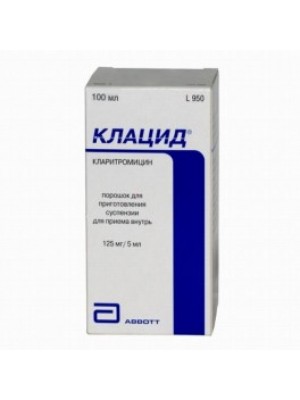
Klacid syrup 125 mg. / 5 ml. 100 ml.WHAT Klacid granules for..
19.00€