Your shopping cart is empty!
Welcome visitor you can login or create an account.
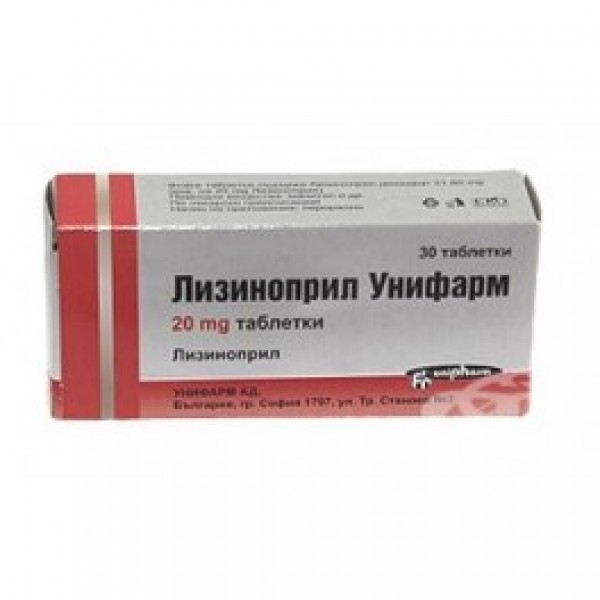
Lisinopril. 20 mg. 30 tablets
Product Code: Lisinopril. 20 mg. 30 tablets
Availability: In Stock
Product viewed: 798


Lisinopril. 20 mg. 30 tablets

CLINICAL DATA
4.1. Indications o Treatment of essential and renovascular hypertension alone or in combination with other antihypertensive agents ;
• Treatment of heart failure in addition to the cardiac glycosides and diuretics ;
• prevention of the development of left ventricular dysfunction or heart failure and to improve survival in patients with acute myocardial infarction and stable hemodynamics in the first 24 hours.
4.2 . The dosage and method of administration
Food does not affect absorption of the medicinal product and therefore can be used before, . during or after meals . The individual dose of the product is taken at once .
adults:
Treatment of essential or renovascular hypertension :
The recommended starting dose is 10 mg ( one tablet of 10 mg) once daily. At an unsatisfactory therapeutic effect , the dose may be increased to 20 mg. The maximum daily dose should not exceed 40-80 mg.
In patients with renovascular hypertension initial dose should be lower than - 2,5 mg - 5 mg, and gradually increased to the effective .
In patients with hypertension of diuretic therapy risk of symptomatic hypotension is larger , so that special attention is needed at the start of treatment with lisinopril . The diuretic should be discontinued two to three days prior to initiation of therapy with lisinopril . In the event that the diuretic can not be stopped , lisinopril treatment should be initiated at a low dose - 2,5 mg per day.
Treatment of heart failure :
The initial dose is 2,5 mg, which can then be increased to 5 mg - 20 mg once a day depending on : therapeutic response and tolerability.
In acute myocardial infarction with stable hemodynamics in the first 24 hours
The initial dose is 5 mg, followed by 5 mg after 24 hours. The dose may be increased to 10 mg per 48 hour ~ January . Treatment with lisinopril 10 mg daily continued b weeks.
In patients with myocardial infarction and lower systolic pressure (120 mmHg or lower ) , treatment should be started at a dose of 2,5 mg C for 3 days. In hypotension (systolic pressure below 100 mmHg) a daily dose of 5 mg may be temporarily reduced to 2,5 mg. In the event naprolongirana hypotension (systolic pressure less than 90 mmHg for more than one hour) lisinopril should be discontinued . During therapy with lisinopril patients should receive the recommended standard therapy with thrombolytics , aspirin and beta- blockers. Lisinopril is compatible with nitrates, intravenously or transdermally.
Patients with renal impairment
The dosage of lisinopril in patients with impaired renal function is determined by creatinine clearance.
In patients at risk . eg patients with salt depletion with hypovolemia due to vomiting , diarrhea and more. , with malignant hypertension, severe heart failure, patients with coronary heart disease or cerebrovascular disease , the effect of the starting dose should be carefully monitored.
children:
No specific clinical studies on the effectiveness and safety of lisinopril in children is therefore not recommended for use in children.
4.3 . Contraindications
• Known hypersensitivity to the active substance or excipients of the tablet ;
• Known hypersensitivity to other ACE inhibitors;
• hereditary / idiopathic angioneurotic edema , and patients with a history of angioedema with previous treatment with ACE inhibitors;
• Haemodynamically significant aortic or mitral stenosis or hypertrophic cardiomyopathy ;
• Patients with bilateral renal artery stenosis or stenosis of the artery to a solitary kidney.
• Patients with unstable hemodynamics after acute myocardial infarction;
• Cardiogenic shock;
• Simultaneous use of lisinopril and high flux membranes by poliakrilnitrilnatriy -2- metilalilsulfonat ( eg AN 96 ) within the emergency dialysis ;
• Patients with creatinine> 220 mmol / l;
• Pregnancy ;
breastfeeding
4.4 . Special warnings and special precautions for use
• During treatment with lisinopril careful monitoring is required in patients with severe heart failure whose renal function depends on the activity of the renin -angiotensin -aldosterone system . Treatment of such patients with ACE inhibitors, including lisinopril, can lead to oliguria , azotemia , and progression in rare cases, acute renal failure.
- In patients with renal disease, there is a high risk of renal impairment (increased levels of plasma creatinine ) acute renal failure . " ACE inhibitors can cause agranulocytosis . The risk of agranulocytosis or neutropenia was higher in patients with collagen (systemic lupus erythematosus, scleroderma) in patients receiving immunosuppressive therapy, especially if there is concomitant kidney dysfunction . During treatment with lisinopril require regular monitoring of blood counts .
Treatment with lisinopril hypotension as an adverse reaction is rare . Careful monitoring is necessary in patients receiving diuretic therapy, located on dialysis , diarrhea or vomiting during surgery or general anesthesia , as they lisinopril can cause a more pronounced hypotensive effect.
• In patients with a high risk of hypotension ( ischemic heart disease , cerebrovascular disease) , in which a sharp drop in blood pressure can lead to heart attack or serious ischemic attack , treatment with lisinopril should be initiated in hospital conditions , under strict medical supervision .
• In patients with acute myocardial infarction should not take lisinopril treatment if there is evidence of renal dysfunction , serum creatinine above 177 pmol / i and / or proteinuria exceeding 500 mg/24 hours. In case of renal impairment , treatment with lisinopril should be discontinued .
• In patients treated with ACE inhibitors , including . lisinopril may, rarely, be seen angioneurotic edema, which results in swelling of the face, extremities, lips, tongue , larynx and / or pharynx . In these cases, treatment with lisinopril sheet should be discontinued immediately and the patient be monitored until disappearance of the edema . If the swelling affects only the face and lips , do not need special treatment . When affecting the pharynx and / or larynx , which can be fatal due to the obstruction of the respiratory tract, it is recommended that the introduction of a solution of epinephrine subcutaneously 1/1000 (0,3 ml - 0,5 ml). Contraindicated reappointment of drugs from the group of ACE inhibitors in patients with a history of edema Quincke.
• Risk of severe anaphylactic reactions in patients with desensitization ( specific immunotherapy ) against insect venom and LDL- apheresis with dextran sulfate .
• In patients on hemodialysis with high-flux membranes ( polyacrylonitrile ) and concomitant therapy with lisinopril can be observed anaphylactic reactions (swelling of the tongue and lips , dyspnea, hypotension) .
• During treatment with lisinopril require periodic monitoring of liver function tests . When deviations in their treatment with lisinopril should be discontinued .
• During treatment with lisinopril to monitoring levels of potassium ions . In raising their levels , treatment with the product should be stopped .
• During treatment with lisinopril should be monitored and serum electrolytes , blood count , serum creatinine and urea , especially at the beginning of treatment and at-risk patients ( with renal disease, collagen , etc. . ) And concomitant immunosuppressants, cytostatics , allopurinol, procainamide .
" Upon the occurrence of cough during treatment with lisinopril it is necessary to make a differential diagnosis with respect to its origin . Persistent non-productive cough may be associated with the use of lisinopril .
4.5 . drug Interactions
• Concomitant administration of lisinopril with diuretics or other antihypertensive agents can be observed increased hypotensive effect;
• Concomitant administration of lisinopril and products containing potassium or potassium-sparing diuretics may lead to increased plasma potassium ;
• therapeutic and adverse effects of lisinopril can be increased by neuroleptics, tricyclic antidepressants or lithium salts when administered concomitantly .
• Indomethacin and other NSAIDs may diminish the therapeutic effect of lisinopril when co-administered .
• Co-administration of lisinopril allopurinol , cytostatic , immunosuppressive agents , systemic corticosteroids , procainamide increased risk of leucopenia .
• Co-administration of lisinopril with oral antidiabetic agents ( sulfonylureas , biguanides ) and insulin potentiate the hypoglycaemic effect.
4.6 . Pregnancy and lactation
Like all other ACE inhibitors, lisinopril when administered in II and III trimester of pregnancy can cause fetal harm . Lesions consist of hypotension, neonatal skull hypoplasia , anuria, reversible and irreversible renal failure and mortality. For these reasons, its use is contraindicated in pregnancy .
Due to lack of sufficient clinical data on the excretion of lisinopril in human milk and its safety for infants not recommend its use during lactation.
4.7 . EFFECTS ON THE ABILITY TO DRIVE AND USE MACHINES
Lisinopril can have adverse effects on psychosomatic status as, in some cases, cause dizziness and vertigo in individual patients . It is carefully monitored for the appearance of these symptoms during treatment with lisinopril and their appearance does not undertake activities requiring active attention.
4.8 . SIDE EFFECTS
Tolerability of lisinopril as a whole is good.
The most frequently recorded adverse events (broken down by system organ class) are:
Body as a Whole / 1810 /
Asthenia, fatigue . Syrdechno vascular / 1010 /
Hypotensive reactions , orthostatic hypotension , palpitations , tachycardia, cardiac arrhythmia , angina pectoris, myocardial infarction, cerebrovascular accidents .
Gastrointestinal / 0600 /
More frequently, can be observed anorexia, dry mouth , taste perversion , abdominal pain , nausea , vomiting , diarrhea , dyspepsia, liver dysfunction , hepatitis , pancreatitis , ileus , obstipation . Treatment with an ACE inhibitor is rarely associated with syndrome beginning with cholestatic jaundice which can progress to liver necrosis fatal . The mechanism of this syndrome is unknown. If jaundice or abnormal liver function tests , treatment with lisinopril should be discontinued .
Musculoskeletal / 0200 /
Isolated cases of muscle cramps .
In the central nervous system and psyche / 0410 , 0500 /
More common were headache and dizziness. In rare cases , possible sleep disorders , depression, paresthesia , decreased libido , vertigo . Respiratory System / 1100 /
More common are cough, upper respiratory tract in rare cases - nasal congestion, symptoms similar to " cold " , bronchospasm , dyspnea, pharyngeal pain , angioneurotic edema covering the upper respiratory tract .
Leather / 0100 /
Possible allergic reactions such as urticaria , pruritus , angioneurotic edema covering the face and lips . In isolated cases , serious skin reactions such as pemphigus , exfoliative dermatitis , erythema multiforme syndrome, Stevens-Johnson and toxic epidermal necrolysis . Skin changes may be accompanied by fever, myalgia , arthralgia , vasculitis , eosinophilia , leukocytosis or increased titer of ANA. On suspicion of a serious skin reaction , a consultation and discontinuation of lisinopril . There have been isolated cases of psoriasis skin changes , photosensitivity , diaphoresis , alopecia, oniholizis , exacerbation of Raynaud's disease .
Urogenital / 1300.1410 /
Can be seen isolated cases of impotence , oliguria / anuria , acute renal failure.
Changes in laboratory values
Decreased hemoglobin, hematocrit, leukocytes or platelets , isolated cases of agranulocytosis or pancytopenia , haemolytic anemia, hyponatremia, hyperkalemia , increased serum creatinine and urea , proteinuria , increased bilirubin , increase in liver transaminases .
4.8 . OVERDOSE
No evidence of accidental overdose lisinopril .
In a single dose , multiple exceeding therapeutic , may be seen marked hypotension and asthenia. They can be corrected by infusion of normal saline . Lisinopril can be removed by hemodialysis.
5 . Pharmacological
ATC - code S09AA03
Drugs acting on the renin-angiotensin system , ACE - inhibitors alone
5.1. Pharmacodynamic properties
Lisinopril is a synthetic peptide derivative that relates to nonsulfhydryl ACE inhibitors for oral administration . It is a long-acting angiotensin - converting enzyme . (ACE ) , and therefore it is effective when administered once daily. It turns on the ACE inhibitory activity ( peptidyl dipeptidase ) for 36 hours , demonstrated in humans and experimental animals. Inhibition of ACE causes a reduction in the production of angiotensin II, resulting in a decreased peripheral vascular resistance and of aldosterone secretion . As with other ACE inhibitors, lisinopril causes lowering of the sodium ions and potassium increase . Potassium level can be increased to 0,1 mEq / L in most cases , as in individual patients ( 4% ), this increase can be up to 0,5 mEq / L.
The antihypertensive effect of lisinopril may be conditioned on its ability to influence adrenergic receptors indirectly. As with other ACE inhibitors , it could reduce the membrane permeability of the sodium level of the renal tubules. Also, probably , it affects bradykinin and other kinins as it has structural similarity to kininase , an enzyme involved in the breakdown of bradykinin. Thus accumulates bradykinin , which has pronounced vasodilating and decreasing the adhesion and platelet aggregation action .
Reducing the levels of angiotensin II of lisinopril in heart failure leads to the elimination of the inter- venous and arterial vasospasm, resulting in improved hemodynamics .
Positive haemodynamic changes in heart failure are as follows : a decrease in peripheral vascular resistance , lower blood pressure and filling pressures of the left and right ventricle , reducing pulmonary congestion , reduce telediastolniya telesistolniya and volume of the left ventricle , an increase in the fraction of left ventricular ejection , improve tissue perfusion , increases in stroke volume and cardiac output .
Neurohormonal and metabolic changes under the influence of lisinopril include lowering the levels of noradrenaline, vasopressin , aldosterone and increased levels of potassium .
Increasing the amount of bradykinin , in turn , leads to the release of large quantities of nitrogen oxide (N0) - associated with endothelial vasodilator .
5.2 . Pharmacokinetic properties
resorption
Following oral administration of lisinopril is absorbed relatively slowly and incompletely . Approximately 25 % to 30 % of the single dose is absorbed , but there are significant individual differences between patients. Thus , in patients with heart failure, the absorption is less , and may be only 15% of the administered dose . The drug is absorbed into its active form , therefore it is not necessary transformation in the liver . Food does not significantly affect the volume of his rezorbtsiya.Pri patients with heart failure class II - IV , NYHA absolute bioavailability of the product is 16%.
distribution
After administration of a single oral dose , the maximum plasma concentration (Cmax ) occurred between b - 7 hours . Known shift the time of appearance of the peak of maximum plasma concentration was observed in patients with acute myocardial infarction. No evidence of binding of lisinopril plasma proteins, except angiotensin -converting enzim.V small quantities cross the blood brain barrier , which no clinically znachenie.Samo in experimental studies found that lisinopril crosses the placental barrier and is excreted in breast milk.
Repeated dose half-life time ( half-life ) of lisinopril is approximately 12-13 hours.
metabolism
Lisinopril is not metabolized and is excreted unchanged .
excretion
Excreted mainly through the kidneys unchanged , only with significantly impaired renal function ( at a volume of GFR less than 30ml/min) is a clinically significant change in its excretion.
However, in significant renal impairment may be an increase in plasma concentrations of lisinopril, which may have significant clinical relevance. In elderly patients occur almost twice higher plasma concentrations and AUC compared with those parameters in young patients following administration of lisinopril in the same single dose.
Lisinopril can be removed by dialysis . 5.3 . Preclinical BEZOPASNOSTV experimental studies on mice , rats and rabbits at the introduction of lisinopril at doses in excess of the therapeutic , no teratogenic effects. However , lisinopril and other ACE - inhibitors, can cause damage to the fetus , resulting in hypotension, neonatal skull hypoplasia , anuria , reversible or irreversible renal failure and death.
Studies in animal models have shown no carcinogenicity and mutagenicity administration of lisinopril in doses greatly exceeding therapeutic .
6 . PHARMACEUTICAL PARTICULARS
6.1. List of excipients and their amounts in mg / tablet
Tablet 5 mg Usinopril
Microcristalline cellulose 38,56
Mannitol 35,00
Maize starch 35,00
Hypromellose 2,00
Silica colloidal anhydrous 1,00
Magnesium stearate 3,00
Tablet 10 mg Usinopril
Microcristalline cellulose 42,97
Mannito! 35.00
Maize starch 35,00
Hypromellose 2,30
Silica colloidal anhydrous 1,00
Magnesium stearate 3,00
Yellow Iron oxide 0,13
Tablet 20 mg Usinopril
Microcristalline cellulose 49,55
Mannitol 39,00
Maize starch 40,00
Hypromellose 2,50
Silica colloidal anhydrous 1,00
Magnesium stearate 3,00
Talk 3,00
Yellow Iron oxide E172 0,05
Red Iron oxide E172 0,10
Write a review
Your Name:Your Review: Note: HTML is not translated!
Rating: Bad Good
Enter the code in the box below:
Related Products
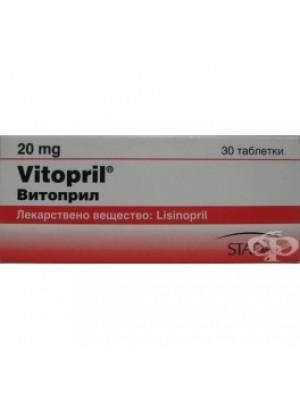
Vitopril. table. 20 mg. 30 tablets Indications:o High blood ..
16.00€