
Your shopping cart is empty!
Welcome visitor you can login or create an account.
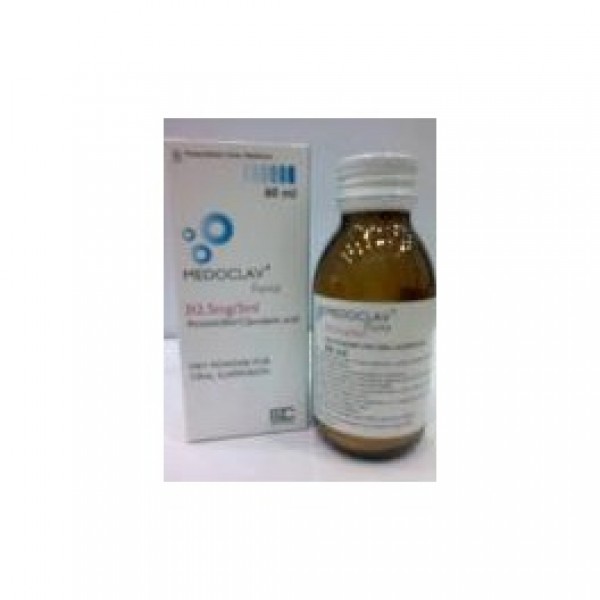
MEDOCLAV 312 mg. 100 ml.
Product Code: MEDOCLAV 312 mg. 100 ml.
Availability: In Stock
Product viewed: 1143


MEDOCLAV 312 mg. 100 ml.
WHAT MEDOCLAV AND WHAT IT IS USED
Medoclav is an antibiotic and works by killing bacteria that cause infections. It contains two different medicines known as amoxicillin and clavulanic acid. Amoxicillin belongs to a group of medicines called "penicillins" whose action can sometimes be prevented (is inactivated). The other active component (clavulanic acid) prevents this from happening.
Medoclav use in infants and children to treat the following infections:
Infections of the middle ear and sinuses;
Respiratory tract infections;
Urinary tract infections;
Infections of skin and soft tissues, including dental infections;
Infections of bones and joints.
2. BEFORE YOU GIVE MEDOCLAV
MEDOKLAV Do not give your child:
if allergic (hypersensitive) to amoxicillin, clavulanic acid or any of the other ingredients of MEDOCLAV (listed in section 6);
if it ever had severe allergic reactions (hypersensitivity) to any other antibiotic. This can include a skin rash or swelling of the face or neck;
if in the past there was any liver problems or jaundice (yellowing of the skin) while taking an antibiotic.
If any of the above applies to your child, do not give Medoklav. If you are unsure, check with your doctor or pharmacist before giving Medoklav.
Take special care with MEDOCLAV
Consult your doctor or pharmacist before giving this medication to your child if it:
It has glandular fever (mononucleosis);
receives treatment for liver or kidney problems;
not urinate regularly.
If you are not sure if any of the above applies to your child before giving Medoklav consult your doctor or pharmacist.
In certain cases, your doctor may perform tests of the type of bacteria causing the infection to your child. Depending on the results of your child can be given a different concentration of Medoklav or other medicine.
Conditions which need to be taken:
Medoklav can worsen certain underlying conditions or cause serious side effects. These include allergic reactions, convulsions (seizures), and inflammatory bowel disease. To reduce the risk of any problems while your child is taking Medoklav need to watch whether manifest certain symptoms. See "Conditions which need to be taken 'in Section 4.
Blood and urine
Tell the doctor or nurse that your child is taking Medoklav if he will do blood tests (such as studies of the number of red blood cells or liver function tests) or urinalysis. This is because Medoklav may affect the results of these studies.
Taking other medicines
Please tell your doctor or pharmacist if your child is taking or have recently taken any other medicines. This includes medicines obtained without a prescription and herbal products.
If your child is taking allopurinol (used in gout) and Medoklav, it may be more likely to have allergic skin reactions.
If your child is taking probenecid (used for gout), your doctor may decide to change the dose of Medoklav.
May require additional blood tests if Medoklav with taking medications prophylactics of blood clots (such as warfarin).
Medoklav may affect the action of methotrexate (a drug used to treat cancer or rheumatic diseases).
Pregnancy and lactation
If your child who will take this medicine is pregnant or nursing, please consult your doctor or pharmacist.
Consult your doctor or pharmacist before taking any medicine.
Important information about some of the ingredients of Medoklav:
Medoklav contains aspartame (E951), a source of phenylalanine. This may be harmful for children born with a condition called 'phenylketonuria'.
Medoklav contains maltodextrin (glucose). If your doctor has told you that your child has an intolerance to some sugars, contact him before you start taking this medicine.
3. HOW TO GIVE MEDOCLAV
Always give MEDOCLAV exactly as you have been told by your doctor. If you're not sure, ask your doctor or pharmacist.
Adults and children weighing 40 kg or more:
This suspension is not usually recommended for adults and children weighing 40 kg or more. Consult your doctor or pharmacist for advice.
Children weighing less than 40 kg
All doses are calculated depending on the child's weight in kilograms.
Your doctor will advise you on how Medoklav should give to your baby or child;
You will receive a plastic measuring spoon or measuring cup. You should use it to give the correct dose to your baby or child;
Usual dose - 20 mg / 5 mg to 60 mg / 15 mg for each kilogram of body weight per day, given as three divided doses.
Patients with kidney and liver problems
if your child has kidney problems the dose can be changed. Your doctor may choose another concentration or another drug;
if your child has liver problems may make him more often blood tests to check how does his liver.
How to give Medoklav
Always shake the bottle well before each dose.
Dosed at the beginning of a meal, or shortly before it.
Allow the intervals between doses during the day with at least 4 hours in between. It does not accept 2 doses within 1 hour.
Medoklav Do not give your child for more than two weeks. It is only necessary to consult a doctor if your child is still not feeling well.
If you give more than the amount Medoklav
If you give your child more than the amount Medoklav, symptoms may include gastrointestinal irritation (nausea, vomiting or diarrhea) or convulsions. As soon as possible, consult with your doctor. Take your medicine cabinet to show the doctor.
If you forget to give Medoklav
If you forget to give your child a dose, give it as soon as you remember. Do not give the next dose too soon, but wait about four hours before you give.
If your child stops taking Medoklav
Even if your child is feeling better continue to give him Medoklav to complete the treatment. Your child needs every dose to help him fight off infection. If the bacteria survive, they may lead to the resumption of the infection.
If you have any further questions on the use of this product, consult your doctor or pharmacist.
4. POSSIBLE SIDE EFFECTS
Like all medicines MEDOCLAV can cause side effects, although not everybody gets them. Adverse reactions described below, may occur on this medication:
Conditions which need to be taken
Allergic reactions:
Skin rash;
Inflammation of the blood vessels (vasculitis) which may be visible as red or purple raised areas of the skin, but can also affect other parts of the body;
Fever, joint pain, swollen glands in the neck, axilla or groin;
Swelling, sometimes covering the face or mouth (angioedema), leading to difficulty breathing;
Collapse.
Immediately consult a doctor if your child has any of these symptoms. Stop taking Medoklav.
Inflammation of the colon
Inflammation of the large intestine, causing watery diarrhea usually with blood and mucus, stomach pain and / or fever.
Consult your doctor for advice as soon as possible if your child has any of these symptoms.
Very common side effects - they can affect more than 1 in 10 people:
Diarrhea (in adults).
Common side effects - they may affect up to 1 in 10 people:
Candidiasis (candida - a yeast infection of the vagina, mouth or skin folds);
Nausea, especially when taken in high doses - if you are affected, take Medoklav before eating;
Vomiting;
Diarrhea (in children).
Uncommon side effects - they may affect up to 1 in 100 people:
Skin rash, itching;
Bumpy rash with itching (hives);
Indigestion;
Dizziness;
Headache.
Uncommon side effects that may show up in blood tests:
Increase in some substances (enzymes) produced by the liver.
Rare side effects - they can affect up to 1 in 1000 people:
skin rash, which may be as blisters and looks like small targets (central dark spots surrounded by a paler area, with a dark ring on the edge - erythema multiforme).
Consult a doctor if you notice any of these symptoms.
Rare side effects that may show up in your blood tests:
low number of cells responsible for blood clotting;
low number of white blood cells.
Other side effects
In a very small number of people get other side effects, but their exact frequency is not known.
Allergic reactions (see above);
Inflammatory bowel disease (see above);
Serious skin reactions:
very widespread rash with bubbles and peeling skin, particularly around the mouth, nose, eyes and genitals (Stevens-Johnson), and a more severe form, causing extensive peeling of the skin (more than 30% of the body surface - toxic epidermal necrolysis );
widespread red skin rash with small vesicles containing pus (bullous exfoliative dermatitis);
red, scaly rash with bumps and blisters (ekzantemozna pustulosis).
If your child experiences any of these symptoms, immediately consult a doctor.
liver inflammation (hepatitis);
jaundice, caused by increases in bilirubin (a substance produced in the liver), which can make so that your skin and the whites of your eyes look yellow;
inflammation of the tubules in the kidneys;
required a longer time for blood clotting;
hyperactivity;
convulsions (in people taking high doses Medoklav or those with kidney problems);
black tongue which looks covered with hairs;
staining of the teeth (in children), which is usually removed by washing.
Side effects that may occur in blood or urine:
severe reduction in the number of white blood cells;
low red blood cells (hemolytic anemia);
crystals in urine.
If your child gets side effects
If any of the side effects become severe or troublesome, or you notice other effects not listed in this leaflet, please tell your doctor or pharmacist.
5. HOW TO STORE MEDOCLAV
Keep out of reach of children.
Do not store above 25 ° C
Store in the original container.
Store in a dry place, protected from light.
After preparation, the slurry must be stored in a refrigerator (2-8 ° C). It can use the reconstituted suspension to seven (7) days if you store it at 2-8 ° C in the refrigerator. Do not freeze.
Do not use after the expiry date stated on the carton. The expiry date is the last day of that month.
Medicines should not be disposed of in wastewater or household waste. Ask your pharmacist how to dispose of medicines no longer required. These measures will help to protect the environment.
6. ADDITIONAL INFORMATION
What Medoclav
The active substances are: amoxicillin (amoxicillin) as amoxicillin trihydrate and clavulanic acid (clavulanic acid) as potassium clavulanate.
Medoklav powder for oral suspension comprises after reconstitution each 5 ml 250 mg of active substance amoxycillin, as amoxycillin trihydrate, and 62.5 mg of the active ingredient clavulanic acid in the form of potassium clavulanate.
Other ingredients are: xanthan gum, hydroxypropylmethyl cellulose, silicon dioxide (colloidal anhydrous), syloid AL 1, sodium saccharin, succinic acid, flavors, strawberry, lemon, peach.
Medoklav looks like and contents of the pack
Medoklav is available as a powder for oral suspension with white to almost white freely flowing powder. Medoklav powder for oral suspension is supplied in brown glass bottles with aluminum cap with a seal containing a powder for preparation of 100 ml of suspension when reconstituted.
Write a review
Your Name:Your Review: Note: HTML is not translated!
Rating: Bad Good
Enter the code in the box below:
Related Products
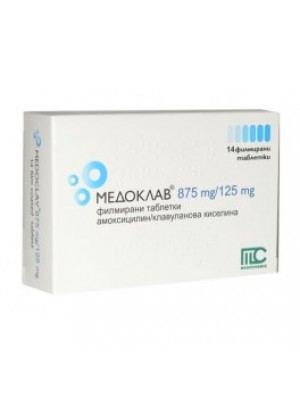
MEDOCLAV 875 mg. / 125 mg. 14 tabletsWHAT MEDOCLAV AND WHAT ..
29.00€