Your shopping cart is empty!
Welcome visitor you can login or create an account.
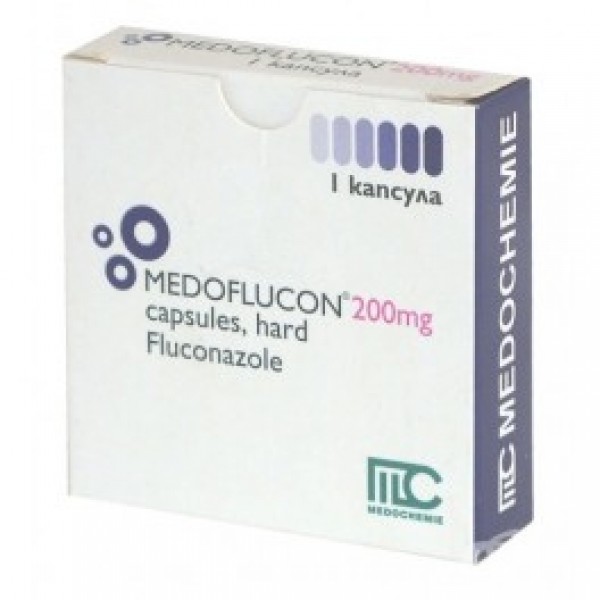
MEDOFLUCON 200 mg. 1 capsule
Product Code: MEDOFLUCON 200 mg. 1 capsule
Availability: In Stock
Product viewed: 1376


MEDOFLUCON 200 mg. 1 capsule
WHAT MEDOFLUCON AND WHAT IT IS USED
The active substance in your capsules is fluconazole. It belongs to the group Pharmacovigilance products called antifungal agents.
Medoflukon be used to treat infections caused by fungi. Medoflukon can also be used to protect you from getting infected with fungus.
The most common causes of yeast infections are called candida. The drug can be prescribed by your doctor to treat fungal infection such as:
- Thrush of the mouth or throat / infection of the mucous membranes / thrush is often caused by Candida;
- Skin infections - eg. etc. "athletic" foot / feet fungus / ringworm;
- Internal fungal infections caused by Candida - for example, blood infection, urinary tract and other organs of the body;
- Internal infections caused by Cryptococcus, for example Cryptococcus meningitis and infections of other sites such as lung, skin;
- Genital Candida infections, for example. vaginal discharge or candida balanitis / inflammation of the glans penis and / or surrounding skin.
You may appoint Medoflukon to:
- Prevent getting infected with fungus / if your immune system is not functioning properly / or after chemotherapy / radiotherapy
- To be stopped repeated manifestation of diseases caused by Cryptococcus / AIDS patients /
Medoflukon be used for the treatment of some rare diseases caused by fungi, such as coccidioidomycosis, paracoccidioidomycosis, histoplasmosis, and sporotrichosis.
Your doctor will explain what treat you and tell you more about it.
BEFORE YOU TAKE MEDOFLUCON
Do not take Medoflucon if:
- Are allergic to the active substance fluconazole, other antifungal agents, or any of the excipients of Medoflukon;
- Are taking cisapride or terfenadine
Take special care with Medoflukon and tell your doctor or pharmacist if:
- You are pregnant, trying to become pregnant or breast-feeding;
- Have any kidney problems;
- Have any liver problems;
- Suffer from heart disease, including heart rhythm problems.
Taking other medicines
Tell your doctor if you are taking or have recently taken any other medicines, including medicines obtained without a prescription, natural supplements and vitamins, including:
- Warfarin or coumarin derivatives
- Benzodiazepines such as midazolam
- Diuretics such as hydrochlorothiazide, used to treat fluid retention and high blood pressure
- Oral sulfonylurea as Chlorpropamide, glibenclamide, glipizide or tolbutamide
- Phenytoin
- Rifampicin or rifabutin
- Cyclosporine or tacrolimus
- Astemizole
- Zidovudine, also known as AZT available even
Pregnancy and lactation:
If you are pregnant or trying to get pregnant, ask your doctor or pharmacist before taking any medicine, including Medoflukon. It is best to avoid taking Medoflukon if you are pregnant, especially during the first three months of pregnancy.
If you are taking this medicine and breast-feeding should das is consult your doctor. Fluconazole is found in small quantities in breast milk and may affect the infant
DRIVE AND USE MACHINES
Medoflucon use can cause some side effects that affect your ability to drive and use machines. If this happens, you should not drive or operate machinery until the effects wear off.
HOW TO TAKE MEDOFLUCON
It is orally. The usual doses of this drug in different infections are listed below.
Adults:
- Infection of the vagina, a single dose of 150 mg; women who suffer from frequent vaginal yeast infections from Candida can take Medoflukon at a dose of 150 mg once a month for 4-12 months
- Infection of the mouth and pharynx - 200 mg on the first day followed by 100 mg once daily. Clinical data on the disease usually resolve within a few days, but the treatment should last at least two weeks in order to reduce the likelihood of recurrence of expression;
- Likagitsata infections of the esophagus, infection of the bronchi and lungs, mucocutaneous candidiasis and thrush in urine - the recommended dose of 200 mg hlukonazol is the first day followed by 100 mg once daily. Doses up to 400 mg per day may be used based on a medical assessment of the patient's response to treatment. Patients should be treated for a minimum of three weeks and at least two weeks after the disappearance of symptoms.
- Infection of the oral cavity in patients with dentures - the recommended dose of 200mg fluconazole is the first day followed by 100 mg once daily for 14 days as the prosthesis is disinfected;
- Fungal skin reaction, 50 mg once daily, 2-4 weeks, or an alternative scheme - 150 mg as a once a week; fungus on foot to 6 weeks;
- Internal infections caused by Candida, 400 mg on the first day and 200-400 mg single dose in the next days, as the dose may be increased in life-threatening infections, up to 800 mg daily;
- Internal infection; ii caused by Cryptociccus / fungi / incl. cryptococcal meningitis - the recommended dose for the treatment of acute cryptococcal meningitis is an initial dose of 400 mg on the first day, then 200 mg once daily. Dose of 400 mg once daily may be used as the basis of medical assessment of the patient's response to lechenieto.Preporachvanata duration of treatment for initial therapy of cryptococcal meningitis is 10-12 weeks after negativated culture of CSF;
- To prevent fungal infection 50-400 mg once daily concern;
- Prevention of relapse of cryptococcal infection, 200 mg once daily with unlimited duration;
- On Prevention of recurrence of infection with fungi, 50 mg - 400 mg once daily.
In coccidioidomycosis, paracoccidioidomycosis, sporotrichosis and histoplasmosis - 200-400 mg daily for 2 years or more.
Children:
From 6 years to 15 years:
- Infection of the mucous membranes, 3 mg / kg body weight, once daily; on the first day can be given 6 mg / kg body weight;
- Internal infections caused by Candida or Cryptociccus - starting dose of 12 mg_kg body weight on the first day, and then 6 mg / kg body weight once daily. Dose of 12 mg / kg body weight once daily can be used based on medical judgment of the patient's response to treatment. The dose should not exceed 600 mg daily. The recommended duration of treatment for initial therapy of cryptococcal meningitis is 10-12 weeks after negativated culture of CSF;
- Prevention of fungal infections 3-12 mg / kg once daily at risk of infection. The dose should not exceed 600 mg daily.
Elderly:
Apply the usual daily dose for adults unless you have kidney problems;
Patients with kidney disease:
The doctor may change the dose depending on your kidney function
POSSIBLE SIDE EFFECTS
Most chestite- nausea, stomach discomfort, diarrhea, vomiting, rash, headache
Rare - Rarely, some people have allergic reactions to the drug. If anything happens by following, immediately contact your doctor or go to the emergency department of the nearest hospital
- Sudden wheezing, difficulty breathing or chest tightness;
- Swelling of the eyelids, face or lips;
- Swelling and red spots on skin itch;
- Itching all over the body.
Write a review
Your Name:Your Review: Note: HTML is not translated!
Rating: Bad Good
Enter the code in the box below:
Related Products