Your shopping cart is empty!
Welcome visitor you can login or create an account.
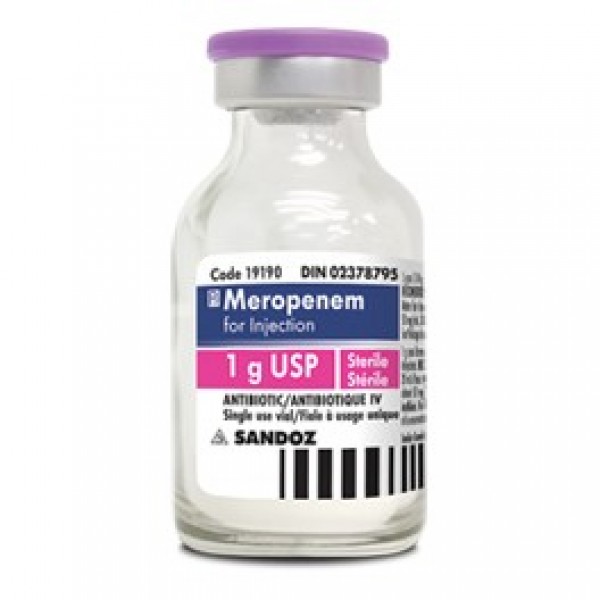
MEROPENEM 1000 mg. 10 vials
Product Code: MEROPENEM 1000 mg. 10 vials
Availability: In Stock
Product viewed: 2901


MEROPENEM 1000 mg. 10 vials
What is Meropenem and what it is used
Meropenem belongs to a group of antibiotics called carbapenems. It works by killing the bacteria, which may cause serious infections such as:
Infection affecting the lungs (pneumonia);
Lung and bronchial infections in patients suffering from cystic fibrosis;
Complicated urinary tract infections;
Complicated infections in the abdomen;
Infections that can get during or after birth;
Complicated infections of skin and soft tissues;
Acute bacterial infection of the brain (meningitis).
Meropenem can be used for the treatment of patients with neutropenia who have a high temperature, which is believed to be due to bacterial infection.
2. Before you use Meropenem
Do not use Meropenem:
if you are allergic (s) (hypersensitive (s)) to meropenem or any of the other ingredients of Meropenem (listed in section 6. Further information);
if you are allergic (s) (hypersensitive (s)) to other antibiotics such as penicillins, cephalosporins or carbapenems as you may be allergic (s) to meropenem.
Take special care with Meropenem:
Consult with your doctor before using Meropenem:
if you have health problems, such as problems with your liver or kidneys;
if you have had severe diarrhea after taking other antibiotics.
When you can develop a positive test (Koombs), indicating the presence of antibodies that may destroy red blood cells. Your doctor will discuss this with you.
If you are not sure if any of the above things apply to you, talk to your doctor or nurse before taking Meropenem.
Taking other medicines
Please tell your doctor if you are taking or have recently taken any other medicines, even those who are without a prescription and herbal medicines. This is because Meropenem can affect the way some medicines work and some medicines can affect Meropenem.
In particular, tell your doctor or nurse if you are taking any of the following medications:
Probenecid (used for gout);
Sodium valproate (used to treat epilepsy). Meropenem should not be used because it may decrease the effect of sodium valproate.
Pregnancy and lactation
It is important to tell your doctor if you are pregnant or planning to become pregnant before you are given meropenem. It is preferable to avoid the use of meropenem during pregnancy.
Your doctor will decide whether you should use meropenem.
It is important to tell your doctor if you are breastfeeding or plan to breastfeed before you are given meropenem. Small amounts of this medicine may pass into breast milk and may affect the baby. Therefore, your doctor will decide whether you should use meropenem while breastfeeding.
Ask your doctor before taking any medicine.
Driving and using machines
No studies on the effects on the ability to drive and use machines.
Important information about some of the ingredients of Meropenem
Meropenem contain sodium.
This medicinal product contains approximately 4.0 mEq of sodium per dose of 1.0 g, which must be taken into consideration by patients on a controlled diet of sodium.
If you have a condition that requires to monitor your sodium intake please inform your doctor or nurse.
3. How to use Meropenem
adults
The dose depends on the type of infection you have, where the infection is in the body and how serious the infection. Your doctor will determine how much you need;
The dose for adults is usually between 500 mg (milligrams) and 2 g (gram). You will usually receive a dose every 8 hours. However you may receive a dose less often if your kidneys do not work very well.
Children and adolescents
The dose for children 3 months to 12 years of age is determined using the age and weight of the child. The usual dose is between 10 mg and 40 mg Meropenem for every kilogram (kg) of weight of the child. Typically one dose is administered every 8 hours. Children who weigh over 50 kg were given an adult dose.
How will be given Meropenem
Meropenem will be given by injection or infusion into a large vein;
Your doctor or nurse will usually apply Meropenem;
Some patients, parents and carers are trained to apply Meropenem home. Instructions for doing this are given in this leaflet (in the point called "Guidelines for the implementation of Meropenem yourself or someone else at home '). Always use Meropenem exactly as prescribed by your doctor. If in doubt, consult your doctor or pharmacist;
Your injection should not be mixed with or added to solutions containing other drugs;
The injection may take about 5 minutes or between 15 and 30 minutes. Your doctor will tell you how to apply Meropenem;
Usually injections should be administered at the same time each day.
If you take a large amount Meropenem than you should:
If you use more than your prescribed dose, contact your doctor or nearest hospital immediately.
If you forget to take Meropenem:
If you miss an injection, you should be done as soon as possible. However, if it is almost time for your next injection, skip the missed injection. Do not take a double dose (two injections at the same time) to make up the missed dose.
If you stop taking Meropenem:
Do not stop taking Meropenem until your doctor tells you.
If you have further questions about the use of this product, ask your doctor or nurse.
4. Possible side effects
Like all medicines, Meropenem can cause side effects, although not everybody gets them.
The frequency of possible side effects is given using the following convention:
very common (affects more than 1 in 10 patients);
Common (affects 1 to 10 out of 100 patients);
Uncommon (affects 1 to 10 of 1000 patients);
rare (affects 1 to 10 of 10,000 patients);
very rare (affects less than 1 in 10,000 patients);
not known (can not be estimated from the available data but this is rare or very rare).
Severe allergic reactions
If you have a severe allergic reaction, stop taking Meropenem and immediately go to the doctor. You may need urgent medical attention. The signs may include sudden onset of:
Severe rash, itching or hives on the skin;
Swelling of face, lips, tongue or other parts of the body;
Shortness of breath, wheezing or trouble breathing.
Damage to red blood cells (not known).
Signs include:
Run out of breath when you do not expect it;
Red or brown urine.
If you notice any of the above symptoms, see a doctor immediately.
Other possible side effects:
common:
Abdominal (stomach) pain;
Feeling sick (nausea);
vomiting;
diarrhea;
headache;
Skin rash, itchy skin;
Pain and inflammation;
Increasing the number of platelets in the blood (shown by blood tests);
Changes in blood tests, including tests that show how well your liver is working.
Uncommon:
Changes in the blood. They include a decreased number of platelets (which may make it easier to bruise), increasing the number of certain white blood cells, decreased numbers of other white cells and increased amounts of a substance called 'bilirubin'. Your doctor may do blood tests from time to time;
Changes in blood tests, including tests that show how well your kidneys work;
Numbness;
Infections of the mouth or the vagina, which are caused by a fungus (thrush).
rare:
Seizures (convulsions).
Other possible side effects of unknown frequency:
Inflammation of the bowel with diarrhea;
Inflammation of the veins where it is injected Meropenem;
Other changes in the blood. Symptoms include frequent infections, fever and sore throat. Your doctor may do blood tests from time to time;
Sudden onset of a severe rash or blistering or peeling of the skin. This may be associated with fever and arthralgia.
If any of the side effects gets serious, or you notice any side effects not listed in this leaflet, please tell your doctor or nurse.
5. How to store Meropenem
Keep out of reach of children.
Meropenem not use after the expiry date stated on the pack. The expiry date refers to the last day of that month.
This medicinal product does not require any special storage conditions.
After reconstitution: The reconstituted solution for intravenous injection or infusion should be used immediately. The time interval between the beginning and the end of the preparation of an intravenous injection or infusion should not exceed one hour.
Do not freeze the reconstituted solution.
Medicines should not be disposed of via wastewater or household waste. Ask your pharmacist how to dispose of medicines no longer required. These measures will help to protect the environment.
6. Further information
What Meropenem
The active substance is meropenem trihydrate.
Each vial contains meropenem trihydrate equivalent to 1 g anhydrous meropenem.
The other ingredient is anhydrous sodium carbonate.
Meropenem looks like and contents of the pack
Meropenem is a powder for injection or infusion.
Meropenem is white to pale yellow crystalline powder. The ready to use solution is colorless to yellow solution.
Meropenem powder for injection or infusion is available in single packs with 1x1 and 10x1 vial.
Not all pack sizes may be marketed.
Advice / medical education
Antibiotics are used to treat infections caused by bacteria. They have no effect against infections caused by viruses.
Occasionally an infection caused by bacteria does not respond to treatment with an antibiotic. One of the most common reasons for this is because the bacteria causing the infection are resistant to the antibiotic that is taken. This means that they can survive and even multiply despite the antibiotic.
Bacteria can become resistant to antibiotics for many reasons. Careful use of antibiotics can help to reduce the chance of bacteria becoming resistant to them.
When your doctor prescribes an antibiotic, it is intended to treat only your current illness. If you pay attention to the following advice will help prevent the emergence of resistant bacteria that could stop the antibiotic.
1. It is very important that you take the antibiotic at the right dose at the right time and for the right number of days. Read the instructions on the label and if you do not understand something, ask your doctor or pharmacist to explain.
2. You should not take an antibiotic unless it is prescribed for you and you should use it only to treat the infection for which it was prescribed.
3. You should not take antibiotics that have been prescribed for other people even if they had an infection similar to yours.
4. You should not give antibiotics that were prescribed for you to other people.
5. If you have any other antibiotics when you have completed the course as directed by your doctor, you should take the remainder to a pharmacy to be disposed of properly.
The following information is intended for medical and healthcare professionals:
Guidance for Meropenem yourself or someone else at home
Some patients, parents and carers are trained to apply Meropenem home.
Warning - You must use this medicine to yourself or someone else at home only after the doctor or nurse have trained (s).
The drug must be mixed with another liquid (solvent). Your doctor will tell you how to use thinner;
Use the medicine immediately after preparation. Do not freeze.
How to prepare this medicine
1. Wash your hands and dry them very well. Prepare a clean working area.
2. Remove the bottle (vial) Meropenem from the pack. Check the vial and the expiry date. Make sure that the vial is intact and not damaged.
3. Remove the colored cap and clean the gray rubber stopper with a swab with alcohol. Allow the rubber stopper to dry.
4. Connect a new sterile needle to a new sterile syringe, without touching the edges.
5. Download the recommended amount of sterile 'Water for Injections' into the syringe. The amount of liquid that you need is shown in the table below:
dose Meropenem
Amount of 'Water for Injections' needed for dilution
500 mg (milligrams) 10 ml (milliliters)
1 g (gram) 20 ml
1.5 g 30 ml
2 g 40 ml
Please note: If the prescribed dose of Meropenem more than 1 g, you will need to use more than one vial Meropenem. You can then draw the liquid in the vials in the same syringe.
6. Put the needle of the syringe through the center of the gray rubber stopper and inject the recommended amount of water for injections into the vial or vials Meropenem.
7. Remove the needle from the vial and shake the bottle well until all the powder is dissolved. Clean the gray rubber stopper once more with a new swab with alcohol and allow the rubber stopper to dry.
8. With the plunger of the syringe pushed fully into the syringe, put the needle back through the gray rubber stopper. Have to hold the syringe and the vial and turn the vial upside down.
9. While holding the end of the needle in the liquid, pull back the plunger and draw all the liquid from the vial into the syringe.
10. Remove the needle and syringe from the vial and throw the empty vial in a safe place.
11. Hold the syringe upright, with the needle pointing upwards. Push the syringe so that any bubbles in the liquid rise to the top of the syringe.
12. Remove the air into the syringe, gently press the plunger until all the air out.
13. If you use Meropenem home, dispose of any needles and infusion tubes, which are used in an appropriate way. If your doctor decides to stop treatment, dispose of all unused Meropenem appropriately.
The injection
You can apply this medicine through a short cannula or venflon, or through a port or central catheter.
Application of Meropenem through a short cannula or venflon
1. Remove the needle from the syringe and discard the needle carefully in the basket for sharps.
2. Wipe the end of the short cannula or venflon with a swab with alcohol and let it dry. Open the cap on your cannula and connect the syringe.
3. Slowly push the plunger of the syringe to apply antibiotic evenly for about 5 minutes.
4. Once you have completed the application of the antibiotic and the syringe is empty, remove the syringe and flush as recommended by your doctor or nurse.
5. Close the cap of your cannula and carefully throw the syringe into the basket for sharps.
Application of Meropenem through a port or central catheter
1. Remove the cap on the port or catheter, clean the end of the catheter with a swab with alcohol and let it dry.
2. Connect the syringe and slowly push the plunger of the syringe to apply antibiotic evenly for about 5 minutes.
3. Once you have completed the application of the antibiotic, remove the syringe and flush as recommended by your doctor or nurse.
4. Place a new clean cap on your central catheter and discard the syringe carefully into the basket for sharps.
Write a review
Your Name:Your Review: Note: HTML is not translated!
Rating: Bad Good
Enter the code in the box below:
Related Products
GLYUKAGEN HIPOKIT Fl. 1 mg. + solvent GLYUKAGEN WHAT IS AND ..
37.00€
Stelara amp. 45 mg. 1 JANSSEN - CILAG What Stelara and wh..
3,990.00€