
Your shopping cart is empty!
Welcome visitor you can login or create an account.
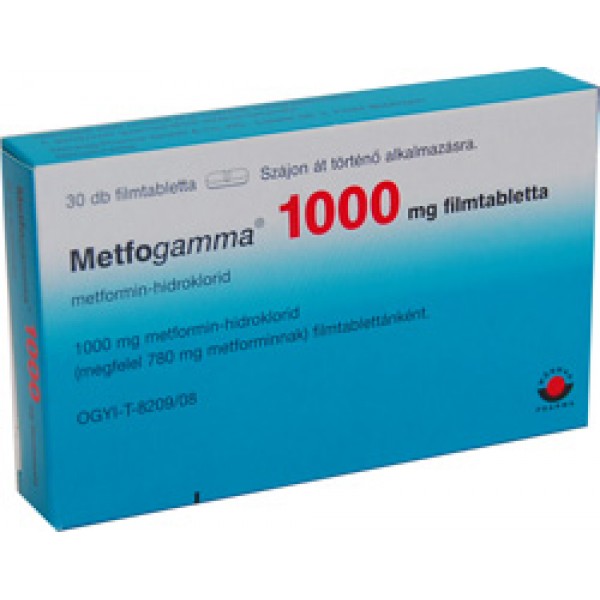
Metfogamma 1000 mg. 60 tablets
Product Code: Metfogamma 1000 mg. 60 tablets
Availability: In Stock
Product viewed: 3061


WHAT IS METFOGAMMA AND WHAT IS IT USED FOR?
Metformin 1000 mg contains the active substance metformin.
Metformin belongs to a group of medicines called biguanides that are used to treat diabetes as they regulate blood sugar levels.
Metformin is used to treat patients with non-insulin-dependent (type 2) diabetes (diabetes mellitus); Especially in overweight patients where only diet and physical activity have not improved.
In adults, Metformam 1000 mg can be taken alone or in combination with other oral antidiabetic agents or insulin.
In children over and above 10 years of age and adolescents, Metformam 1000 mg can be taken alone or in combination with insulin.
2. BEFORE YOU TAKE METFOGAMMA
Do not take Metformam 1000 mg film-coated tablets:
• If you are allergic (hypersensitive) to metformin hydrochloride or to any of the excipients contained in Metformam 1000 mg film-coated tablets.
If you have increased blood acidity due to diabetes (diabetic ketoacidosis) or diabetes overdose;
• If you suffer from kidney failure or a reduction in kidney function;
• If your kidney function is impaired by, for example,:
Dehydration due to prolonged vomiting or severe diarrhea; Severe infections; Collapse (shock);
• Investigations with iodine-containing contrast media in the blood vessels before, during and within 48 hours after the study;
• If you suffer from acute or chronic illnesses that can lead to oxygen deficiency (hypoxia) in body tissues such as:
Heart failure or disturbances in lung function, "fresh" heart attack, collapse (shock);
• If you suffer from impaired hepatic function, severe alcohol poisoning, alcoholism;
• If you are breast-feeding.
Take special care with Metphagamma: The risk of accumulation in the body and thus the risk of acidification of the blood by lactic acid (lactic acidosis) is determined primarily by renal function. Therefore, normal kidney function is required prior to treatment with this medicinal product.
Assessment of your kidney function by determining the serum creatinine level should be done at least once a year, in some cases and more often. If your serum creatinine levels are at the upper limit of normal, you should have a control of at least 2 to 4 times a year. It should be considered, especially in older patients, that only serum creatinine levels are not always indicative. In such cases, for the assessment of renal function, the value of another indicator - creatinine clearance - is determined before the start of therapy.
Particular attention is paid to situations that may lead to impairment of renal function (eg initiation of therapy with certain medicinal products for the treatment of high blood pressure or rheumatic diseases).
In studies requiring intravascular administration of iodine-containing contrast media, there is a risk of acute renal failure. Your Metformin therapy should be stopped before the study and started 2 days after it, if a subsequent check reveals that renal function is normal. If you are planning a full narcosis or spinal anesthesia surgery, treatment with Metformin should be stopped 2 days before surgery and resumed no sooner than 2 days after surgery if normal kidney function is present. Tell your doctor if you have a bacterial or viral infection (for example, flu, upper respiratory tract infection, urinary tract infection). Continue your diet during Metphagamma therapy and be especially careful with the even distribution of carbohydrates throughout the day. If you are overweight, you should have your weight loss diet under medical supervision. You should avoid drinking alcohol during treatment with metformin.
Children and adolescents:
In children and adolescents, the doctor must have confirmed the diagnosis of type 2 diabetes mellitus before starting treatment with Metformam 1000 mg.
During one year clinical studies, metformin has not been shown to affect growth or puberty, although there is no evidence of long-term results precisely on these specific indicators.
Since a limited number of children aged between 10 and 12 years were included in the clinical trials, caution is advised when treating Metformin with 1000 mg of children in this age group.
Elderly patients
Because renal function is often impaired in elderly patients, the dosage of Metformam 1000 mg should be determined according to the available renal function. In this connection, conduct regular studies with your doctor.
Special warnings
Metformin, in case of unacceptable accumulation in the body, can cause an increase in acidity of the blood with lactic acid (lactic acidosis) or favor the occurrence of a complication (eg coma) that can take life-threatening proportions if it is not treated in a timely manner. The reason for the increase in acidity of the blood with lactic acid may be overdose inadvertently or due to contraindications. Therefore, the contraindications should be strictly observed (see Do not take Metformam 1000 mg film-coated tablets in ...). "The signs of an initial lactic acidosis may be similar to the adverse reactions of metformin on the digestive tract: nausea, vomiting, diarrhea and The complete picture of muscle pains and cramps, excessive breathing, and loss of consciousness with coma can develop over the course of hours and require immediate life-saving treatment in a hospital.
Taking Metfogamma with other medicines
Please tell your doctor or pharmacist if you are taking / have been prescribed another medicinal product, You have recently taken another medicine. This also applies to medicinal products that are not prescribed by prescription.
During continued treatment with Metformin, blood glucose control may be impaired if additional medication is initiated or discontinued. Tell your doctor or pharmacist if you are taking or have recently taken the following medicines:
- corticosteroids (certain anti-inflammatory medicines, eg for the treatment of asthma or other severe inflammations);
- medicines for the treatment of high blood pressure (ACE inhibitors); Drainage agents (diuretics);
Certain products for the treatment of bronchial asthma iodine containing contrast media or alcohol containing medicinal products. Take care and consult with your doctor if you are starting treatment for high blood pressure or you are starting to take a diuretic (urinary excretion tablets) or NSAIDs (non-steroidal anti-inflammatory drugs, eg ibuprofen) as this may increase the risk of kidney problems .
Taking Methotharma with food and drink
When taking Metformin, you should refrain from eating foods and drinks containing alcohol.
Pregnancy and breastfeeding
Diabetically ill patients who are pregnant or would like to become pregnant should not be treated with Methotrextile. In these cases, the blood glucose level should be maintained with insulin as best as possible within the normal range. Tell your doctor so that he can appoint you insulin therapy. You should not take this medicine during breast-feeding.
Driving and using machines
Treatment with metformin 1000 mg only does not reduce blood glucose (hypoglycaemia) and therefore has no effect on driving ability or on the ability to service machines. In combination therapy with sulphonylureas, insulin or other hypoglycaemic medicines, your ability to drive, to service machines, and to operate on the ground without a secure support may be affected by a possible lowering of blood sugar (hypoglycaemia).
3. HOW TO TAKE METFOGAMM?
Take Metformam 1000 mg film-coated tablets exactly as directed by your doctor. Please ask your doctor or pharmacist if you are not sure about anything. For each patient, the dosage of Metphagamma 1000 mg should be performed by a physician based on blood glucose levels and monitored by constant medical supervision.
Individual 500 mg film-coated tablets and 850 mg strengths of the active substance, metformin hydrochloride, are also available to individually identify the required treatment dose.
In cases where your doctor has not prescribed you otherwise, the usual doses are:
Adults
Metformin and combination with other oral antidiabetic drugs This strength of active substance in one tablet is appropriate when high-dose
The maximum daily dose is three film-coated tablets of Metformam 1000 mg daily (corresponding to 3000 mg metformin hydrochloride) given in various intakes.
Combination with insulin
Metformin and insulin can be used in combination therapy to achieve better control of blood sugar. The usual starting dose is 1/2 film-coated tablet Metformam 1000 mg 2 or 3 times a day until the insulin dose is adjusted based on blood glucose measurements.
Elderly patients
As the elderly patients often experience a disorder of renal function, the dose of metformin should be adjusted accordingly. It is therefore necessary to regularly measure kidney function.
Children over 10 years of age and adolescents
The usual starting dose is 1/2 (half) film-coated tablet Metformam 1000 mg (containing 500 mg metformin hydrochloride) once a day during or after a meal.
The dose may be increased to the recommended daily dose of two 1000 mg film-coated tablets (corresponding to 2 g metformin hydrochloride).
Take the film-coated tablets without chewing them, during a meal or after a meal, with a large amount of liquid. When taking two or more film-coated tablets, you should make a daily distribution, such as taking one tablet after breakfast and after dinner.
Please talk to your doctor if you have the impression that the effect of Metformam 1000 mg is too strong or not strong enough.
If you take more than the required dose of Metformam 1000 mg
If you take more than you need, tell your doctor immediately. Overdose with Metformam 1000 mg does not result in lowering of blood glucose (hypoglycaemia), but increases the risk of acidic acidosis with lactic acid (lactic acidosis). The signs of a starting lactic acidosis may be similar to the undesirable effects of metformin on the digestive tract: nausea, vomiting, diarrhea, abdominal pain.
In heavier cases, you may experience muscle pains and cramps, excessive breathing, and loss of consciousness, and coma may develop for hours and require immediate life-saving treatment in a hospital.
If you forget to take Metformam 1000 mg
If you forget to take Metformin at the next time you take the product, take the Metphagamma 1000 mg prescribed by your doctor and try to keep the prescription in the future. Do not catch up with your missed dose by taking the larger number of film-coated tablets at once.
If you stop taking Metformam 1000 mg
If you discontinue treatment with metformin without prescription, you should keep in mind that the level of blood sugar rises uncontrollably and the long-term consequences of diabetes appear, for example, in the long term. Ocular, kidney and vascular disorders.
4. POSSIBLE SIDE EFFECTS
Like all medicines, Metformam 1000 mg film-coated tablets can cause side effects.
Gastrointestinal disorders:
- Very common
Nausea, vomiting and diarrhea, abdominal pain, loss of appetite. These are most common at the beginning of therapy and in most cases disappear spontaneously. To prevent gastrointestinal complaints, it is recommended that Metformia 1000 mg be taken during a meal or after a meal in two or three divided doses. If these complaints continue for a long time, stop taking Metformin and talk to your doctor.
- Frequently
Changing the sense of taste.
Metabolism and Nutrition Disorders
- Very rare
Severe metabolic disturbance in terms of increased blood acidity with lactic acid (lactic acidosis). As a sign of this, vomiting and abdominal pain may occur, accompanied by muscle aches and cramps or severe general fatigue (see "Special warnings").
Reduce the absorption of vitamin 13,2 and consequently reduce its serum level. This could be considered as a possible cause in patients with megaloblastic anemia.
Skin and subcutaneous tissue disorders
- Very rare
Very rare: Skin reactions such as erythema, itching and urticaria.
Liver and biliary disorders
Very rare
Abnormal liver function tests or hepatic inflammation (hepatitis) with or without jaundice, reversible after discontinuation of Metformam 1000 mg.
Children and adolescents
There are limited data on adverse reactions in children (10-16 year olds) and adolescents. However, their frequency, type and severity are similar to reactions in adults.
If any of the side effects gets serious, or if you notice any side effects not listed in this leaflet, please tell your doctor or pharmacist.
5. HOW TO STORE METFOGAMMA?
Keep the medicine out of the reach and sight of children.
Do not use the medicinal product after the expiry date
Write a review
Your Name:Your Review: Note: HTML is not translated!
Rating: Bad Good
Enter the code in the box below:
Related Products
As monotherapy or in combination with sulphonylureas for the..
25.00€