Your shopping cart is empty!
Welcome visitor you can login or create an account.
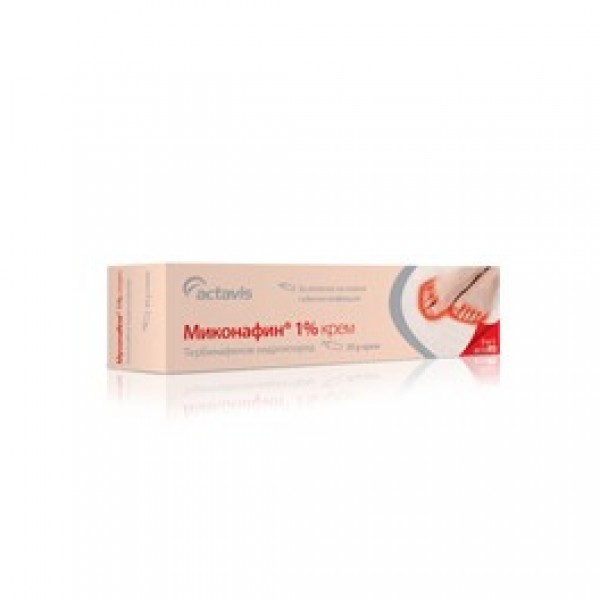
Myconafine cream 15 g.
Product Code: Myconafine cream 15 g.
Availability: In Stock
Product viewed: 1262


Myconafine cream 15 g.
What Myconafine cream is and what it is used
Myconafine cream is an antifungal medicine (intended for the treatment of fungus). It has a broad spectrum of action - inhibits or kills the majority of fungi causing infections of skin and nails (dermatophytes and yeasts).
Myconafine cream is used in:
Fungal infections of the skin caused by dermatophytes (tinea microsporia, epidermophyton, rubromikozi);
Candidiasis of the skin;
Tinea versicolor (pityriasis verzikolor);
2. What you should know before using the cream Myconafine
Myconafine cream not be used in patients with hypersensitivity to terbinafine or any of the other ingredients of this medicine (listed in section 6).
Warnings and precautions:
Myconafine cream is applied topically on the skin only. Do not apply on mucous membranes! The cream should not be applied around the eyes, mouth, nose! Following exposure of the cream in the eyes they should be washed thoroughly with running water. Before and after use of the cream Wash hands!
In case of allergic reaction is required discontinuation of cream. It is a treatment cream Myconafine be carried out without interruption for the recommended period of time!
Keep out of reach of children!
During treatment with Myconafine cream is recommended to wear comfortable and loose clothing made of natural fabrics, providing air access to the treated areas.
After treatment with Myconafine cream is necessary to observe good personal hygiene (underwear, socks, shoes) to prevent recurrence of infection.
Children and adolescents
Myconafine cream use is not recommended in children under 12 years.
Myconafine cream with food, drinks and alcohol
The product is for administration to the skin.
Other medicines and Myconafine cream
Tell your doctor or pharmacist if you are taking, you have recently taken or might take any other medicines.
There are no known interactions with Myconafine cream, but with concomitant use of other means cream spreads on the same skin areas (incl. Of plant origin) it is possible to impede its penetration through the skin and reduce its effectiveness.
Pregnancy and lactation
If you are pregnant or breast-feeding, you think you may be pregnant or planning to become pregnant, ask your doctor or pharmacist before taking this medicine.
Myconafine cream is not recommended for use during pregnancy. Myconafine cream is used during pregnancy only if strictly necessary and upon the recommendation of the doctor.
This product should not be used during breastfeeding, because it is excreted in human milk. Moreover infant should not have contact with the treated cream skin areas, including those of the breast.
In animal experiments no evidence of impaired fertility.
Driving and using machines
Myconafine cream does not affect the ability to drive and use machines.
Myconafine cream contains cetyl alcohol and stearyl
Stearin and cetyl alcohol may cause local skin reactions (eg. Contact dermatitis).
3. How to apply cream Myconafine
Always use Myconafine cream exactly as described in the package insert. If you're not sure, ask your doctor or pharmacist.
Route of administration:
The cream is intended for external use on skin areas affected and the unaffected area immediately around them, avoiding its application around the eyes, nose and mouth.
Adults, children over 12 years of age and the elderly
The cream is applied 1 or 2 times a day in a thin layer with a slight rubbing on previously clean and dry skin areas. In case of wetting fungal infections arising as a result of abrasion (in large and small skin folds) smeared with cream portion may be covered with gauze dressing for the night.
Fungal infection of the feet - 1 to 2 weeks;
Fungal infection of the body and limbs - one week;
Skin candida infection - two weeks;
Tinea versicolor (pityriasis verzikolor) - 2 weeks.
Relief of symptoms occurs in the first days. If the symptoms of the infection resolved quickly, it is necessary to continue treatment without interruption for the recommended period of time to achieve a complete cure. Otherwise possible infection to recur.
Strictly follow recommended treatment. Do not apply more or less than the designated amount!
If you have the impression that the effect of the application of Myconafine is strong or too weak, talk to your doctor or pharmacist!
If you take a large amount of the drug:
Ingestion of large quantities consult a doctor!
No evidence of an overdose of the product. Symptoms of overdose ingestion of large amounts inadvertently are the same as for an overdose of tablets: headache, nausea, pain in the upper abdomen and dizziness.
If you forget to Myconafine cream:
If you forget to take another dose, take it as soon as possible. Do not apply a large amount of the drug to make up for the omission.
4. Possible side effects
Like all medicines, Myconafine can cause side effects, although not everybody gets them.
Sometimes on the application site may be redness of the skin, itching, peeling of the skin, pain, application site irritation, application site abnormal pigmentation, burning sensation of the skin, redness, scabbing. If these symptoms should stop using the cream and consult immediately consult the doctor: If the physician's discretion no evidence of allergic skin reaction that occurs in very rare cases, it does not require discontinuation of treatment .
Adverse reactions listed below are ranked by frequency:
Common (affects less than 1 in 10 patients): exfoliation of the skin, itching.
Uncommon (affects less than 1 in 100 patients): skin lesions, abnormal pigmentation, wounds, skin redness, burning sensation of the skin, pain, application site irritation at the application site.
Rare (affects less than 1 in 1000 patients): eye irritation, rash, dry skin, contact dermatitis, eczema, deterioration.
Not known (from the available data can not be estimated) - hypersensitivity rash.
If any of the side effects gets serious, or you notice other effects not listed in this leaflet, please tell your doctor or pharmacist.
5. How to store Myconafine cream
This medicinal product does not require any special storage conditions.
Keep out of reach of children.
Do not use Myconafine cream after the expiry date stated on the packaging. The expiry date refers to the last day of that month. Shelf life after opening the tube - 6 months.
Do not dispose of medications in wastewater or household waste. Ask your pharmacist how to dispose of medicines you no longer use. These measures will help to protect the environment.
6. Contents of the pack and further information
What Myconafine cream
The active substance in 1 g of cream is terbinafine hydrochloride (terbinafine hydrochloride) 10 mg.
Other ingredients are: stearyl alcohol, cetyl alcohol, sorbitan stearate, cetyl palmitate, isopropyl myristate, benzyl alcohol, polysorbate 60, sodium hydroxide, purified water.
Myconafine cream looks like and contents of the pack
Creamy white or almost white.
Myconafine 1% cream in aluminum tubes in 15 g and 30 g.
Write a review
Your Name:Your Review: Note: HTML is not translated!
Rating: Bad Good
Enter the code in the box below:
Related Products