Your shopping cart is empty!
Welcome visitor you can login or create an account.
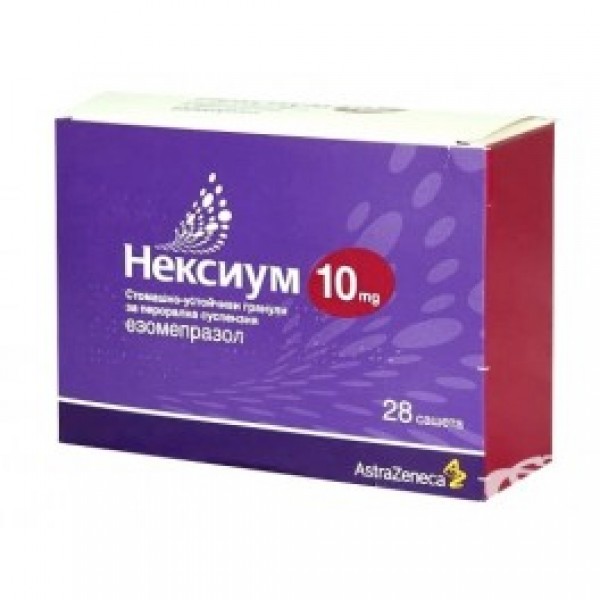
Nexium 10 mg sachet. 28 sachet
Product Code: Nexium 10 mg sachet. 28 sachet
Availability: In Stock
Product viewed: 1684


Nexium 10 mg sachet. 28 sachet

NAME OF THE MEDICINAL PRODUCT
Nexium 10 mg gastro-resistant granules for oral suspension, sachet
Nexium 10 mg gastro-resistant granules for oral suspension, sachet
QUALITATIVE AND QUANTITATIVE COMPOSITION
Each sachet contains: 10 mg ezomeprazol (esomeprazole) as magnesium trihydrate.
List of ingredients: 6,8 mg 2,8 mg sucrose and glucose.
Esomeprazole pellets:
Glycerol monostearate 40-55
Hydroxypropyl
Hypromellose
Magnesium stearate
Methacrylic acid-ethyl acrylate copolymer (1:1) dispersion 30%
Polysorbate 80
Sugar spheres (sucrose and maize starch)
Talc
Triethyl citrate
Help granules:
Citric acid anhydrous (to adjust pH)
Crospovidone
Glucose
Hydroxypropyl
Yellow iron oxide (E172 colorant)
Xanthan gum
PHARMACEUTICAL FORM
Gastro-resistant granules for oral suspension, sachet.
Fine pale yellow granules. Can be seen and brown granules.
Clinical DATA
Indications
Nexium granules for oral suspension are indicated primarily for:
Children 1 to 11 years
Gastro-oesophageal reflux disease (GERD):
Treatment of endoscopically proven erosive reflux esophagitis;
Symptomatic treatment of gastroesophageal reflux disease (GERD).
Children over 4 years
In combination with antibiotics to treat duodenal ulcers caused by Helicobacter pylori
Nexium oral suspension may be used in patients who have difficulty swallowing dissolved gastro-resistant tablets Nexium. For readings in patients over 12 years is necessary to refer to the prescribing information in the SPC for Nexium gastro-resistant tablets.
Dosage and method of administration
Adults and children over 12 years
For dosage in patients 12 years and older is necessary to consult the Summary of Nexium gastro-resistant tablets.
Paediatric population
Children 1-11 years weighing ≥ 10 kg
Gastro-oesophageal reflux disease (GERD)
Treatment of endoscopically proven erosive reflux oesophagitis
Weight ≥ 10 kg - <20 kg: 10 mg once daily for 8 weeks.
Weight ≥ 20 kg: 10 mg or 20 mg once daily for 8 weeks.
Symptomatic treatment of gastroesophageal reflux disease (GERD)
10 mg once daily for 8 weeks.
Children over 4 years
Treatment of duodenal ulcers caused by Helicobacter pylori
When selecting appropriate combination therapy should be given to official national, regional and local guidance regarding bacterial resistance, duration of treatment (most commonly 7 days but sometimes up to 14 days) and the appropriate use of antibacterial agents.
Treatment should be supervised by a specialist.
Impaired renal function
There is no need for dosage adjustment in patients with impaired renal function. Due to limited experience in patients with severe renal insufficiency, such patients should be treated with caution.
Impaired liver function
No adjustment is necessary for patients with mild to moderate hepatic impairment. In patients over 12 years of age with severe hepatic impairment should not exceed a maximum dose of 20 mg Nexium. In children 1-11 years with severe hepatic impairment the maximum dose should not exceed 10 mg (see section 5.2).
Method of application
For the 10 mg dose empty the contents of the sachet 10 mg in a cup containing 15 ml of water. Dosage of 20 mg empty the contents of two sachets of 10 mg in a cup containing 30 ml of water. Do not use carbonated water. Stir the mixture until the granules dissolve and allow the solution for a few minutes to thicken. Stir again and drink within 30 minutes of preparation. The granules should not be chewed or crushed. Rinse with 15 ml of water to accept all granules.
Patients who use a nasogastric or gastric tube, see section 6.6 for instructions for preparation and administration.
For patients with a nasogastric or gastric tube:
For a dose of 10 mg add content of 10 mg to 15 ml sachet water.
For the 20 mg dose add the contents of two sachets of 10 mg to 30 ml of water.
Stir.
Leave for a few minutes to thicken.
Stir again.
Withdraw the suspension into a syringe.
Inject through the enteral tube size 6 or larger, into the stomach within 30 minutes of reconstitution.
Refill the syringe with 15 ml of water for 10 mg and 30 ml dose of 20 mg.
Shake and enter the remainder of the mixture through enteral tube into the stomach.
Any unused suspension should be discarded.
Contraindications
Known hypersensitivity to esomeprazole, substituted benzimidazoles or any other constituents of the product.
Ezomeprazol should not be coadministered with nelfinavir.
Special warnings and precautions for use
With any troublesome symptoms (eg significant weight loss without patsienta is to goal is weight reduction, recurrent vomiting, dysphagia, haematemesis or melaena) and in cases with suspected or diagnosed gastric ulcer should be ruled out malignancy as treatment with Nexium may mask symptoms and delay diagnosis.
Patients on long-term treatment (particularly those receiving therapy for more than a year) should be monitored regularly. Long term treatment is indicated for adults and adolescents (12 years and older).
Patients treated with Nexium if necessary, should be advised to immediately contact their physician if their symptoms change in character. Treatment need not studied in children and is therefore not recommended in these patients.
When prescribing esomeprazole for treatment need to be given to the possibility of interactions with other pharmaceuticals, due to fluctuating plasma concentrations of esomeprazole.
This medicinal product contains sucrose and glucose. Patients with rare hereditary diseases characterized by intolerance to fructose malabsorption of glucose-galactose or sucrase-isomaltase insufficiency should not take this medicine.
Treatment with proton pump inhibitors may lead to slightly increased risk of gastrointestinal infections such as Salmonella and Campylobacter ..
Concomitant administration of esomeprazole with atazanavir is not recommended. If it is considered that the combination of atazanavir with a proton pump inhibitor is inevitable, careful clinical observation in combination with increasing doses of atazanavir 400 mg with ritonavir 100 mg, the dose of esomeprazole 20 mg should not be exceeded.
Results from studies in healthy volunteers showed a pharmacokinetic / pharmacodynamic interaction between clopidogrel (300 mg loading doza/75 mg daily maintenance dose) and esomeprazole (40 mg daily), which leads to reduced exposure to the active metabolite of clopidogrel on average 40% and reducing the maximum inhibition (ADP-induced) platelet aggregation by 14% on average. Based on these data, concomitant administration of esomeprazole and clopidogrel should be avoided.
Taking other medicines
Please tell your doctor or pharmacist if you are taking or have recently taken any other medicines, including those not prescribed by a doctor. Nexium can affect the way some other medicines work and some medicines can have an effect on the action of Nexium.
In particular, tell your doctor or pharmacist if you are taking any of these medicines:
Atazanavir (used to treat HIV). Do not take Nexium if you are taking nelfinavir.
Ketoconazole, itraconazole or voriconazole (used to treat fungal infections).
Diazepam (used to treat anxiety or muscle relaxants).
Citalopram, imipramine or clomipramine (used to treat depression).
Phenytoin (used in epilepsy).
Warfarin or coumarin (medicines called anticoagulants, is applied to thin the blood).
Cisapride (used for indigestion and "acid"
Clarithromycin (used to treat infections).
Pregnancy and lactation
Insufficient clinical data on exposure to Nexium during pregnancy. Epidemiological studies with omeprazole racemic mixture of a large number of exposures during pregnancy showed no malformative or foetotoxic effect. Animal studies with esomeprazole do not indicate direct or indirect harmful effects with respect to embryonal / fetal development. Animal studies with the racemic mixture do not indicate direct or indirect harmful effects with respect to pregnancy, parturition or postnatal development. Caution should be exercised when prescribing to pregnant women.
It is not known whether esomeprazole is excreted in human milk. No studies in lactating women. Therefore Nexium should not be used during breastfeeding.
Effects on ability to drive and use machines
No effects were observed.
SIDE EFFECTS
The following adverse reactions have been identified or suspected in the clinical trials of esomeprazole and postmarketing use. None of them were related to dose.
General disorders and administration site conditions
Rare: Malaise, increased sweating
Respiratory, thoracic and mediastinal disorders
Rare: Bronchospasm
Blood and lymphatic system
Rare: Leukopenia, thrombocytopenia
Very Rare: Agranulocytosis, pancytopenia
Nervous System
Common: Headache
Uncommon: dizziness, paresthesia, somnolence
Rare: Disturbances of taste
Immune System
Rare: Hypersensitivity reactions eg. fever, angioedema and anaphylactic reaction / shock
Skin and subcutaneous tissue disorders
Uncommon: dermatitis, pruritus, rash, urticaria
Rare: Alopecia, photosensitivity
Very rare: Erythema multiforme syndrome, Stevens-Johnson, toxic epidermal necrolysis (TEN)
Hepatobiliary disorders
Uncommon: Increased liver enzymes
Rare: Hepatitis with or without jaundice
Very rare: Hepatic failure, encephalopathy in patients with pre-existing liver disease
Gastrointestinal Disorders
Common: Abdominal pain, constipation, diarrhea, flatulence, nausea / vomiting
Uncommon: Dry mouth
Rare: Stomatitis, gastrointestinal candidiasis
Very rare: Microscopic colitis
Metabolism and nutrition
Uncommon: Peripheral edema
Rare: Hyponatraemia
Very rare: Hypomagnesaemia
Musculo-skeletal and connective tissue disorders
Rare: Arthralgia, myalgia
Very rare: Muscle weakness
Renal and urinary disorders
Very rare: Interstitial nephritis
Psychiatric Disorders
Uncommon: Insomnia
Rare: Agitation, confusion, depression
Very rare: Aggression, hallucinations
Reproductive system and breast disorders
Very rare: Gynaecomastia
Eye Disorders
Uncommon: Blurred vision
Ear and labyrinth disorders
Uncommon: Vertigo
Overdose
Currently there is very limited experience with intentional overdose. The symptoms described in connection with 280 mg, were gastrointestinal symptoms and weakness. Single doses of 80 mg did not result in any event. There is no specific antidote. Esomeprazole is extensively bound to plasma proteins to a very high degree and therefore not readily dialyzable. As in any case of overdose, treatment should be symptomatic and general supportive measures.
Incompatibilities
Not applicabl
Special precautions for storage
There are no special storage instructions.
Nature and contents of container
Cardboard box containing 28 sachets. Sachets (containing granules): laminate of three layers: polyethylene terephthalate (PET), aluminum, low density polyethylene (LDPE), which protects the grain from moisture.
Write a review
Your Name:Your Review: Note: HTML is not translated!
Rating: Bad Good
Enter the code in the box below:
Related Products