Your shopping cart is empty!
Welcome visitor you can login or create an account.
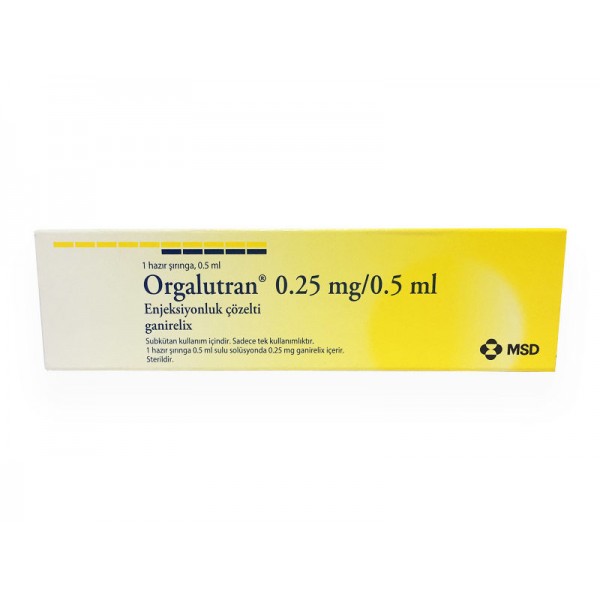
Orgalutran 0.25 mg. / 0.5 ml. 1 ampule
Product viewed: 2678


What ORGALUTRAN is and what it is used for
Orgalutran belongs to a group of medicines called "anti-gonadotropin-releasing hormones" that counteract the natural gonadotropin-releasing hormone (GnRH). GnRH regulates the release of gonadotrophins (luteinizing hormone (LH) and follicle stimulating hormone (FSH). Gonadotropins play an important role in human fertility and reproduction. In women, FSH is necessary for the growth and development of follicles in the ovaries. The follicles are small circular bags that contain the oocytes. LH is necessary for the release of ripe ovaries from the follicles and ovaries (ie ovulation). Orgalutran blocks the action of GnRH, thus suppressing predominantly LH release.
Orgalutran is used for
In women participating in assisted reproduction programs including IVF and other methods, ovulation can sometimes occur too early to significantly reduce the likelihood of becoming pregnant. Orgalutran is used to prevent the premature LH peak that can cause premature oocyte release.
During clinical studies, Orgalutran was co-administered with recombinant follicle-stimulating hormone (FSH) or corifollitropin alfa, a prolonged follicular stimulant.
2. What you need to know before using ORGALUTRAN
Do not use Orgalutran
if you are allergic (hypersensitive) to ganirelix or any of the other ingredients of this medicine (listed in section 6.1);
if you are hypersensitive to gonadotropin-releasing hormone (GnRH) or to a GnRH analogue;
if you suffer from moderate or severe kidney or liver disease;
if you are pregnant or breast-feeding.
Warnings and precautions
Talk to your doctor, pharmacist or nurse before using Orgalutran:
if you have a severe allergic reaction, please tell your doctor. Your doctor will decide, depending on the severity of the particular manifestations, whether additional monitoring is needed during treatment. Cases of hypersensitivity reactions have been reported with the first dose;
The needle cap of this medicine contains a natural latex gum that can cause allergic reactions;
ovarian hyperstimulation syndrome may develop during or after hormonal stimulation of the ovaries. This syndrome is associated with the gonadotropin stimulation procedure. Refer to the package leaflet accompanying the gonadotrophin-containing medicinal product that you have been prescribed for reference;
The incidence of congenital malformations after assisted reproduction programs may be slightly higher than in natural conception. This slightly increased incidence is believed to be related to the characteristics of patients undergoing infertility treatment (eg, female age, sperm characteristics) and to more frequent multiple pregnancy after assisted reproduction programs. The incidence of congenital malformations following assisted reproduction programs using Orgalutran is not different from those following the use of other GnRH analogues in the course of assisted reproduction programs;
There is a slight increase in the risk of ectopic pregnancy in women with uterine tubule damage;
The efficacy and safety of the medicinal product have not been investigated in women weighing less than 50 kg and 90 kg respectively. Ask your doctor for more information.
Children and adolescents
The use of Orgalutran in children is not appropriate.
Other medicines and Orgalutran
Tell your doctor or pharmacist if you are taking, have recently taken or might take any other medicines.
Pregnancy, breastfeeding and fertility
Orgalutran should be used in controlled ovarian stimulation within the assisted reproductive procedure. Orgalutran should not be used during pregnancy and lactation.
Ask your doctor or pharmacist for advice before taking this medicine.
Driving and using machines
There are no studies on the effects on the ability to drive and use machines.
This medicine contains less than 1 mmol sodium (23 mg) per injection, ie. practically does not contain sodium.
3. How to use ORGALUTRAN
Always use this medicine exactly as your doctor or pharmacist has told you. If you are not sure, ask your doctor or pharmacist.
Orgalutran is used as part of assisted reproduction treatment, including in vitro fertilization.
Ovarian stimulation with follicle-stimulating hormone (FSH) or corifollitropin may begin on the 2nd or 3rd day of the start of your menstrual period, Orgalutran (0.25 mg) should be injected subcutaneously, once a day starting from day 5 or 6 of the stimulation. Depending on your ovarian response, your doctor may decide to start treatment on another day.
Orgalutran and the medicinal product containing FSH should be administered at approximately the same time. They should not be mixed at the injection as well
Instructions for use
Injection site
Orgalutran is supplied in pre-filled syringes and should be injected slowly, subcutaneously, preferably in the upper thigh. Inspect the solution well before injection. Do not use the solution if it contains undissolved particles or is cloudy. If you or your partner are taking the injections, follow the instructions below. Do not mix Orgalutran with other medicinal products.
Preparation of the injection site
Wash your hands thoroughly with warm water and soap. Clean the injection site with a disinfectant solution (eg alcohol) to remove the bacteria that are present on the skin's surface. Disinfect 5 cm around the needle and wait for at least one minute to dry.
Needle insertion
Remove the needle guard. Grasp a large part of your skin between your thumb and forefinger to form a skin fold. Insert the needle at the base of the crease at an angle of 45 ° to the skin surface. For each subsequent injection, replace the injection site.
Check the correct needle position
Gently pull the syringe plunger out to check if the needle is in the correct position. If blood enters the syringe barrel, it means that the needle has entered a blood vessel. In this case, Orgalutran should not be injected. Take the syringe carefully, cover the puncture site with a swab, soak in a disinfectant and press gently; bleeding should stop after a minute or two. Do not use the syringe again but discard it. Start the procedure again with another syringe.
Injecting the drug solution
After making sure that the needle is in the correct position and does not enter a blood vessel, push the plunger slowly and evenly so that the solution is injected subcutaneously without damaging the skin tissues.
Removing the syringe
Remove the syringe quickly and press the injection site with a swab with a disinfectant. Use the syringe once.
If you use more Orgalutran than you should
Tell your doctor.
If you forget to use Orgalutran
If you find that you have missed a dose, apply it immediately.
Do not inject a double dose to make up for the missed dose.
If you have been delayed for more than 6 hours (so the time between two injections becomes longer than 30 hours), immediately put the injection and contact your doctor for advice.
If you stop using Orgalutran
Do not stop using Orgalutran unless your doctor has told you, as this may affect the outcome of your treatment.
If you have any further questions on the use of this product, ask your doctor, pharmacist or nurse.
4. Possible side effects
Like all medicines, this medicine can cause side effects, although not everyone gets them.
Common side effects (affects 1 to 10 women in 100) are local skin reactions at the injection site (mostly redness, with or without swelling). The local reaction usually subsides within 4 hours of the injection. Very rarely, in less than 1 in 10,000 women, more extensive reactions with possible allergic origin have been observed with the first dose.
Uncommon side effects (affects 1 to 10 women in 1,000) are headache, nausea and malaise.
In addition, adverse reactions known to occur in controlled ovarian hyperstimulation (ie abdominal pain, ovarian hyperstimulation syndrome (OHSS), ectopic pregnancy (when the embryo develops outside the uterus) and spontaneous abortion (read the package leaflet of the FSH-containing medicinal product that is being administered to you)).
One patient reported a worsening of an existing rash (eczema) after the first administration of Orgalutran.
If any of the side effects gets serious, tell your doctor, pharmacist or nurse. This includes all possible side effects not listed in this leaflet.
How to store ORGALUTRAN
Keep out of the reach and sight of children.
Do not use this medicine after the expiry date which is stated on the carton and the label after EXP. The expiry date refers to the last day of that month.
Do not freeze.
Carefully examine the syringe before use. Use only pre-filled syringes with unbroken integrity, containing a clear solution without any undissolved particles.
Do not dispose of medicines in the sewage system or in the household waste container. Ask your pharmacist how to dispose of medicines you no longer use. These measures will help to protect the environment.
6. Package Contents and Additional Information
What Orgalutran contains
The active substance is ganirelix (0.25 mg in 0.5 ml solution).
The other ingredients are acetic acid, mannitol, water for injections. For pH adjustment (acidity measure), sodium hydroxide and acetic acid may be used.
What Orgalutran looks like and contents of the pack
Orgalutran is a clear and colorless aqueous solution for injection. The solution is ready for use and is intended for subcutaneous use. The needle cap contains a natural latex gum.
Orgalutran is available in packs of 1 or 5 pre-filled syringes.
Not all pack sizes may be marketed.
Write a review
Your Name:Your Review: Note: HTML is not translated!
Rating: Bad Good
Enter the code in the box below:
Related Products