Your shopping cart is empty!
Welcome visitor you can login or create an account.
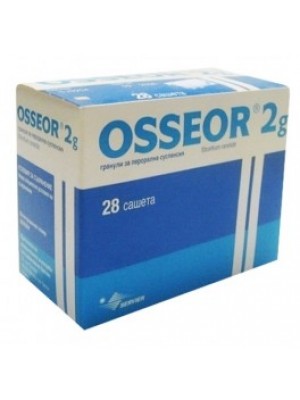
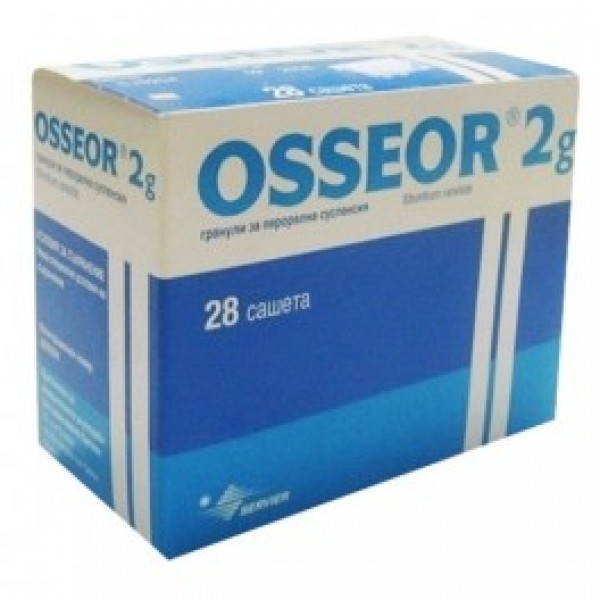
OSSEOR 2 gr sachets 28 sachets
Product Code: OSSEOR 2 gr sachets 28 sachets
Availability: In Stock
Product viewed: 1225


OSSEOR 2 gr sachets 28 sachets

CLINICAL FEATURES
Indications
Treatment of osteoporosis in postmenopausal women to reduce the risk of vertebral and hip fractures (see section 5.1).
Dosage and method of administration
The recommended dose is one 2 g sachet ednokratno.Poradi oral nature of the treated disease, strontium ranelate is intended for long term use.
The absorption of strontium ranelate is reduced by food, milk and derivative products and therefore PROTELOS should be administered between meals. Given the slow absorption, PROTELOS should be taken at bedtime, at least two hours after eating (see sections 4.5 and 5.2). Granules in sachets to be dissolved in a glass of water. Although research in the application have demonstrated that strontium ranelate is stable in suspension for 24 hours after preparation, the suspension should be drunk immediately after being prepared.
Patients treated with strontium ranelate should receive vitamin D and calcium supplements if dietary intake is inadequate.
Use in Elderly People
The efficacy and safety of strontium ranelate have been established for a wide age group postmenopausal women (up incl. 100 years) with osteoporosis. No adjustment is necessary to age.
Use in renal impairment
There is no need dose adjustment in mild to moderate renal impairment (creatinine clearance 30-70 ml / min) (see section 5.2). Strontium ranelate is not recommended in patients with severe renal impairment (creatinine clearance below 30 ml / min) (see sections 5.2 4.4i).
Use in hepatic impairment
As strontium ranelate is not metabolised, does not require dose adjustment in patients with hepatic impairment.
Use in children and adolescents
The efficacy and safety of strontium ranelate have not been established in children and adolescents and the use of these age groups is not recommended.
Contraindications
Hypersensitivity to the active substance or to any of the excipients.
Special warnings and precautions for use
In the absence of data on bone safety in patients with severe renal impairment treated with strontium ranelate, PROTELOS is not recommended in patients with creatinine clearance less than 30 ml / min (see section 5.2). In accordance with good medical practice, periodic assessment of renal function in patients with chronic renal impairment. Continuation of treatment with PROTELOS in patients developing severe renal impairment should be assessed individually.
In the phase III placebo-kontrodiranite studies ranelate treatment was associated with an increase in the annual incidence of venous thromboembolism (VTE), including pulmonary embolism (see section 4.8). The reason for this is not known. OSSEOR should be used with caution in patients at risk for VTE, including patients with a history of VTE. In the treatment of patients at risk or developing risk of VTE, particular attention should be given to possible signs and symptoms of VTE and should be adequate preventive measures taken.
Strontium interferes with colorimetric methods for the determination of calcium concentrations in the blood and urine Therefore, in medical practice should be using inductively coupled plasma atomic emission spectrometry or atomic absorption spectrometry to perform accurate study of the concentration of calcium in the blood and urine.
OSSEOR contains phenylalanine which may be harmful for people with phenylketonuria.
Drug and other forms of interaction
Food, milk and derivative products, and medicinal products containing calcium may. Reduce the bioavailability of strontium ranelate by approximately 60-70%. Therefore, administration of PROTELOS and such products should be separated by at least two hours (see section 5.2).
In vivo clinical interaction study showed that the administration of aluminum and magnesium hydroxide two hours before or together with strontium ranelate caused a slight decrease in the absorption of strontium ranelate (20-25% decrease in AUC). At the same time, the absorption was almost unaffected when the antacid was given two hours after strontium ranelate. Therefore it is preferable to antacids taken at least two hours after PROTELOS. However, when this dosing regimen is impractical due to the recommended administration of PROTELOS at bedtime, concomitant intake remains acceptable.
As divalent cations can form complexes with oral tetracycline and quinolone antibiotics in the digestive tract and thereby reduce their absorption, simultaneous administration of strontium ranelate with these medicinal products is not recommended. As a precaution, PROTELOS treatment should be withheld during treatment with oral tetracycline and quinolone antibiotics.
No interaction was observed with supplementation of vitamin D, taken peroralno.Pri clinical studies have not found any clinical interactions or relevant increase of blood strontium levels with medicinal products that are commonly prescribed together with OSSEOR in the target population. Among them are: NSAIDs (including acetylsalicylic acid), anilides (such as paracetamol), H2 blockers and proton pump inhibitors, diuretics, digoxin and cardiac glycosides, organic nitrates and other vasodilators for heart disease, calcium channel blockers , beta blockers, ACE inhibitors, angiotensin I, selective beta-2 adrenoceptor agonists, oral anticoagulants, inhibitors of platelet aggregation, statins, fibrates and benzodiazepine derivatives.
Pregnancy and lactation
OSSEOR is intended for use by women after menopause.
We do not have any clinical data on pregnancies exposed to strontium ranelate. Animal studies have shown reversible bone effects in the offspring of rats and rabbits treated with large doses during pregnancy (see section 5.3). If PROTELOS is used inadvertently during pregnancy, you should be spryano.Strontsiumat is excreted in milk. Strontium ranelate should not be given to nursing women.
Effects on ability to drive and use machines
Strontium ranelate has no or negligible influence on the ability to drive and use machines.
Undesirable effects
OSSEOR has been studied in clinical trials, which involved almost 8,000 people. Long-term safety was assessed in postmenopausal women with osteoporosis treated for up to 56 months with strontium ranelate 2 g / day (n = 3,352) or placebo (n = 3,317) in phase III studies. The average age was 75 years at baseline, and 23% of the patients were between 80 and 100 years.
The overall incidence of adverse effects of strontium ranelate did not differ from placebo, but side effects are usually mild and transient. The most common side effects are nausea and diarrhea, which are usually seen at the beginning of treatment with no noticeable difference between groups afterwards. Discontinuation of therapy was mainly due to nausea (1.3% and 2.2% in the placebo and strontium ranelate).
Adverse reactions, defined as adverse events considered at least possibly attributable to strontium ranelate treatment in phase III studies are listed below using the following convention (frequency vs. placebo):
very common (> 1/10), common (> 1/100, <1/10) times (> 1/1, 000, <1/100), rare (> 1/10, 000, <1/1, 000) very rare (<1/10, 000).
Nervous system disorders
Common: headache (3.0% vs. 2.4%)
Gastro - intestinal disturbances
Common: nausea (6.6% vs. 4.3%), diarrhea (6.5% vs. 4.6%), loose stools (1.1% vs. 0.2%)
Disturbances of skin and subcutaneous tissue
Common: dermatitis (2.1% vs. 1.6%), eczema (1.5% vs. 1.2%)
There were no differences in the nature of adverse events between treatment groups regardless of whether patients were aged below or above 80 at inclusion.
In phase III studies, the annual incidence of venous thromboembolism (VTE) observed over four years was approximately 0.7%, with a relative risk of 1,42 (CI 1,02; 1,98, p = 0.036) in patients treated with strontium ranelate compared with placebo (see section 4.4)
In phase III studies, for four years, disorders of the nervous system are observed with greater frequency in patients treated with strontium ranelate, compared with placebo: disturbances in consciousness (2.5% vs. 2 0%), memory loss (2.4% vs. 1.9%) and seizures (0.3% vs. 0.1%)
Signs of laboratory research
Reported transient appearing increase (> 3 times the upper limit of normal) in creatine kinase (CK) (fraction of skeletal muscles) in 1.0% and 0.4% respectively from the groups treated with strontium ranelate and placebo . In most cases, these values spontaneously normalized without change in treatment.
Overdose
Good tolerance was shown in a clinical study investigating the repeated administration of 4 g strontium ranelate daily for 25 days in healthy postmenopausal doses up to 11 g in healthy male volunteers did not cause any particular simptomi.V Following episodes of overdoses in clinical trials (up to 4 g / day with - duration 147 days), there were no clinically relevant proyavi.Priemaneto milk or antacids may help reduce the absorption of the active substance. In cases of substantial overdose may be considered to induce vomiting to remove unabsorbed active substance.
Pharmacological Properties
Pharmacodynamic properties
Pharmacotherapeutic group: Drugs for treatment of bone diseases - Other drugs affecting bone structure and mineralization
ATC Code: M05BX03
In vitro, strontium ranelate:
increases bone formation in bone tissue culture and precursor replication osteoblasta and collagen synthesis in bone cell cultures, decreases bone resorption by decreasing differentiation and resorbing activity of osteoclast This results in a rebalance of bone turnover in favor of formation of kosttaAktivnostta of strontium ranelate was studied in various preclinical models. In particular, in intact rats, strontium ranelate increases trabecular bone mass, number and thickness of trabeculae, leading to improved bone strength.
In bone tissue of treated animals and humans, strontium is mainly adsorbed onto the crystal surface and only slightly substitutes for calcium in the apatite crystal of newly formed bone. Strontium ranelate does not modify the bone crystal characteristics. Of bone biopsies from the iliac crest bone obtained after 60 months of treatment with strontium ranelate 2 g / day in phase III trials, no deleterious effects on bone quality or mineralization her
The combined effects of strontium distribution in bone (see section 5.2) and increased absorption of strontium as compared to calcium leads to increased bone mineral density (BMD) by dual-photon X-ray absorptiometry (DXA). Available data indicate that these factors account for approximately 50% of the measured change in BMD after 3 years of treatment with PROTELOS 2 g / day. This should be taken into account when interpreting BMD changes during treatment with PROTELOS. In phase III studies, which demonstrated anti-fracture efficacy of treatment with PROTELOS measured BMD increased from baseline by 4% per year at the lumbar spine and 2% per year at the femoral neck, reaching 13% to 15% and 5% to 6% respectively after 3 years depending on the study.
In phase III studies, compared with placebo, biochemical markers of bone formation (bone specific alkaline phosphatase and C-terminal propeptide of procollagen type I) increased and those of bone resorption (serum C-telopeptide and cross-linked N- telopeptide in urine) decreased from the third month of treatment up to 3 years.
Secondary to the pharmacological effects of strontium ranelate, slight decreases in serum calcium and parathyroid hormone (PTH) increases in blood phosphorus concentrations and in total alkaline phosphatase without clinical sequelae were observed
Clinical Efficacy
Osteoporosis is defined as BMD of the spine or hip 2.5 SD below the mean value of a normal population. Postmenopausal osteoporosis combined with several risk factors, including low bone mass, low bone mineral density, early menopause, a history of smoking and a family history of osteoporosis. The clinical consequences of osteoporosis are fractures. The risk of fracture increases with the number of risk factors.
Treatment of postmenopausal osteoporosis:
Program OSSEOR anti-fracture studies based on two placebo-controlled trials - Phase III: SOTI and TROPOS. SOTI involved 1,649 postmenopausal women with established osteoporosis (low lumbar BMD and prevalent vertebral fracture) and a mean age of 70 years. TROPOS involved 5,091 postmenopausal women with osteoporosis (low femoral neck BMD and prevalent fractures in more than half of them) and a mean age of 77 years. Together, SOTI and TROPOS enrolled 1,556 patients over 80 years at baseline (23.1% of the study population). To treatment (2 g / day strontium ranelate or placebo) patients receiving concurrent adapted calcium and vitamin D in both prouchvaniya.OSEOR reduced the relative risk of new vertebral fractures by 41% over three years in the study SOTI (Table 1 ). The effect was significant in the first year Similar benefits were demonstrated in women with multiple fractures at baseline. With respect to clinical vertebral fractures (defined as fractures associated with back pain and / or loss of body height at least 1 cm), the relative risk was reduced by 38%. OSSEOR also decreased the number of patients with a height loss of at least 1 cm as compared to placebo. Assessment of quality of life in specific scale QUALIOST, and ball of feeling overall health of the overall SF-36 scale indicated benefit of PROTELOS compared with placebo.
Efficacy of OSSEOR to reduce the risk of new vertebral fracture was confirmed by the study TROPOS, including patients with osteoporosis without fractures at baseline. In patients older than 80 years at inclusion, a pooled analysis of SOTI and TROPOS studies showed that OSSEOR reduced the relative risk of experiencing new vertebral fractures by 32% over 3 years (incidence 19.1% with strontium ranelate vs. 26 , 5% placebo).
In a posteriori analysis of patients from the SOTI and TROPOS studies with baseline lumbar spine and / or femoral neck BMD in the osteopenic range and without fracture, but at least I no additional risk factor for fracture (N = 176), OSSEOR reduces the risk of a first vertebral fracture by 72% for 3 years (incidence of vertebral fracture 3.6% with strontium ranelate vs. 12.0% with placebo).
Was carried out a posteriori analysis of the subgroup of patients from the TROPOS study of particular medical interest and at high risk of fracture [defined by T score of femoral neck BMD <3 SD (manufacturer's range corresponding to - 2.4 SD if applied NHANESIII) and age> 74 years (n = 1,977, ie 40% "of the group studied by TROPOS)]. In this group, over three years, OSSEOR reduces the risk of fracture of the femur by 36% compared with placebo (Table 2).
Farmakokinetnchnn properties
Strontium ranelate is composed of two atoms of stable strontium and 1 molecule ranelic organic part permitting the - best compromise in terms of molecular weight, pharmacokinetics and tolerability of the drug. Mr. pharmacokinetics and strontium and ranelic acid were investigated in healthy young men and healthy postmenopausal women, as well as long-term exposure in postmenopausal women with osteoporosis, including many elderly women.
Due to its high polarity, the absorption, distribution and plasma protein binding of ranelic acid are low. No accumulation of ranelic acid and no evidence of metabolism in animals and humans. Once absorbed ranelic acid is rapidly excreted by the kidneys.
Absorption
The absolute bioavailability of strontium is about 25% (range 19-27%) after an oral dose of 2 g of strontium ranelate. Maximum plasma concentrations are reached 3 to 5 hours after a single dose of 2 g. Steady state is reached after 2 weeks of treatment. Intake of strontium ranelate with calcium or food reduces the bioavailability of strontium by approximately 60-70% compared to 3 hours after a meal. Due to the relatively slow absorption of strontium, food and calcium should be avoided before and after administration of PROTELOS. Oral supplementation with vitamin D has no effect on strontium exposure.
Distribution
Strontium has a volume of distribution of approximately 11/kg. The binding of strontium to human plasma proteins is low (25%) and strontium has a high affinity for bone tissue. Measurement of strontium concentration in iliac crest bone biopsies from patients treated for up to 60 months with strontium ranelate 2 g / day indicate that bone strontium concentrations may reach a plateau after about 3 years. There are no data in patients to demonstrate elimination kinetics of strontium from bone discontinuation.
Biotransformation
As a divalent cation, strontium is not metabolised. Strontium ranelate does not inhibit cytochrome P450 enzymes.
Radiation
Transmission of strontium is time and dose. Effective half-life of strontium is about 60 hours. Strontium excretion occurs via the kidneys and digestive tract. Its plasma clearance is about 12 ml / min (CV 22%) and renal clearance about 7 ml / min (CV 28%)
Pharmacokinetics in special clinical situations
Adults
Pharmacokinetic data showed no relationship between age and apparent clearance of strontium in the target population
Patients with renal impairment
In patients with mild to moderate renal impairment (30-70 ml / min creatinine clearance), strontium clearance decreases as creatinine clearance (approximately 30% decrease over the creatinine clearance between 30 and 70 ml / min) and so induces an increase in plasma levels of strontium. In studies - Phase III, 85% of patients had a creatinine clearance between 30 and 70 ml / min and 6% below 30 ml / min at the beginning, and the mean creatinine clearance was about 50 ml / min. Therefore there is no need dose adjustment in patients with mild and moderate renal impairment. No pharmacokinetic data in patients with severe renal impairment (creatinine clearance below 30 ml / min).
Patients with hepatic impairment
No pharmacokinetic data in patients with hepatic impairment. Due to the pharmacokinetic properties of strontium, no effect is expected.
Preclinical safety data
Preclinical data revealed no special hazard for humans based on conventional studies of safety pharmacology studies, genotoxic and carcinogenic potential.
Chronic oral administration of strontium ranelate at high doses in rodents induced bone and tooth abnormalities, mainly consisting of spontaneous fractures and delayed mineralization. These effects were reported at bone strontium levels 2-3 times higher than the level of strontium chronic clinical treatment and were reversible after discontinuation.
Developmental toxicity studies in rats and rabbits leads to abnormalities of bones and teeth (eg crooked long bones and wavy ribs) in the offspring. In rats, these effects were reversible 8 weeks after treatme
PHARMACEUTICAL PARTICULARS
List of excipients
Aspartame (E951) Maltodextrin Mannitol (E421)
Incompatibilities
Not applicable
Shelf Life
Three years.
Special precautions for storage
This medicinal product does not require any special storage conditions
Write a review
Your Name:Your Review: Note: HTML is not translated!
Rating: Bad Good
Enter the code in the box below:
Related Products