Your shopping cart is empty!
Welcome visitor you can login or create an account.
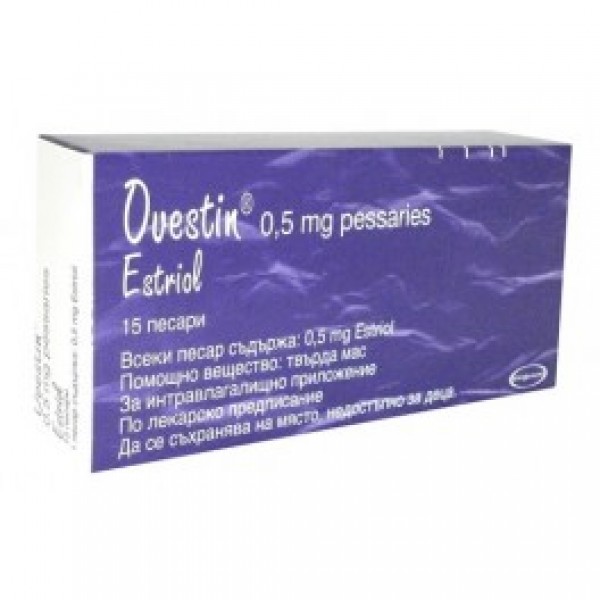
OVESTIN 0.5 mg
Product Code: OVESTIN 0.5 mg
Availability: In Stock
Product viewed: 2143


OVESTIN 0.5 mg

Qualitative and quantitative composition:
Each suppository contains drug Estriol 0.5. For excipients, see section 6.1.
Drugs, form
Vaginal suppositories.
White to off-white colored pessaries shaped torpedo.
4.Klinichni data
4.1. witness
• hormone replacement therapy for the treatment of atrophy of the lower urogenital tract, determined by lack of estrogen.
• Pre-and post-operative treatment of post-menopausal women having vaginal operations.
• Ancillary diagnostic tool for doubtful atrophic cervical smear.
4.2. Dosage and method of administration
• In the lower segment of the atrophy of the urogenital tract:
1 suppository daily for the first week, after which the dose is gradually decreased based on the relief of symptoms until a maintenance dose (e.g. 1 suppositories twice weekly).
• For the pre-and post-operative treatment of women undergoing postmenopazualni vaginal operations: on day 1 of a suppository, two weeks prior to surgery; 1 suppository twice a week, two weeks after surgery.
• As an ancillary diagnostic tool in case of doubtful atrophic cervical smear: 1 suppository every other day, a week before making a new smear.
Ovestin suppositories are placed in the vagina at bedtime. The missed dose should be administered as soon as it is established unless the time coincides with taking the next row doza.V this case the missed dose should be skipped and can be applied directly next in line dose. You should never apply two doses at once.
Upon initiation or continuation of treatment of postmenopausal symptoms should apply the minimum effective dose for the minimum period of time (see Section 4.4). Women who were not using hormone replacement therapy or women so far which have been treated with combined hormone replacement therapy, switching to Ovestin treatment can begin immediately. Women who previously received cyclic hormone replacement preparation should begin treatment with Ovestin one week after the last treatment cycle.
4.3. Contraindications
• Known or suspected breast cancer
• Known or suspected estrogen-dependent malignant tumors (endometrial carcinoma)
• unexplained vaginal bleeding
• Untreated endometrial hyperplasia
• Previous idiopathic or current history of venous thromboembolism (deep vein thrombosis, pulmonary embolism)
• past or current history of arterial thromboembolic events (angina pectoris, myocardial infarction)
• Acute liver disease, or a history of previous liver disease if liver functions are not the norm.
• Hypersensitivity to the active substance or excipients.
• Porphyria
4.4. Special warnings and precautions for use
To treat post-menopausal hormone replacement therapy should only be applied to symptoms that impair quality of life. In all cases, you should make a careful assessment of the possible risks and potential benefits, at least annually, and hormone replacement therapy should be applied only until the benefit is greater than the risks.
Medical examination / follow
• Before starting treatment, you need to lift the complete personal and family medical history of the patient. According to the findings, as well as contraindications and warnings for use must be conducted physical examination (including pelvic and breast). It is recommended to conduct periodic reviews during treatment, their frequency shall be determined individually. Women should be advised what changes in their breasts should notify their physician. Preventive breast examinations and / or mammograms should be performed according to accepted norms in healthy women, tailored to the specific clinical needs of patients. Diseases that require medical supervision
If any of the below listed conditions are met, if a history of them, or complications during past pregnancy or previous hormone treatment, during treatment, the patient should be monitored by a doctor. It should be noted that it is possible for these conditions to be repeated or exacerbated during treatment with Ovestin, in particular:
- Leiomyoma (uterine fibroids) or endometriosis
- Past history of thromboembolic disorders or risk factors (see below)
- Risk factors on estrogen-dependent tumors, 1st degree heredity for breast cancer
- High blood pressure
- Acute liver disorders (liver adenoma)
- Diabetes meilitus with or without vascular complications
- Cholestatic jaundice
- Migraine or severe headache
- Lupus erythematosus
- A history of endometrial hyperplasia (see below)
- Epilepsy
- Asthma
- Otosclerosis
Reasons for immediate discontinuation
Treatment should be discontinued in case of contraindications found as below mentioned cases:
- Jaundice or deterioration of liver function
- A significant increase in blood pressure
- New onset of migraine-type headache
- Pregnancy
Endometrial hyperplasia:
To prevent endometrial stimulation, the daily dose should not exceed 1 applicator dose (0.5 mg estriol), such that a maximum dose must not be used for a longer period of several weeks.
Breast Cancer
Results from a randomized placebo-controlled trial - Women's Health initiative (WHI), and epidemiological studies, including Million Women Study (MWS) was shown to increase breast cancer in women who use estrogen combination of estrogens and progestogens or tibolone as hormone replacement therapy for several years (see Section 4.8). In all types of hormone replacement therapy, the use of several years will lead to an increased risk for breast cancer, such as the increase is proportional to the duration of reception. After discontinuation of treatment within a few years (up to five) risk gradually returns to baseline levels prior to initiating therapy.
• Within Million Women Study (MWS), the relative risk of breast cancer with conjugated equine estrogen (CEE) or estradiol (EL), is increased with the addition - sequence-or constant - a progestagen, regardless of its type. Not found statistical difference in risk between the different routes of administration.
• Use in the Million Women Study (MWS) combination hormone replacement - conjugated equine estrogens (CEE) and Medroxyprogesteroneacetate (MPA) is associated with a slightly larger size and frequency of metastasis to regional lymph nodes of cancers.
• hormone replacement therapy, particularly in the combination therapy oestrogens and progestogens increased density in mammographic examination, and can complicate the radiological diagnosis of breast cancer.
venous Thromboembolism
- Hormone replacement therapy is associated with a higher relative risk of developing venous thromboembolism (VTE), ie deep vein thrombosis or pulmonary embolism. Results of a randomized clinical trial and several epidemiological studies have shown that there is a 2-3 times higher risk for patients consuming hormone replacement therapy than in those who do not use. It is estimated that among women who do not use HRT for a period of five years will occur VTE events among the three in every thousand women aged 50-59 years and in 8 of every 1,000 women aged 60-69 years. It is expected that in women who used HRT for five years the number of cases of VTE in this period will increase by 2-6 (possibly 4) per 1000 women aged 50-59 years and 5-15 (at probably 9) aged 60-69 years. Risk for the occurrence of VTE is highest during the first year of use of HRT.
- Generally recognized risk factors for DVT include personal and family history of myocardial similar incident, obesity (body mass index> 30kg/m2) and systemic lupus erythematosus (SEL). Currently there is no consensus about the possible role of varicose veins for the occurrence of DVT.
- Patients with a history of recurrent VTE or established trombobofilichni states have an increased risk of VTE. The use of HRT may add to this risk. Past or family history of thromboembolism or frequent miscarriages should be examined carefully to exclude a thrombophilic predisposition. While not a definitive assessment of the factors for thrombophilia or starting anticoagulant therapy, the use of HRT in such patients should be considered contraindicated. In patients who are already treated with anticoagulants, the use has to be done very careful consideration of the benefit-risk ratio.
- The existence of past or serious family history of recurrent RET, or frequent miscarriages should be seriously investigated to exclude predisposition thrombophilias. Until you determine the final diagnosis has been made or anticoagulant therapy, use of hormone replacement therapy in such patients should be considered contraindicated.
- The risk of TBE may be temporarily increased with prolonged immobilisation, major trauma or massive surgery. As with all patients received operation must be carried out very stringent measures for the prevention of post-operative BET. When you know in advance that after planned surgery, particularly abdominal or orthopedic surgery, yet prolonged immobilization should consider discontinuation of hormone replacement therapy 4 to 6 weeks earlier, if possible. When Ovestin apply to pre-and postoperative therapy should be considered implementation of prevention of thrombotic events.
- If BET occur after initiation of therapy with Ovestin, treatment should be discontinued. Patients should be advised to immediately contact their doctor if they notice possible signs of BET (painful swelling of a leg, sudden chest pain, shortness of breath).
Coronary artery disease (CAD)
- Data from randomized controlled trials of treatment with combined conjugated estrogens and MPA failed to reveal the presence of a benefit to the cardiovascular system. Two large clinical trials (WHI and HERS - Heart and Estrogen / progestin Replacement Study) found an increased risk of cardiovascular disease in 1st year of use without significant cardiovascular benefits. There is limited data from randomized controlled trials of other HRT drugs in terms of their effects on cardiovascular morbidity and mortality. It is therefore not known whether the above-mentioned conclusions are relevant to other HRT products.
stroke
In a large randomized trial (WHI) is found as a secondary consequence, there is a greater risk of ischemic stroke in healthy women taking the combined preparations of conjugated estrogens and MPA for an extended period of time. The assessment of women who use no HRT shows that the number of cases of stroke, which is expected to occur for a period of 5 years is about 3 per 1000 women aged 50 59god. And from 1 to 9 of 1,000 patients aged 60-69 years for women who use conjugated estrogens and MPA for 5 years it is expected the number of cases of stroke will increase by 0-3 (most likely 1) cases per 1000 women aged 50-59 years . using HRT and 1-9 (possibly 4) cases per 1000 women aged 60-69 years who use HRT. It is not known whether the estimated increased risk also extends to other HRT products.
Ovarian Cancer
- Some epidemiological studies associate the long-term (at least 5-10g.) Use of estrogen replacement medications hysterectomy women at increased risk of ovarian cancer. It is not known whether long-term use of combined hormone replacement therapy or estrogen with low estrogen action, Ovestin, is associated with a different risk than other estrogen-containing products.
other conditions
- Estrogens may cause fluid retention and therefore patients with cardiac or renal dysfunction should be carefully monitored. Patients with acute renal failure should be closely monitored as it is expected to increase circulatory level of active ingredients Ovestin.
- Estriol is a weak inhibitor gonadotrophin no other significant effects on the endocrine system.
- There is no conclusive evidence for improvement of cognitive function. There is some evidence from the WHI trial is likely to increase the risk of dementia in women who start using combined preparation of CEE and MPA after the age of 65. It is not known whether the findings apply, and for younger postmenopausal women or other HRT products. - In the presence of vaginal infections recommended specific concomitant medications.
4.5. Interactions
There is no clinical evidence for an interaction between Ovestin, and other medications.
The metabolism of estrogens may be increased by concomitant use of substances that induce enzymes that metabolize drug substances, especially cytochrome P450 enzymes, and anticonvulsant drugs (phenobarbital, phenytoin, carbamazapin), and parasitic agents (rifampicin, rifabutin, nevirapine , efavirenz).
Although potent inhibitors Ritonavir and nelfinavir induce these enzymes when used concomitantly with steroid hormones. Herbal preparations containing St John's wort (Hypericum Perforatum) may induce the metabolism of clinically estrogenite.V increased metabolism of estrogen may lead to a decrease in the effect, and changes in the characteristics of uterine bleeding.
4.6. Pregnancy and lactation
Not recommended to Ovestin during pregnancy. If pregnancy occurs during treatment with Ovestin it should be discontinued. The results of the epidemiological studies to date on unintentional exposure of the fetus to estrogens on indicate a teratogenic or foetotoxic effects.
Taking this drug is contraindicated during lactation. Estriol is excreted in milk and may decrease milk production.
4.7. Effects on ability to drive and use machines
There is no evidence suggesting that Ovestin affect alertness and concentration.
4.8. Undesirable effects
Like any composition which is applied to the mucosa, suppositories Ovestin sometimes can cause local irritation and itching. In some cases you may experience tension and pain in the chest. Usually these side effects go away quickly, but could serve as an indication of overdose.
When combinations of estrogen and progestogen are identified and other possible side effects. As no clinical data is not known whether they also apply when administering Ovestin.
- Estrogen-dependent neoplasms, benign and malignant tumors, endometrial and breast cancer. For more information, see section 4.3 "Contraindications" and 4.4 "Special warnings and precautions for use".
- Venous thromboembolism, ie deep vein thrombosis in the leg or pelvis, and pulmonary embolism. These diseases are much more common in women use hormone replacement therapy. Due to insufficient data, it is unknown whether this also applies to Ovestin. For more information, see section 4.3 "Contraindications" and 4.4 "Special warnings and precautions for use".
- Myocardial infarction
- Gallbladder disease
- Skin and subcutaneous disorders: chloasma, erythema multiforme, erythema nodosum, vascular purpura.
- It is possible onset of dementia (see section 4.4)
4.9. overdose
The acute toxicity of estriol in animals is very low. Ovestin suppositories overdose is unlikely. However, the use of very large amounts may experience the following symptoms: nausea, vomiting, and menstrual-like bleeding. A specific antidote is not known. If necessary, symptomatic treatment.
5. Pharmacological
5.1. Pharmacodynamic properties
ATC code: G03C A04
Vaginal suppositories Ovestin pessaries 0.5mg contain natural female hormone estriol. It applies to replacement for the loss of natural estrogen production after menopause to relieve postmenopausal symptoms. Estriol is particularly effective in the treatment of urogenital symptoms. In atrophy of the lower urogenital tract Estriol induce normalization of the epithelium, and helps to restore the normal physiological pH and microflora in the vagina. As a result, it increases the resistance of urogenital epithelial cells to infection and inflammation. Thus reducing complaints from the vagina as dyspareunia, dryness, itching, frequent vaginal and urinary tract infections, difficulty in urinating and mild urinary incontinence.
Write a review
Your Name:Your Review: Note: HTML is not translated!
Rating: Bad Good
Enter the code in the box below:
Related Products
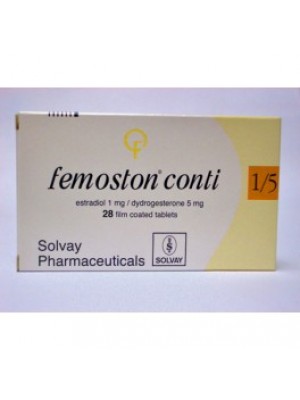
FEMOSTON CONTI 1/5 mg. 28 tabletsFormulationFilm coated tabl..
23.00€